



 Chat with AI
Exam 24: Measuring the Cost of Living

Exam 1: Ten Principles of Economics455 Questions
Exam 2: Thinking Like an Economist643 Questions
Exam 3: Interdependence and the Gains From Trade547 Questions
Exam 4: The Market Forces of Supply and Demand693 Questions
Exam 5: Elasticity and Its Application626 Questions
Exam 6: Supply, Demand, and Government Policies668 Questions
Exam 7: Consumers, Producers, and the Efficiency of Markets547 Questions
Exam 8: Applications: the Costs of Taxation509 Questions
Exam 9: Application: International Trade521 Questions
Exam 10: Externalities543 Questions
Exam 11: Public Goods and Common Resources452 Questions
Exam 12: The Design of the Tax System664 Questions
Exam 13: The Costs of Production649 Questions
Exam 14: Firms in Competitive Markets604 Questions
Exam 15: Monopoly662 Questions
Exam 16: Monopolistic Competition649 Questions
Exam 17: Oligopoly522 Questions
Exam 18: The Markets for the Factors of Production592 Questions
Exam 19: Earnings and Discrimination511 Questions
Exam 20: Income Inequality and Poverty478 Questions
Exam 21: The Theory of Consumer Choice570 Questions
Exam 22: Frontiers in Microeconomics461 Questions
Exam 23: Measuring a Nation S Income547 Questions
Exam 24: Measuring the Cost of Living565 Questions
Exam 25: Production and Growth527 Questions
Exam 26: Saving, Investment, and the Financial System637 Questions
Exam 27: Tools of Finance534 Questions
Exam 28: Unemployment and Its Natural Rate701 Questions
Exam 29: The Monetary System540 Questions
Exam 30: Money Growth and Inflation504 Questions
Exam 31: Open-Economy Macroeconomics: Basic Concepts540 Questions
Exam 32: A Macroeconomic Theory of the Open Economy511 Questions
Exam 33: Aggregate Demand and Aggregate Supply572 Questions
Exam 34: The Influence of Monetary and Fiscal Policy on Aggregate Demand523 Questions
Exam 35: The Short-Run Tradeoff Between Inflation and Unemployment536 Questions
Exam 36: Six Debates Over Macroeconomic Policy354 Questions
Select questions type


For some racquet sports, there have been increases in the size of the racquets; also, the methods and materials used for making racquets have improved. To which problem in the construction of the CPI is this situation most relevant?
(Multiple Choice)
4.9/5  (63)
(63) Table 24-12. Will's expenditures on food for three consecutive years, along with other values, are presented in the table below.  -Refer to Table 24-12. Will's 2009 food expenditures in 2010 dollars amount to
 (Multiple Choice)
4.7/5 (74)
(74) The inflation rate you are likely to hear on the nightly news is calculated from
(Multiple Choice)
4.9/5 (86)
(86) Henry Ford paid his workers $5 a day in 1914, when the CPI was 10. Today, with the price index at 177, the $5 a day is worth $88.50.
(True/False)
5.0/5 (84)
(84) Suppose the price of a quart of milk rises from $1.00 to $1.20 and the price of a T-shirt rises from $8.00 to $9.60. If the CPI rises from 150 to 195, then people likely will buy
(Multiple Choice)
4.9/5 (77)
(77) Scenario 24-6
TOPICS:
Price levels
Inflation
KEYWORDS:
BLOOM'S: Application
CUSTOM ID:
016.24 - SAE - MANK08
Table 24-14
The table below lists the per pound prices of meat and potatoes for the months of January, February, and March. Assume that the typical consumer buys 25 pounds of meat and 15 pounds of potatoes each month, and that January is the base period.  -Refer to Table 24-14. Calculate the inflation rate for March.
 (Short Answer)
4.9/5 (84)
(84) Consternation Corporation has an agreement with its workers to index completely the wage of its employees using the CPI. Consternation Corporation currently pays its production line workers $7.50 an hour and is scheduled to index their wages today. If the CPI is currently 130 and was 125 a year ago, the firm should increase the hourly wages of its workers by
(Multiple Choice)
4.8/5 (67)
(67) Table 24-7. The table below applies to an economy with only two goods - hamburgers and hot dogs. The fixed basket consists of 4 hamburgers and 8 hot dogs.  -Refer to Table 24-7. Between 2009 and 2011, the cost of living increased by
 (Multiple Choice)
4.9/5 (80)
(80) Which of the following changes in the price index produces the greatest rate of inflation: 106 to 112, 112 to 118, or 118 to 124?
(Multiple Choice)
4.7/5 (84)
(84) Suppose the price for one gallon of gasoline rises from $3.50 to $4.00 and the price of one gallon of milk rises from $3.00 to $3.20. If the CPI rises from 120 to 132, then people likely will buy
(Multiple Choice)
4.9/5 (66)
(66) If the nominal interest rate is 6 percent and the rate of inflation is 10 percent, then the real interest rate is
(Multiple Choice)
4.9/5 (67)
(67) In 1970, Professor Plum earned $12,000; in 1980, he earned $24,000; and in 1990, he earned $36,000. If the CPI was 40 in 1970, 70 in 1980, and 130 in 1990, then in real terms, Professor Plum's salary was highest in
(Multiple Choice)
4.8/5 (62)
(62) If the CPI was 90 in 1975 and is 225 today, then $100 today purchases the same amount of goods and services as
(Multiple Choice)
4.9/5 (87)
(87) Reports on the current consumer price index are released every
(Multiple Choice)
4.9/5 (81)
(81) Suppose a basket of goods and services has been selected to calculate the CPI and 2014 has been selected as the base year. In 2013, the basket's cost was $80; in 2014, the basket's cost was $86; and in 2015, the basket's cost was $90. The value of the CPI in 2015 was
(Multiple Choice)
4.9/5 (89)
(89) Table 24-1
The table below lists annual consumer price index and inflation rates for a country over the period 2005-2010. Assume the year 2005 is used as the base year. 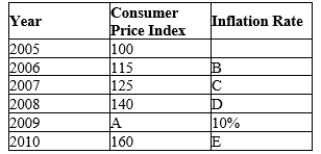 -Refer to Table 24-1. What belongs in space E?
 (Multiple Choice)
5.0/5 (91)
(91) Price indexes allow comparisons of dollar figures over time and provide us a sense of how the economy is changing.
(True/False)
5.0/5 (73)
(73) 
Filters
- Essay(0)
- Multiple Choice(0)
- Short Answer(0)
- True False(0)
- Matching(0)