



 Chat with AI
Exam 24: Measuring the Cost of Living

Exam 1: Ten Principles of Economics455 Questions
Exam 2: Thinking Like an Economist643 Questions
Exam 3: Interdependence and the Gains From Trade547 Questions
Exam 4: The Market Forces of Supply and Demand693 Questions
Exam 5: Elasticity and Its Application626 Questions
Exam 6: Supply, Demand, and Government Policies668 Questions
Exam 7: Consumers, Producers, and the Efficiency of Markets547 Questions
Exam 8: Applications: the Costs of Taxation509 Questions
Exam 9: Application: International Trade521 Questions
Exam 10: Externalities543 Questions
Exam 11: Public Goods and Common Resources452 Questions
Exam 12: The Design of the Tax System664 Questions
Exam 13: The Costs of Production649 Questions
Exam 14: Firms in Competitive Markets604 Questions
Exam 15: Monopoly662 Questions
Exam 16: Monopolistic Competition649 Questions
Exam 17: Oligopoly522 Questions
Exam 18: The Markets for the Factors of Production592 Questions
Exam 19: Earnings and Discrimination511 Questions
Exam 20: Income Inequality and Poverty478 Questions
Exam 21: The Theory of Consumer Choice570 Questions
Exam 22: Frontiers in Microeconomics461 Questions
Exam 23: Measuring a Nation S Income547 Questions
Exam 24: Measuring the Cost of Living565 Questions
Exam 25: Production and Growth527 Questions
Exam 26: Saving, Investment, and the Financial System637 Questions
Exam 27: Tools of Finance534 Questions
Exam 28: Unemployment and Its Natural Rate701 Questions
Exam 29: The Monetary System540 Questions
Exam 30: Money Growth and Inflation504 Questions
Exam 31: Open-Economy Macroeconomics: Basic Concepts540 Questions
Exam 32: A Macroeconomic Theory of the Open Economy511 Questions
Exam 33: Aggregate Demand and Aggregate Supply572 Questions
Exam 34: The Influence of Monetary and Fiscal Policy on Aggregate Demand523 Questions
Exam 35: The Short-Run Tradeoff Between Inflation and Unemployment536 Questions
Exam 36: Six Debates Over Macroeconomic Policy354 Questions
Select questions type


The Bureau of Labor Statistics determines which prices are most important to the typical consumer by surveying consumers.
(True/False)
4.9/5  (89)
(89) The CPI does not reflect the increase in the value of the dollar that arises from the introduction of new goods.
(True/False)
4.8/5 (79)
(79) Categories of U.S. consumer spending, ranked from largest to smallest, are
(Multiple Choice)
4.9/5 (82)
(82) In the U.S., when the price of oil rises, the CPI rises by much more than does the GDP deflator.
(True/False)
4.9/5 (75)
(75) If the nominal interest rate is 8.3% and the inflation rate is 4.4%, what is the real interest rate?
(Short Answer)
4.9/5 (71)
(71) The inflation rate is the absolute change in the price level from the previous period.
(True/False)
4.8/5 (90)
(90) Suppose a basket of goods and services has been selected to calculate the CPI and 2012 has been selected as the base year. In 2012, the basket's cost was $77; in 2013, the basket's cost was $82; and in 2014, the basket's cost was $90. The value of the CPI in 2014 was
(Multiple Choice)
4.9/5 (93)
(93) Suppose that the prices of dairy products have risen relatively less than prices in general over the last several years. To which problem in the construction of the CPI is this situation most relevant?
(Multiple Choice)
4.9/5 (76)
(76) The three problems with using the consumer price index as a measure of the cost of living are
(Multiple Choice)
4.9/5 (70)
(70) The price index was 220 in one year and 238.2 in the next year. What was the inflation rate?
(Multiple Choice)
4.8/5 (86)
(86) John just graduated law school and has two competing job offers. The first is in Phoenix and pays a salary of $150,000. He has a similar job offer in Cleveland that pays $90,000. Which pair of CPIs would make the two salaries have the same purchasing power?
(Multiple Choice)
4.9/5 (77)
(77) Suppose that the CPI in 1990 was 150, that the inflation rate in 1991 was 6%, and that the inflation rate in 1992 was 4%. What was the CPI in 1991 and 1992?
(Essay)
4.9/5 (69)
(69) The CPI assumes a fixed basket of goods over time. In fact, consumers are likely to change purchasing behavior over time by purchasing less of the goods whose prices have risen by relatively large amounts and by buying more of the goods whose prices have risen less or maybe even fallen. What problem does this cause for measuring the cost of living?
(Essay)
4.9/5 (81)
(81) Table 24-3
The table below pertains to Iowan, an economy in which the typical consumer's basket consists of 4 pounds of pork and 3 bushels of corn. 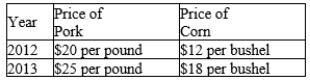 -Refer to Table 24-3. If 2012 is the base year, then the CPI for 2012 was
 (Multiple Choice)
4.9/5 (76)
(76) Archie has a savings account at a bank. If he earns 6 percent interest on his account and if there is deflation, then his purchasing power rises by more than 6 percent over the course of a year.
(True/False)
5.0/5 (81)
(81) Consumer spending in what category is the largest component of the CPI?
(Short Answer)
4.9/5 (67)
(67) Scenario 24-2
The price tag on a golf ball in 1975 read $0.20, and the price tag on a golf ball in 2005 read $2.00. The CPI in 1975 was 52.3, and the CPI in 2005 was 191.3.
-Refer to Scenario 24-2. In 1975 dollars, a 1975 golf ball cost $0.20 and a 2005 golf ball cost
(Multiple Choice)
4.9/5 (89)
(89) Table 24-13. Olivia's expenditures on clothing for three consecutive years, along with some values for the CPI, are presented in the table below.  -Refer to Table 24-13. To the nearest dollar, how much is Olivia's 2010 clothing expenditure in 2011 dollars?
 (Multiple Choice)
4.9/5 (94)
(94) 
Filters
- Essay(0)
- Multiple Choice(0)
- Short Answer(0)
- True False(0)
- Matching(0)