



 Chat with AI
Exam 24: Measuring the Cost of Living

Exam 1: Ten Principles of Economics455 Questions
Exam 2: Thinking Like an Economist643 Questions
Exam 3: Interdependence and the Gains From Trade547 Questions
Exam 4: The Market Forces of Supply and Demand693 Questions
Exam 5: Elasticity and Its Application626 Questions
Exam 6: Supply, Demand, and Government Policies668 Questions
Exam 7: Consumers, Producers, and the Efficiency of Markets547 Questions
Exam 8: Applications: the Costs of Taxation509 Questions
Exam 9: Application: International Trade521 Questions
Exam 10: Externalities543 Questions
Exam 11: Public Goods and Common Resources452 Questions
Exam 12: The Design of the Tax System664 Questions
Exam 13: The Costs of Production649 Questions
Exam 14: Firms in Competitive Markets604 Questions
Exam 15: Monopoly662 Questions
Exam 16: Monopolistic Competition649 Questions
Exam 17: Oligopoly522 Questions
Exam 18: The Markets for the Factors of Production592 Questions
Exam 19: Earnings and Discrimination511 Questions
Exam 20: Income Inequality and Poverty478 Questions
Exam 21: The Theory of Consumer Choice570 Questions
Exam 22: Frontiers in Microeconomics461 Questions
Exam 23: Measuring a Nation S Income547 Questions
Exam 24: Measuring the Cost of Living565 Questions
Exam 25: Production and Growth527 Questions
Exam 26: Saving, Investment, and the Financial System637 Questions
Exam 27: Tools of Finance534 Questions
Exam 28: Unemployment and Its Natural Rate701 Questions
Exam 29: The Monetary System540 Questions
Exam 30: Money Growth and Inflation504 Questions
Exam 31: Open-Economy Macroeconomics: Basic Concepts540 Questions
Exam 32: A Macroeconomic Theory of the Open Economy511 Questions
Exam 33: Aggregate Demand and Aggregate Supply572 Questions
Exam 34: The Influence of Monetary and Fiscal Policy on Aggregate Demand523 Questions
Exam 35: The Short-Run Tradeoff Between Inflation and Unemployment536 Questions
Exam 36: Six Debates Over Macroeconomic Policy354 Questions
Select questions type


In a simple economy, people consume only 2 goods, food and clothing. The market basket of goods used to compute the CPI consists of 50 units of food and 10 units of clothing.  a.What are the percentage increases in the price of food and in the price of clothing?
b.What is the percentage increase in the CPI?
c.Do these price changes affect all consumers to the same extent? Explain.
a.What are the percentage increases in the price of food and in the price of clothing?
b.What is the percentage increase in the CPI?
c.Do these price changes affect all consumers to the same extent? Explain. (Essay)
4.9/5  (75)
(75) Henri earned a salary of $50,000 in 2001 and $60,000 in 2012. The consumer price index was 177 in 2001 and 225 in 2012. Henri's 2001 salary in 2012 dollars is
(Multiple Choice)
4.9/5 (96)
(96) Table 24-10
The table below shows the prices of baseballs and baseball bats for three years. Assume the typical consumer's basket consists of 6 baseballs and 2 baseball bats. 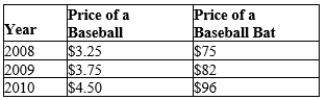 -Refer to Table 24-10. If 2010 is the base year, then the consumer price index was
 (Multiple Choice)
4.7/5 (90)
(90)  × 100.
Suppose in the year 2000 Ken earned $60,000 per year. If the CPI in the year 2000 was 172.2 and in 2015 was 236.7, what is the minimum level of income Ken would have needed to earn in 2015 to have maintained the same standard of living he had in 2000?
(Multiple Choice)
4.9/5 (83)
(83) Table 24-13. Olivia's expenditures on clothing for three consecutive years, along with some values for the CPI, are presented in the table below.  -Refer to Table 24-13. Suppose Olivia's 2009 clothing expenditure in 2010 dollars amounts to $1,440. Then X, the consumer price index for 2009, has a value of
 (Multiple Choice)
4.8/5 (75)
(75) What is the difference between the Consumer Price Index and the Producer Price Index?
(Essay)
4.8/5 (71)
(71) If the CPI was 170 in 1998 and was 187 in 1999, what was the inflation rate in 1999?
(Short Answer)
4.7/5 (85)
(85) If the real interest rate is 5 percent and the inflation rate is 2 percent, then the nominal interest rate is 7 percent.
(True/False)
4.8/5 (71)
(71) The Bureau of Labor Statistics is part of the U.S. Department of Labor.
(True/False)
4.8/5 (71)
(71) If the nominal interest rate is 5 percent, and the rate of inflation is 3 percent, then the real interest rate is equal to
(Multiple Choice)
4.9/5 (83)
(83) Table 24-6
The table below pertains to Napandsnack, an economy in which the typical consumer's basket consists of 2 pillows and 15 hotdogs. 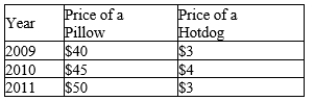 -Refer to Table 24-6. The cost of the basket
 (Multiple Choice)
4.8/5 (73)
(73) Table 24-11. Megan's salary for three consecutive years, along with other values, is presented in the table below.  -Refer to Table 24-11. Megan's 2011 salary in 2013 dollars is
 (Multiple Choice)
4.9/5 (88)
(88) If the price of Italian shoes imported into the United States increases, then
(Multiple Choice)
4.8/5 (89)
(89) Scenario 24-5
TOPICS:
Price levels
Inflation
KEYWORDS:
BLOOM'S: Application
CUSTOM ID:
012.24 - SAE - MANK08
Scenario 24-6
A small economy produced and consumed goods X and Y in 2010 and 2011 in the amounts shown in the table below. Assume that the market basket for the CPI is defined in the base year.  -Refer to Scenario 24-6. Using 2011 as the base year, what is the CPI in each year?
 (Essay)
4.9/5 (81)
(81) The CPI is a measure of the overall cost of the goods and services bought by a typical consumer.
(True/False)
4.8/5 (85)
(85) If the nominal interest rate is 5 percent and the rate of inflation is 9 percent, then the real interest rate is
(Multiple Choice)
4.8/5 (84)
(84) 
Filters
- Essay(0)
- Multiple Choice(0)
- Short Answer(0)
- True False(0)
- Matching(0)