



 Chat with AI
Exam 24: Measuring the Cost of Living

Exam 1: Ten Principles of Economics455 Questions
Exam 2: Thinking Like an Economist643 Questions
Exam 3: Interdependence and the Gains From Trade547 Questions
Exam 4: The Market Forces of Supply and Demand693 Questions
Exam 5: Elasticity and Its Application626 Questions
Exam 6: Supply, Demand, and Government Policies668 Questions
Exam 7: Consumers, Producers, and the Efficiency of Markets547 Questions
Exam 8: Applications: the Costs of Taxation509 Questions
Exam 9: Application: International Trade521 Questions
Exam 10: Externalities543 Questions
Exam 11: Public Goods and Common Resources452 Questions
Exam 12: The Design of the Tax System664 Questions
Exam 13: The Costs of Production649 Questions
Exam 14: Firms in Competitive Markets604 Questions
Exam 15: Monopoly662 Questions
Exam 16: Monopolistic Competition649 Questions
Exam 17: Oligopoly522 Questions
Exam 18: The Markets for the Factors of Production592 Questions
Exam 19: Earnings and Discrimination511 Questions
Exam 20: Income Inequality and Poverty478 Questions
Exam 21: The Theory of Consumer Choice570 Questions
Exam 22: Frontiers in Microeconomics461 Questions
Exam 23: Measuring a Nation S Income547 Questions
Exam 24: Measuring the Cost of Living565 Questions
Exam 25: Production and Growth527 Questions
Exam 26: Saving, Investment, and the Financial System637 Questions
Exam 27: Tools of Finance534 Questions
Exam 28: Unemployment and Its Natural Rate701 Questions
Exam 29: The Monetary System540 Questions
Exam 30: Money Growth and Inflation504 Questions
Exam 31: Open-Economy Macroeconomics: Basic Concepts540 Questions
Exam 32: A Macroeconomic Theory of the Open Economy511 Questions
Exam 33: Aggregate Demand and Aggregate Supply572 Questions
Exam 34: The Influence of Monetary and Fiscal Policy on Aggregate Demand523 Questions
Exam 35: The Short-Run Tradeoff Between Inflation and Unemployment536 Questions
Exam 36: Six Debates Over Macroeconomic Policy354 Questions
Select questions type


Table 24-2
The table below pertains to Pieway, an economy in which the typical consumer's basket consists of 15 bushels of peaches and 10 bushels of pecans. 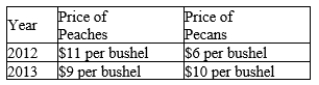 -Refer to Table 24-2. If 2013 is the base year, then the CPI for 2012 was
 (Multiple Choice)
4.9/5  (87)
(87) Iggie took a university teaching job as an assistant professor in 1980 at a salary of $15,000. By 2011, she had been promoted to full professor, with a salary of $70,000. If the price index was 82 in 1980 and 225 in 2011, then what is Iggie's 1980 salary in 2011 dollars?
(Multiple Choice)
5.0/5 (83)
(83) If the real interest rate is 10.3% and the nominal interest rate is 12.6%, what is the inflation rate?
(Short Answer)
4.8/5 (83)
(83) Wilson is offered a job in Kansas City that pays $50,000 and a job in Dallas that pays $60,000. Which pair of CPIs would ensure that the two salaries have the same purchasing power?
(Multiple Choice)
4.9/5 (73)
(73) Kristine has a savings account at a bank. If the nominal interest rate she earns exceeds the rate of inflation, then her purchasing power increases over time.
(True/False)
4.8/5 (75)
(75) Suppose Stan Musial earned $115,000 in 1947. If the CPI was 82 in 1947, and was 246 in 1990, what is Stan Musial's 1947 salary in 1990 dollars?
(Essay)
4.9/5 (73)
(73) Scenario 24-6
TOPICS:
Price levels
Inflation
KEYWORDS:
BLOOM'S: Application
CUSTOM ID:
016.24 - SAE - MANK08
Table 24-14
The table below lists the per pound prices of meat and potatoes for the months of January, February, and March. Assume that the typical consumer buys 25 pounds of meat and 15 pounds of potatoes each month, and that January is the base period.  -Refer to Table 24-14. Calculate the cost of a basket of goods for each month.
 (Essay)
4.9/5 (70)
(70) Suppose OPEC succeeds in raising world oil prices by 300 percent. This price increase causes inventors to look at alternative sources of fuel for internal-combustion engines. A hydrogen-powered engine is developed which is cheaper to operate than gasoline engines. Which problems in the construction of the CPI does this situation represent?
(Multiple Choice)
4.8/5 (88)
(88) Table 24-7. The table below applies to an economy with only two goods - hamburgers and hot dogs. The fixed basket consists of 4 hamburgers and 8 hot dogs.  -Refer to Table 24-7. Between 2010 and 2011, the cost of living increased by
 (Multiple Choice)
4.8/5 (78)
(78) In 1969, Malcolm bought a Pontiac Firebird for $2,500. If the price index was 36.7 in 1969 and the price index was 235 in 2013, then what is the price of the Firebird in 2013 dollars?
(Multiple Choice)
4.8/5 (76)
(76) The price index was 120 in 2012 and 126 in 2013. What was the inflation rate?
(Multiple Choice)
4.9/5 (73)
(73) Table 24-5
The table below pertains to Wrexington, an economy in which the typical consumer's basket consists of 20 pounds of meat and 10 toys. 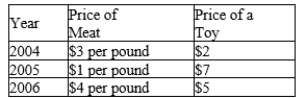 -Refer to Table 24-5. If the base year is 2004, then the CPI in 2005 was
 (Multiple Choice)
4.9/5 (69)
(69) The CPI and GDP deflator usually tell two different stories about how quickly prices are rising.
(True/False)
4.9/5 (82)
(82) Suppose the price of a six-pack of cola rises from $3 to $3.75 and the price of a pack of mints rises from $1.25 to $1.75. If the CPI rises from 140 to 182, then people likely will buy
(Multiple Choice)
4.8/5 (81)
(81) Suppose the typical basket for the calculation of the CPI includes one computer. Since computers have gotten better over time as a result of technological change, what problem does this create for calculating the CPI?
(Essay)
4.9/5 (88)
(88) Table 24-2
The table below pertains to Pieway, an economy in which the typical consumer's basket consists of 15 bushels of peaches and 10 bushels of pecans.
-Refer to Table 24-2. If 2013 is the base year, then the inflation rate in 2013 was
-Refer to Table 24-2. If 2013 is the base year, then the inflation rate in 2013 was (Multiple Choice)
4.9/5 (83)
(83) In 1931, President Herbert Hoover was paid a salary of $75,000. Government statistics show a consumer price index of 15.2 for 1931 and 237 for 2015. President Hoover's 1931 salary was equivalent to a 2015 salary of about
(Multiple Choice)
5.0/5 (87)
(87) 
Filters
- Essay(0)
- Multiple Choice(0)
- Short Answer(0)
- True False(0)
- Matching(0)