



 Chat with AI
Exam 24: Measuring the Cost of Living

Exam 1: Ten Principles of Economics455 Questions
Exam 2: Thinking Like an Economist643 Questions
Exam 3: Interdependence and the Gains From Trade547 Questions
Exam 4: The Market Forces of Supply and Demand693 Questions
Exam 5: Elasticity and Its Application626 Questions
Exam 6: Supply, Demand, and Government Policies668 Questions
Exam 7: Consumers, Producers, and the Efficiency of Markets547 Questions
Exam 8: Applications: the Costs of Taxation509 Questions
Exam 9: Application: International Trade521 Questions
Exam 10: Externalities543 Questions
Exam 11: Public Goods and Common Resources452 Questions
Exam 12: The Design of the Tax System664 Questions
Exam 13: The Costs of Production649 Questions
Exam 14: Firms in Competitive Markets604 Questions
Exam 15: Monopoly662 Questions
Exam 16: Monopolistic Competition649 Questions
Exam 17: Oligopoly522 Questions
Exam 18: The Markets for the Factors of Production592 Questions
Exam 19: Earnings and Discrimination511 Questions
Exam 20: Income Inequality and Poverty478 Questions
Exam 21: The Theory of Consumer Choice570 Questions
Exam 22: Frontiers in Microeconomics461 Questions
Exam 23: Measuring a Nation S Income547 Questions
Exam 24: Measuring the Cost of Living565 Questions
Exam 25: Production and Growth527 Questions
Exam 26: Saving, Investment, and the Financial System637 Questions
Exam 27: Tools of Finance534 Questions
Exam 28: Unemployment and Its Natural Rate701 Questions
Exam 29: The Monetary System540 Questions
Exam 30: Money Growth and Inflation504 Questions
Exam 31: Open-Economy Macroeconomics: Basic Concepts540 Questions
Exam 32: A Macroeconomic Theory of the Open Economy511 Questions
Exam 33: Aggregate Demand and Aggregate Supply572 Questions
Exam 34: The Influence of Monetary and Fiscal Policy on Aggregate Demand523 Questions
Exam 35: The Short-Run Tradeoff Between Inflation and Unemployment536 Questions
Exam 36: Six Debates Over Macroeconomic Policy354 Questions
Select questions type


If the cost of transportation increases by 20 percent, then, other things the same, the CPI is likely to increase by about
(Multiple Choice)
4.9/5  (72)
(72) In 1972, one could buy a bag of chips, a pound of hamburger, a package of buns, and a small bag of charcoal for about $2.50. If the same goods today cost $6.00, then which pair of CPIs would make the cost in today's dollars the same for both years?
(Multiple Choice)
4.8/5 (86)
(86) Table 24-12. Will's expenditures on food for three consecutive years, along with other values, are presented in the table below.  -Refer to Table 24-12. Suppose Will's 2009 food expenditures in 2011 dollars amount to $5,670. Then
 (Multiple Choice)
5.0/5 (76)
(76) The CPI is more commonly used as a gauge of inflation than the GDP deflator is because
(Multiple Choice)
4.9/5 (86)
(86) In the late 1970s, U.S. nominal interest rates were high and real interest rates were low, but in the late 1990s, U.S. nominal interest rates were low and real interest rates were high.
(True/False)
4.8/5 (79)
(79) If the nominal interest rate is 6 percent and the rate of inflation is 2 percent, then the real interest rate is
(Multiple Choice)
4.9/5 (76)
(76) Compute how much each of the following items is worth in terms of today's dollars using 177 as the price index for today.
a.In 1926, the CPI was 17.7 and the price of a movie ticket was $0.25.
b.In 1932, the CPI was 13.1 and a cook earned $15.00 a week.
c.In 1943, the CPI was 17.4 and a gallon of gas cost $0.19.
(Essay)
4.9/5 (85)
(85) When consumer spending is broken down into the major categories of goods and services, the largest single category is spending on transportation.
(True/False)
4.8/5 (76)
(76) With respect to the consumer price index, the substitution bias arises because
(Multiple Choice)
4.8/5 (79)
(79) Explain how the prices of goods and services used in the CPI differ from the prices used in the PPI.
(Essay)
4.8/5 (77)
(77) Table 24-15
The following table shows the prices of good X and good Y for 2013-2015. In addition, assume the basket of goods used to compute the Consumer Price Index consists of 3 units of good X and 4 units of good Y.
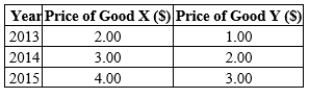
-Refer to Table 24-15. If the base year is 2014, the value of the Consumer Price Index in 2013 is
-Refer to Table 24-15. If the base year is 2014, the value of the Consumer Price Index in 2013 is (Multiple Choice)
4.8/5 (77)
(77) Many economists believe the bias in the CPI is now only about half as large as it once was.
(True/False)
4.8/5 (85)
(85) If the value of the consumer price index is 110 in 2005 and 121 in 2006, then the inflation rate is 11 percent for 2006.
(True/False)
4.8/5 (89)
(89) Economists use the term inflation to describe a situation in which the economy's overall price level is rising.
(True/False)
4.8/5 (71)
(71) The consumer price index was 200 in 2008 and 190 in 2009. The nominal interest rate during this period was 4.5 percent. What was the real interest rate during this period?
(Multiple Choice)
4.8/5 (81)
(81) Scenario 24-5
TOPICS:
Price levels
Inflation
KEYWORDS:
BLOOM'S: Application
CUSTOM ID:
012.24 - SAE - MANK08
Scenario 24-6
A small economy produced and consumed goods X and Y in 2010 and 2011 in the amounts shown in the table below. Assume that the market basket for the CPI is defined in the base year.  -Refer to Scenario 24-6. Using 2010 as the base year, what is the CPI in each year?
 (Essay)
4.8/5 (87)
(87) When the price of nuclear missiles rises, this change is reflected in the CPI but not in the GDP deflator.
(True/False)
4.9/5 (64)
(64) 
Filters
- Essay(0)
- Multiple Choice(0)
- Short Answer(0)
- True False(0)
- Matching(0)