



 Chat with AI
Exam 24: Measuring the Cost of Living

Exam 1: Ten Principles of Economics455 Questions
Exam 2: Thinking Like an Economist643 Questions
Exam 3: Interdependence and the Gains From Trade547 Questions
Exam 4: The Market Forces of Supply and Demand693 Questions
Exam 5: Elasticity and Its Application626 Questions
Exam 6: Supply, Demand, and Government Policies668 Questions
Exam 7: Consumers, Producers, and the Efficiency of Markets547 Questions
Exam 8: Applications: the Costs of Taxation509 Questions
Exam 9: Application: International Trade521 Questions
Exam 10: Externalities543 Questions
Exam 11: Public Goods and Common Resources452 Questions
Exam 12: The Design of the Tax System664 Questions
Exam 13: The Costs of Production649 Questions
Exam 14: Firms in Competitive Markets604 Questions
Exam 15: Monopoly662 Questions
Exam 16: Monopolistic Competition649 Questions
Exam 17: Oligopoly522 Questions
Exam 18: The Markets for the Factors of Production592 Questions
Exam 19: Earnings and Discrimination511 Questions
Exam 20: Income Inequality and Poverty478 Questions
Exam 21: The Theory of Consumer Choice570 Questions
Exam 22: Frontiers in Microeconomics461 Questions
Exam 23: Measuring a Nation S Income547 Questions
Exam 24: Measuring the Cost of Living565 Questions
Exam 25: Production and Growth527 Questions
Exam 26: Saving, Investment, and the Financial System637 Questions
Exam 27: Tools of Finance534 Questions
Exam 28: Unemployment and Its Natural Rate701 Questions
Exam 29: The Monetary System540 Questions
Exam 30: Money Growth and Inflation504 Questions
Exam 31: Open-Economy Macroeconomics: Basic Concepts540 Questions
Exam 32: A Macroeconomic Theory of the Open Economy511 Questions
Exam 33: Aggregate Demand and Aggregate Supply572 Questions
Exam 34: The Influence of Monetary and Fiscal Policy on Aggregate Demand523 Questions
Exam 35: The Short-Run Tradeoff Between Inflation and Unemployment536 Questions
Exam 36: Six Debates Over Macroeconomic Policy354 Questions
Select questions type


Table 24-6
The table below pertains to Napandsnack, an economy in which the typical consumer's basket consists of 2 pillows and 15 hotdogs. 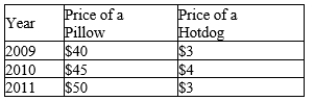 -Refer to Table 24-6. If the base year is 2009, then the consumer price index was
 (Multiple Choice)
4.8/5  (58)
(58) When constructing the consumer price index, the Bureau of Labor Statistics does not do which of the following?
(Multiple Choice)
4.7/5 (80)
(80) Table 24-10
The table below shows the prices of baseballs and baseball bats for three years. Assume the typical consumer's basket consists of 6 baseballs and 2 baseball bats. 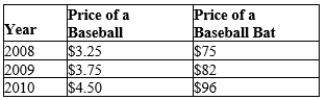 -Refer to Table 24-10. The inflation rate was
 (Multiple Choice)
4.9/5 (71)
(71) Table 24-7. The table below applies to an economy with only two goods - hamburgers and hot dogs. The fixed basket consists of 4 hamburgers and 8 hot dogs.  -Refer to Table 24-7. If the base year is 2010, then the economy's inflation rate is
 (Multiple Choice)
4.8/5 (72)
(72) In an imaginary economy, consumers buy only hot dogs and hamburgers. The fixed basket consists of 10 hot dogs and 6 hamburgers. A hot dog cost $3 in 2006 and $5.40 in 2007. A hamburger cost $5 in 2006 and $6 in 2007. Which of the following statements is correct?
(Multiple Choice)
4.7/5 (81)
(81) In the United States in the late 1970s, nominal interest rates were high and inflation rates were very high. As a result, real interest rates were
(Multiple Choice)
4.7/5 (72)
(72) In 1949, Sycamore, Illinois built a hospital for about $500,000. In 1987, the county restored the courthouse for about $2.4 million. A price index for nonresidential construction was 14 in 1949, 92 in 1987, and 114.5 in 2000. According to these numbers, the hospital cost about
(Multiple Choice)
4.9/5 (79)
(79) Changes in the consumer price index are useful in predicting changes in the producer price index.
(True/False)
4.8/5 (78)
(78) Price changes from year to year are not proportional, and consumers respond to these changes by altering their spending patterns. The problem this creates for inflation calculations is called
(Multiple Choice)
4.9/5 (74)
(74) During a certain year, the consumer price index increased from 120 to 132 and the purchasing power of a person's bank account increased by 4 percent. For that year,
(Multiple Choice)
4.8/5 (81)
(81) In the basket of goods that is used to compute the consumer price index, which of the following categories of consumer spending is the largest?
(Multiple Choice)
4.8/5 (84)
(84) The consumer price index and the GDP deflator are two alternative measures of the overall price level. Which of the following statements about the two measures is correct?
(Multiple Choice)
4.8/5 (87)
(87) In which of the following cases would there be an effect on the value of the U.S. consumer price index, but not on the value of the U.S. GDP deflator?
(Multiple Choice)
4.8/5 (86)
(86) Janelle earned a salary of $62,000 in 2004 and $80,000 in 2014. The consumer price index was 126 in 2004 and 170 in 2014. Janelle's 2004 salary in 2014 dollars is
(Multiple Choice)
4.9/5 (91)
(91) For an imaginary economy, the consumer price index was 80 in 2014, 100 in 2015, and 140 in 2016. Which of the following statements is correct?
(Multiple Choice)
4.8/5 (90)
(90) In an imaginary economy, consumers buy only razors and cologne. The fixed basket consists of 6 razors and 4 bottles of cologne. A razor cost $20 in 2009 and $25 in 2010. A bottle of cologne cost $30 in 2009 and $40 in 2010. Using 2009 as the base year, which of the following statements is correct?
(Multiple Choice)
4.9/5 (84)
(84) The CPI for all goods and services excluding food and energy is called
(Multiple Choice)
4.9/5 (77)
(77) The price index was 128 in 2013, and the inflation rate was 24 percent between 2012 and 2013. The price index in 2012 was
(Multiple Choice)
4.9/5 (89)
(89) Ms. Lane borrowed $1,000 from her bank for one year at an interest rate of 10 percent. During that year, the price level went up by 15 percent. Which of the following statements is correct?
(Multiple Choice)
4.9/5 (78)
(78) 
Filters
- Essay(0)
- Multiple Choice(0)
- Short Answer(0)
- True False(0)
- Matching(0)