



 Chat with AI
Exam 24: Measuring the Cost of Living

Exam 1: Ten Principles of Economics455 Questions
Exam 2: Thinking Like an Economist643 Questions
Exam 3: Interdependence and the Gains From Trade547 Questions
Exam 4: The Market Forces of Supply and Demand693 Questions
Exam 5: Elasticity and Its Application626 Questions
Exam 6: Supply, Demand, and Government Policies668 Questions
Exam 7: Consumers, Producers, and the Efficiency of Markets547 Questions
Exam 8: Applications: the Costs of Taxation509 Questions
Exam 9: Application: International Trade521 Questions
Exam 10: Externalities543 Questions
Exam 11: Public Goods and Common Resources452 Questions
Exam 12: The Design of the Tax System664 Questions
Exam 13: The Costs of Production649 Questions
Exam 14: Firms in Competitive Markets604 Questions
Exam 15: Monopoly662 Questions
Exam 16: Monopolistic Competition649 Questions
Exam 17: Oligopoly522 Questions
Exam 18: The Markets for the Factors of Production592 Questions
Exam 19: Earnings and Discrimination511 Questions
Exam 20: Income Inequality and Poverty478 Questions
Exam 21: The Theory of Consumer Choice570 Questions
Exam 22: Frontiers in Microeconomics461 Questions
Exam 23: Measuring a Nation S Income547 Questions
Exam 24: Measuring the Cost of Living565 Questions
Exam 25: Production and Growth527 Questions
Exam 26: Saving, Investment, and the Financial System637 Questions
Exam 27: Tools of Finance534 Questions
Exam 28: Unemployment and Its Natural Rate701 Questions
Exam 29: The Monetary System540 Questions
Exam 30: Money Growth and Inflation504 Questions
Exam 31: Open-Economy Macroeconomics: Basic Concepts540 Questions
Exam 32: A Macroeconomic Theory of the Open Economy511 Questions
Exam 33: Aggregate Demand and Aggregate Supply572 Questions
Exam 34: The Influence of Monetary and Fiscal Policy on Aggregate Demand523 Questions
Exam 35: The Short-Run Tradeoff Between Inflation and Unemployment536 Questions
Exam 36: Six Debates Over Macroeconomic Policy354 Questions
Select questions type


Samantha goes to the grocery store to make her monthly purchase of ginger ale. As she enters the soft drink section, she notices that the price of ginger ale has increased 15 percent, so she decides to buy some peppermint tea instead. To which problem in the construction of the CPI is this situation most relevant?
(Multiple Choice)
5.0/5  (87)
(87) If the current year CPI is 90, then the price level has decreased 10 percent since the base year.
(True/False)
4.7/5 (64)
(64) Which of the following is the correct formula for calculating the inflation rate?
(Multiple Choice)
4.9/5 (79)
(79) Scenario 24-3
Sue Holloway was an accountant in 1944 and earned $12,000 that year. Her son, Josh Holloway, is an accountant today and he earned $210,000 in 2013. The price index was 17.6 in 1944 and 218.4 in 2013.
-Refer to Scenario 24-3. Josh Holloway's 2013 income in 1944 dollars is
(Multiple Choice)
4.9/5 (80)
(80) In a particular economy, the price index was 120 in 2012 and 130 in 2013. Which of the following statements is correct?
(Multiple Choice)
4.8/5 (84)
(84) Explain how the prices of goods and services used in the CPI differ from the prices reflected by GDP deflator.
(Essay)
4.7/5 (77)
(77) Data from the Bureau of Labor Statistics show that the largest category of consumer spending is housing.
(True/False)
5.0/5 (83)
(83) A worker received $5 for a daily wage in 1930, which has the equivalent value of $63.24 today. If the CPI was 17 in 1930 what is the value of the CPI today, rounded to the nearest whole number?
(Multiple Choice)
5.0/5 (83)
(83) Table 24-2
The table below pertains to Pieway, an economy in which the typical consumer's basket consists of 15 bushels of peaches and 10 bushels of pecans. 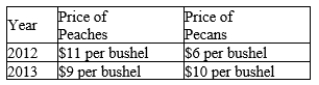 -Refer to Table 24-2. If 2012 is the base year, then the CPI for 2013 was
 (Multiple Choice)
4.9/5 (81)
(81) When box office receipts are not corrected for inflation, the most popular movie of all time is
(Multiple Choice)
4.8/5 (86)
(86) Suppose a basket of goods and services has been selected to calculate the CPI and 2012 has been selected as the base year. In 2012, the basket's cost was $50; in 2014, the basket's cost was $52; and in 2016, the basket's cost was $55. The value of the CPI in 2016 was
(Multiple Choice)
4.8/5 (71)
(71) The price of milk increases dramatically, causing a 0.5 percent increase in the CPI. The price increase will most likely cause the GDP deflator to increase by
(Multiple Choice)
4.9/5 (81)
(81) Table 24-1
The table below lists annual consumer price index and inflation rates for a country over the period 2005-2010. Assume the year 2005 is used as the base year. 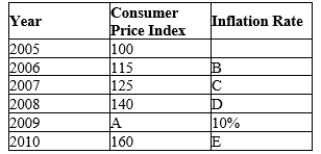 -Refer to Table 24-1. What belongs in space A?
 (Multiple Choice)
5.0/5 (81)
(81) In 1931 the price of a movie ticket was $0.25. The consumer price index was 15.2 in 1931, and 210 in 2008. Using 2008 prices, the real price of a movie in 1931 was
(Multiple Choice)
4.9/5 (86)
(86) David earned a salary of $43,500 in 1994 and $89,000 in 2010. The consumer price index was 148.2 in 1994 and 215.3 in 2010. David's 1994 salary in 2010 dollars is
(Multiple Choice)
4.7/5 (84)
(84) If the CPI was 68 in 1965 and is 285 today, then $100 today purchases the same amount of goods and services as
(Multiple Choice)
4.7/5 (80)
(80) Table 24-6
The table below pertains to Napandsnack, an economy in which the typical consumer's basket consists of 2 pillows and 15 hotdogs. 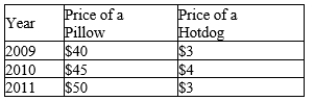 -Refer to Table 24-6. If the base year is 2011, then the economy's inflation rate in 2011 was
 (Multiple Choice)
4.9/5 (75)
(75) 
Filters
- Essay(0)
- Multiple Choice(0)
- Short Answer(0)
- True False(0)
- Matching(0)