



 Chat with AI
Exam 24: Measuring the Cost of Living

Exam 1: Ten Principles of Economics455 Questions
Exam 2: Thinking Like an Economist643 Questions
Exam 3: Interdependence and the Gains From Trade547 Questions
Exam 4: The Market Forces of Supply and Demand693 Questions
Exam 5: Elasticity and Its Application626 Questions
Exam 6: Supply, Demand, and Government Policies668 Questions
Exam 7: Consumers, Producers, and the Efficiency of Markets547 Questions
Exam 8: Applications: the Costs of Taxation509 Questions
Exam 9: Application: International Trade521 Questions
Exam 10: Externalities543 Questions
Exam 11: Public Goods and Common Resources452 Questions
Exam 12: The Design of the Tax System664 Questions
Exam 13: The Costs of Production649 Questions
Exam 14: Firms in Competitive Markets604 Questions
Exam 15: Monopoly662 Questions
Exam 16: Monopolistic Competition649 Questions
Exam 17: Oligopoly522 Questions
Exam 18: The Markets for the Factors of Production592 Questions
Exam 19: Earnings and Discrimination511 Questions
Exam 20: Income Inequality and Poverty478 Questions
Exam 21: The Theory of Consumer Choice570 Questions
Exam 22: Frontiers in Microeconomics461 Questions
Exam 23: Measuring a Nation S Income547 Questions
Exam 24: Measuring the Cost of Living565 Questions
Exam 25: Production and Growth527 Questions
Exam 26: Saving, Investment, and the Financial System637 Questions
Exam 27: Tools of Finance534 Questions
Exam 28: Unemployment and Its Natural Rate701 Questions
Exam 29: The Monetary System540 Questions
Exam 30: Money Growth and Inflation504 Questions
Exam 31: Open-Economy Macroeconomics: Basic Concepts540 Questions
Exam 32: A Macroeconomic Theory of the Open Economy511 Questions
Exam 33: Aggregate Demand and Aggregate Supply572 Questions
Exam 34: The Influence of Monetary and Fiscal Policy on Aggregate Demand523 Questions
Exam 35: The Short-Run Tradeoff Between Inflation and Unemployment536 Questions
Exam 36: Six Debates Over Macroeconomic Policy354 Questions
Select questions type


An important difference between the GDP deflator and the consumer price index is that
(Multiple Choice)
4.7/5  (76)
(76) The goal of the consumer price index is to gauge how much incomes must rise to maintain a constant standard of living.
(True/False)
4.9/5 (77)
(77) Suppose in the year 2000 Ken earned $60,000 per year and that in 2015 he earned $78,000 per year. If the CPI in the year 2000 was 172.2 and in 2015 was 236.7, which of the following statements is correct?
(Multiple Choice)
4.8/5 (77)
(77) Consider a small economy in which consumers buy only two goods: pretzels and cookies. In order to compute the consumer price index for this economy for two or more consecutive years, we assume that
(Multiple Choice)
4.8/5 (75)
(75) The CPI is a measure of the overall cost of the goods and services bought by
(Multiple Choice)
4.9/5 (83)
(83) Explain how the introduction of new goods might bias the calculation of the consumer price index.
(Essay)
4.8/5 (66)
(66) Table 24-4
The table below pertains to Studious, an economy in which the typical consumer's basket consists of 5 books and 10 calculators. 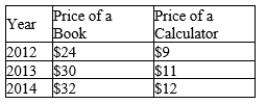 -Refer to Table 24-4. The cost of the basket
 (Multiple Choice)
4.9/5 (99)
(99) The Bureau of Labor Statistics does not try to account for quality changes in the goods and services in the basket used to compute the CPI.
(True/False)
4.8/5 (84)
(84) Which of the following statements is correct about the relationship between the nominal interest rate and the real interest rate?
(Multiple Choice)
4.9/5 (75)
(75) The price index that measures the cost of a basket of goods and services bought by firms is called the
(Multiple Choice)
4.9/5 (92)
(92) If the CPI today is 120 and the CPI five years ago was 80, then something that cost $1 five years ago would cost $1.50 in today's prices.
(True/False)
4.8/5 (86)
(86) The nominal interest rate tells you how fast the number of dollars in your bank account rises over time.
(True/False)
4.8/5 (74)
(74) The value of the consumer price index increased from 140 to 147 during 2006. Nathan opened a bank account at the beginning of 2006, and at the end of 2006 his account balance was $12,840. The purchasing power of Nathan's account increased by 2 percent during the year. We can conclude that Nathan opened his account with a deposit of $11,500 at the beginning of 2006.
(True/False)
4.7/5 (84)
(84) Ruben earned a salary of $60,000 in 2001 and $80,000 in 2006. The consumer price index was 177 in 2001 and 221.25 in 2006. Ruben's 2006 salary in 2001 dollars is
(Multiple Choice)
4.9/5 (82)
(82) Scenario 24-1
The price tag on a tennis ball in 1975 read $0.10, and the price tag on a tennis ball in 2005 read $1.00. The CPI in 1975 was 52.3, and the CPI in 2005 was 191.3.
-Refer to Scenario 24-1. In 1975 dollars, a 1975 tennis ball cost $0.10 and a 2005 tennis ball cost
(Multiple Choice)
5.0/5 (77)
(77) If the real value of an item bought ten years ago is less than it's nominal value at that time, what can one infer about the change in the overall price level during this ten year period?
(Essay)
4.8/5 (65)
(65) Two alternative measures of the overall level of prices are
(Multiple Choice)
4.7/5 (71)
(71) Suppose that the CPI in 2009 is 220 and that the inflation rate is 5% in 2010. What is the CPI in 2010?
(Short Answer)
4.9/5 (68)
(68) If the nominal interest rate is 5 percent and the rate of inflation is -2.5 percent, then the real interest rate is
(Multiple Choice)
4.9/5 (75)
(75) 
Filters
- Essay(0)
- Multiple Choice(0)
- Short Answer(0)
- True False(0)
- Matching(0)