



 Chat with AI
Exam 7: Consumers, Producers, and the Efficiency of Markets

Exam 1: Ten Principles of Economics455 Questions
Exam 2: Thinking Like an Economist643 Questions
Exam 3: Interdependence and the Gains From Trade547 Questions
Exam 4: The Market Forces of Supply and Demand693 Questions
Exam 5: Elasticity and Its Application626 Questions
Exam 6: Supply, Demand, and Government Policies668 Questions
Exam 7: Consumers, Producers, and the Efficiency of Markets547 Questions
Exam 8: Applications: the Costs of Taxation509 Questions
Exam 9: Application: International Trade521 Questions
Exam 10: Externalities543 Questions
Exam 11: Public Goods and Common Resources452 Questions
Exam 12: The Design of the Tax System664 Questions
Exam 13: The Costs of Production649 Questions
Exam 14: Firms in Competitive Markets604 Questions
Exam 15: Monopoly662 Questions
Exam 16: Monopolistic Competition649 Questions
Exam 17: Oligopoly522 Questions
Exam 18: The Markets for the Factors of Production592 Questions
Exam 19: Earnings and Discrimination511 Questions
Exam 20: Income Inequality and Poverty478 Questions
Exam 21: The Theory of Consumer Choice570 Questions
Exam 22: Frontiers in Microeconomics461 Questions
Exam 23: Measuring a Nation S Income547 Questions
Exam 24: Measuring the Cost of Living565 Questions
Exam 25: Production and Growth527 Questions
Exam 26: Saving, Investment, and the Financial System637 Questions
Exam 27: Tools of Finance534 Questions
Exam 28: Unemployment and Its Natural Rate701 Questions
Exam 29: The Monetary System540 Questions
Exam 30: Money Growth and Inflation504 Questions
Exam 31: Open-Economy Macroeconomics: Basic Concepts540 Questions
Exam 32: A Macroeconomic Theory of the Open Economy511 Questions
Exam 33: Aggregate Demand and Aggregate Supply572 Questions
Exam 34: The Influence of Monetary and Fiscal Policy on Aggregate Demand523 Questions
Exam 35: The Short-Run Tradeoff Between Inflation and Unemployment536 Questions
Exam 36: Six Debates Over Macroeconomic Policy354 Questions
Select questions type


Table 7-13
The only four producers in a market have the following costs:
Seller
Cost
Abbey
$30
Bev
$40
Carl
$55
Dale
$65
-Refer to Table 7-13. If Abbey, Bev, and Carl sell the good, and the resulting producer surplus is $55 altogether, then the price must have been
(Multiple Choice)
5.0/5  (79)
(79) Figure 7-24 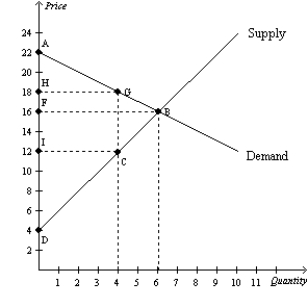 -Refer to Figure 7-24. At equilibrium, producer surplus is
 (Multiple Choice)
4.8/5 (83)
(83) Bob purchases a book, and his consumer surplus is $3. If Bob is willing to pay $8 for the book, then the price of the book must be
(Multiple Choice)
4.8/5 (73)
(73) Figure 7-2 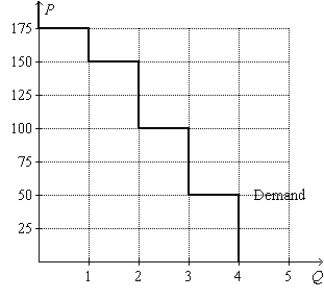 -Refer to Figure 7-2. If the price of the good is $80, then consumer surplus amounts to
 (Multiple Choice)
4.7/5 (82)
(82) The lower the price, the lower the producer surplus, all else equal.
(True/False)
4.8/5 (97)
(97) Figure 7-17 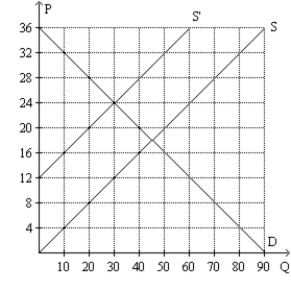 -Refer to Figure 7-17. If the demand curve is D and the supply curve shifts left from S to S', what is the change in producer surplus when comparing the new equilibrium with the original equilibrium?
 (Multiple Choice)
4.8/5 (87)
(87) Table 7-1 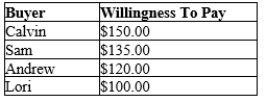 -Refer to Table 7-1. If the price of the product is $130, then who would be willing to purchase the product?
 (Multiple Choice)
4.7/5 (86)
(86) Figure 7-26 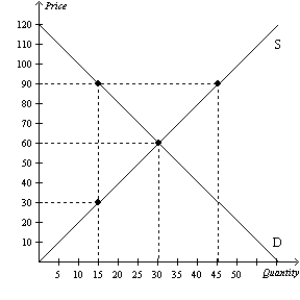 -Refer to Figure 7-26. At the equilibrium price, producer surplus is
 (Multiple Choice)
4.8/5 (77)
(77) 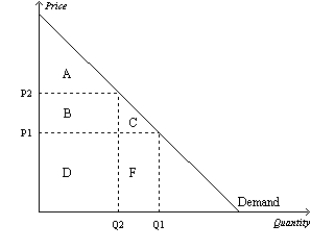 -Refer to Figure 7-3. Area C represents the
Figure 7-24
-Refer to Figure 7-24. At equilibrium, total surplus is
-Refer to Figure 7-24. At equilibrium, total surplus is (Multiple Choice)
4.8/5 (64)
(64) Figure 7-33  -Refer to Figure 7-33. How much is total consumer surplus in this market at the equilibrium price?
 (Essay)
4.8/5 (79)
(79) Figure 7-24
-Refer to Figure 7-24. At equilibrium, consumer surplus is measured by the area
-Refer to Figure 7-24. At equilibrium, consumer surplus is measured by the area (Multiple Choice)
4.8/5 (74)
(74) Table 7-19 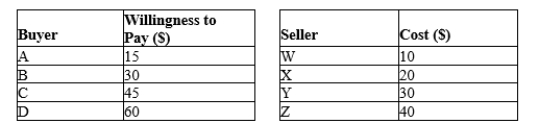 -Refer to Table 7-19. How much is total surplus at the equilibrium price in this market?
 (Essay)
4.8/5 (89)
(89) Table 7-3
The only four consumers in a market have the following willingness to pay for a good: 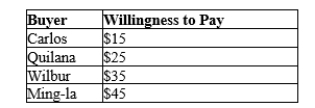 -Refer to Table 7-3. If the market price for the good is $20, who will purchase the good?
 (Multiple Choice)
4.9/5 (74)
(74) All else equal, an increase in demand will cause an increase in producer surplus.
(True/False)
4.9/5 (79)
(79)  -Refer to Figure 7-15. Area A represents
Table 7-19
-Refer to Table 7-19. How much is total consumer surplus at the equilibrium price in this market?
-Refer to Table 7-19. How much is total consumer surplus at the equilibrium price in this market? (Essay)
4.9/5 (75)
(75) 
Filters
- Essay(0)
- Multiple Choice(0)
- Short Answer(0)
- True False(0)
- Matching(0)