



 Chat with AI
Exam 7: Consumers, Producers, and the Efficiency of Markets

Exam 1: Ten Principles of Economics455 Questions
Exam 2: Thinking Like an Economist643 Questions
Exam 3: Interdependence and the Gains From Trade547 Questions
Exam 4: The Market Forces of Supply and Demand693 Questions
Exam 5: Elasticity and Its Application626 Questions
Exam 6: Supply, Demand, and Government Policies668 Questions
Exam 7: Consumers, Producers, and the Efficiency of Markets547 Questions
Exam 8: Applications: the Costs of Taxation509 Questions
Exam 9: Application: International Trade521 Questions
Exam 10: Externalities543 Questions
Exam 11: Public Goods and Common Resources452 Questions
Exam 12: The Design of the Tax System664 Questions
Exam 13: The Costs of Production649 Questions
Exam 14: Firms in Competitive Markets604 Questions
Exam 15: Monopoly662 Questions
Exam 16: Monopolistic Competition649 Questions
Exam 17: Oligopoly522 Questions
Exam 18: The Markets for the Factors of Production592 Questions
Exam 19: Earnings and Discrimination511 Questions
Exam 20: Income Inequality and Poverty478 Questions
Exam 21: The Theory of Consumer Choice570 Questions
Exam 22: Frontiers in Microeconomics461 Questions
Exam 23: Measuring a Nation S Income547 Questions
Exam 24: Measuring the Cost of Living565 Questions
Exam 25: Production and Growth527 Questions
Exam 26: Saving, Investment, and the Financial System637 Questions
Exam 27: Tools of Finance534 Questions
Exam 28: Unemployment and Its Natural Rate701 Questions
Exam 29: The Monetary System540 Questions
Exam 30: Money Growth and Inflation504 Questions
Exam 31: Open-Economy Macroeconomics: Basic Concepts540 Questions
Exam 32: A Macroeconomic Theory of the Open Economy511 Questions
Exam 33: Aggregate Demand and Aggregate Supply572 Questions
Exam 34: The Influence of Monetary and Fiscal Policy on Aggregate Demand523 Questions
Exam 35: The Short-Run Tradeoff Between Inflation and Unemployment536 Questions
Exam 36: Six Debates Over Macroeconomic Policy354 Questions
Select questions type


Bill created a new software program he is willing to sell for $300. He sells his first copy and enjoys a producer surplus of $250. What is the price paid for the software?
(Multiple Choice)
4.8/5  (71)
(71) The French expression used by free-market advocates, which literally translates as "allow them to do," is
(Multiple Choice)
4.9/5 (94)
(94) Joel has a 1966 Mustang, which he sells to Susie, an avid car collector. Susie is pleased since she paid $8,000 for the car but would have been willing to pay $11,000 for the car. Susie's consumer surplus is $2,000.
(True/False)
4.8/5 (63)
(63) Let P represent price; let QS represent quantity supplied; and assume the equation of the supply curve is  . If 90 units of the good are produced and sold, then producer surplus amounts to $1,350.
 (True/False)
4.7/5 (72)
(72) Figure 7-12 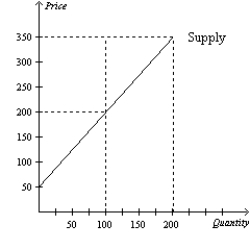 -Refer to Figure 7-12. If the equilibrium price rises from $200 to $350, what is the producer surplus to new producers?
 (Multiple Choice)
4.8/5 (76)
(76) At present, the maximum legal price for a human kidney is $0. The price of $0 maximizes
(Multiple Choice)
4.8/5 (83)
(83) Figure 7-22 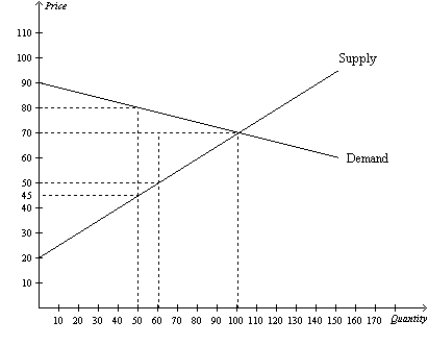 -Refer to Figure 7-22. If 110 units of the good are bought and sold, then
 (Multiple Choice)
4.8/5 (76)
(76) Suppose Lauren, Leslie and Lydia all purchase bulletin boards for their rooms for $15 each. Lauren's willingness to pay was $35, Leslie's willingness to pay was $25, and Lydia's willingness to pay was $30. Total consumer surplus for these three would be
(Multiple Choice)
4.8/5 (88)
(88) Figure 7-20 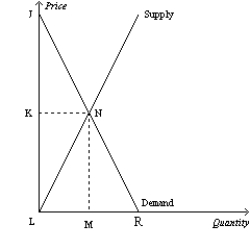 -Refer to Figure 7-20. For quantities greater than M, the value to the marginal buyer is
 (Multiple Choice)
4.8/5 (80)
(80) Figure 7-9 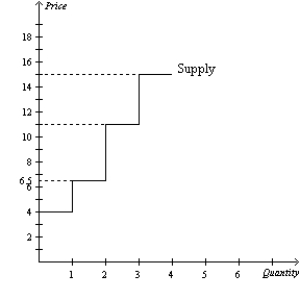 -Refer to Figure 7-9. If producer surplus is $19, then the price of the good is
 (Multiple Choice)
4.9/5 (74)
(74) Figure 7-32 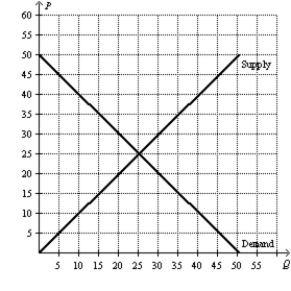 -Refer to Figure 7-32. If the government imposed a price ceiling at $20 in this market, how much are consumer surplus, producer surplus, and total surplus?
 (Essay)
4.7/5 (84)
(84) Table 7-12
The numbers reveal the opportunity costs of providing 10 piano lessons of equal quality.
Seller
Cost
Marcia
$200
Jan
$250
Cindy
$350
Greg
$400
Peter
$700
Bobby
$800
-Refer to Table 7-12. The equilibrium market price for 10 piano lessons is $300. What is the total producer surplus in the market?
(Multiple Choice)
4.9/5 (78)
(78) Scenario 7-1
Suppose market demand is given by the equation  -Refer to Scenario 7-1. If the market equilibrium price falls from $10 to $5, how much additional consumer surplus do consumers initially in the market at the $10 price receive?
 (Essay)
4.9/5 (66)
(66) Laissez-faire is a French expression which literally means
(Multiple Choice)
4.8/5 (79)
(79) Corn chips and potato chips are substitutes. Good weather that sharply increases the corn harvest would
(Multiple Choice)
4.8/5 (77)
(77) Figure 7-27  -Refer to Figure 7-27. Buyers who value this good more than the equilibrium price are represented by which line segment?
 (Multiple Choice)
4.9/5 (78)
(78) The consumption of water by local residents that may include pesticide runoff from local farmers' fields is an example of
(Multiple Choice)
4.9/5 (66)
(66) 
Filters
- Essay(0)
- Multiple Choice(0)
- Short Answer(0)
- True False(0)
- Matching(0)