



 Chat with AI
Exam 7: Consumers, Producers, and the Efficiency of Markets

Exam 1: Ten Principles of Economics455 Questions
Exam 2: Thinking Like an Economist643 Questions
Exam 3: Interdependence and the Gains From Trade547 Questions
Exam 4: The Market Forces of Supply and Demand693 Questions
Exam 5: Elasticity and Its Application626 Questions
Exam 6: Supply, Demand, and Government Policies668 Questions
Exam 7: Consumers, Producers, and the Efficiency of Markets547 Questions
Exam 8: Applications: the Costs of Taxation509 Questions
Exam 9: Application: International Trade521 Questions
Exam 10: Externalities543 Questions
Exam 11: Public Goods and Common Resources452 Questions
Exam 12: The Design of the Tax System664 Questions
Exam 13: The Costs of Production649 Questions
Exam 14: Firms in Competitive Markets604 Questions
Exam 15: Monopoly662 Questions
Exam 16: Monopolistic Competition649 Questions
Exam 17: Oligopoly522 Questions
Exam 18: The Markets for the Factors of Production592 Questions
Exam 19: Earnings and Discrimination511 Questions
Exam 20: Income Inequality and Poverty478 Questions
Exam 21: The Theory of Consumer Choice570 Questions
Exam 22: Frontiers in Microeconomics461 Questions
Exam 23: Measuring a Nation S Income547 Questions
Exam 24: Measuring the Cost of Living565 Questions
Exam 25: Production and Growth527 Questions
Exam 26: Saving, Investment, and the Financial System637 Questions
Exam 27: Tools of Finance534 Questions
Exam 28: Unemployment and Its Natural Rate701 Questions
Exam 29: The Monetary System540 Questions
Exam 30: Money Growth and Inflation504 Questions
Exam 31: Open-Economy Macroeconomics: Basic Concepts540 Questions
Exam 32: A Macroeconomic Theory of the Open Economy511 Questions
Exam 33: Aggregate Demand and Aggregate Supply572 Questions
Exam 34: The Influence of Monetary and Fiscal Policy on Aggregate Demand523 Questions
Exam 35: The Short-Run Tradeoff Between Inflation and Unemployment536 Questions
Exam 36: Six Debates Over Macroeconomic Policy354 Questions
Select questions type


Table 7-5
For each of three potential buyers of oranges, the table displays the willingness to pay for the first three oranges of the day. Assume Allison, Bob, and Charisse are the only three buyers of oranges, and only three oranges can be supplied per day.  -Refer to Table 7-5. If the market price of an orange is $0.70, then the market quantity of oranges demanded per day is
 (Multiple Choice)
4.8/5  (83)
(83) Figure 7-23  -Refer to Figure 7-23. The efficient price-quantity combination is
 (Multiple Choice)
4.9/5 (77)
(77) Figure 7-30  -Refer to Figure 7-30. If the market equilibrium price is $120, how much is total consumer surplus?
 (Short Answer)
4.9/5 (86)
(86) Denise values a stainless steel dishwasher for her new house at $500, but she succeeds in buying one for $350. Denise's consumer surplus is
(Multiple Choice)
4.9/5 (76)
(76) Figure 7-23
-Refer to Figure 7-23. At equilibrium, consumer surplus is represented by the area
-Refer to Figure 7-23. At equilibrium, consumer surplus is represented by the area (Multiple Choice)
4.7/5 (84)
(84) If the government imposes a binding price floor in a market, then the consumer surplus in that market will decrease.
(True/False)
4.8/5 (78)
(78) Economists argue that restrictions against ticket scalping actually drive up the cost of many tickets.
(True/False)
4.8/5 (92)
(92) When the demand for a good increases and the supply of the good remains unchanged, consumer surplus
(Multiple Choice)
4.8/5 (90)
(90) Table 7-16 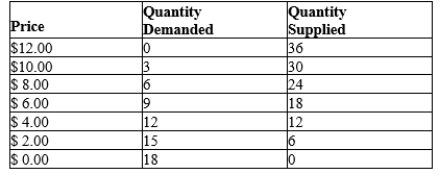 -Refer to Table 7-16. Both the demand curve and the supply curve are straight lines. If the price is $4 but only 6 units are bought and sold, consumer surplus will be
 (Multiple Choice)
4.8/5 (77)
(77) Which of the following events would increase producer surplus?
(Multiple Choice)
5.0/5 (82)
(82) Figure 7-6 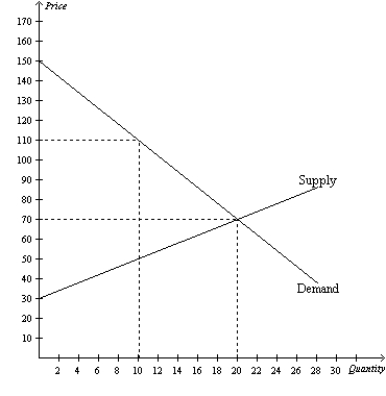 -Refer to Figure 7-6. At the equilibrium price, consumer surplus is
 (Multiple Choice)
4.8/5 (88)
(88) Table 7-11
The only four producers in a market have the following costs:
Seller
Cost
Evan
$50
Selena
$100
Angie
$150
Kris
$200
-Refer to Table 7-11. If the sellers bid against each other for the right to sell the good to a consumer, then the good will sell for
(Multiple Choice)
4.9/5 (84)
(84) Figure 7-24 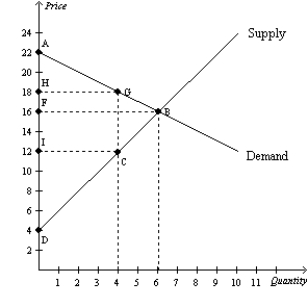 -Refer to Figure 7-24. The equilibrium allocation of resources is
 (Multiple Choice)
4.8/5 (71)
(71) Figure 7-24
-Refer to Figure 7-24. If the government imposes a price ceiling at $12, then producer surplus is
-Refer to Figure 7-24. If the government imposes a price ceiling at $12, then producer surplus is (Multiple Choice)
4.8/5 (77)
(77) Table 7-16
-Refer to Table 7-16. Both the demand curve and the supply curve are straight lines. At equilibrium, total surplus is
-Refer to Table 7-16. Both the demand curve and the supply curve are straight lines. At equilibrium, total surplus is (Multiple Choice)
4.9/5 (78)
(78) Figure 7-21  -Refer to Figure 7-21. Which area represents consumer surplus when the price is P1?
 (Multiple Choice)
4.7/5 (84)
(84) 
Filters
- Essay(0)
- Multiple Choice(0)
- Short Answer(0)
- True False(0)
- Matching(0)