



 Chat with AI
Exam 7: Consumers, Producers, and the Efficiency of Markets

Exam 1: Ten Principles of Economics455 Questions
Exam 2: Thinking Like an Economist643 Questions
Exam 3: Interdependence and the Gains From Trade547 Questions
Exam 4: The Market Forces of Supply and Demand693 Questions
Exam 5: Elasticity and Its Application626 Questions
Exam 6: Supply, Demand, and Government Policies668 Questions
Exam 7: Consumers, Producers, and the Efficiency of Markets547 Questions
Exam 8: Applications: the Costs of Taxation509 Questions
Exam 9: Application: International Trade521 Questions
Exam 10: Externalities543 Questions
Exam 11: Public Goods and Common Resources452 Questions
Exam 12: The Design of the Tax System664 Questions
Exam 13: The Costs of Production649 Questions
Exam 14: Firms in Competitive Markets604 Questions
Exam 15: Monopoly662 Questions
Exam 16: Monopolistic Competition649 Questions
Exam 17: Oligopoly522 Questions
Exam 18: The Markets for the Factors of Production592 Questions
Exam 19: Earnings and Discrimination511 Questions
Exam 20: Income Inequality and Poverty478 Questions
Exam 21: The Theory of Consumer Choice570 Questions
Exam 22: Frontiers in Microeconomics461 Questions
Exam 23: Measuring a Nation S Income547 Questions
Exam 24: Measuring the Cost of Living565 Questions
Exam 25: Production and Growth527 Questions
Exam 26: Saving, Investment, and the Financial System637 Questions
Exam 27: Tools of Finance534 Questions
Exam 28: Unemployment and Its Natural Rate701 Questions
Exam 29: The Monetary System540 Questions
Exam 30: Money Growth and Inflation504 Questions
Exam 31: Open-Economy Macroeconomics: Basic Concepts540 Questions
Exam 32: A Macroeconomic Theory of the Open Economy511 Questions
Exam 33: Aggregate Demand and Aggregate Supply572 Questions
Exam 34: The Influence of Monetary and Fiscal Policy on Aggregate Demand523 Questions
Exam 35: The Short-Run Tradeoff Between Inflation and Unemployment536 Questions
Exam 36: Six Debates Over Macroeconomic Policy354 Questions
Select questions type


Figure 7-33  -Refer to Figure 7-33. Suppose demand shifts such that consumers wish to purchase 12 fewer units at every price. How much is total consumer surplus in this market at the new equilibrium price?
 (Essay)
4.7/5  (69)
(69) Michael values a stainless steel refrigerator for his new house at $3,500, but he succeeds in buying one for $3,000. Michael's willingness to pay is
(Multiple Choice)
4.9/5 (85)
(85) Figure 7-27  -Refer to Figure 7-27. Sellers whose costs are less than the equilibrium price are represented by which line segment?
 (Multiple Choice)
4.9/5 (78)
(78) If a market is allowed to move freely to its equilibrium price and quantity, then an increase in supply will
(Multiple Choice)
4.9/5 (88)
(88) Table 7-6
For each of three potential buyers of apples, the table displays the willingness to pay for the first three apples of the day. Assume Xavier, Yadier, and Zavi are the only three buyers of apples, and only three apples can be supplied per day.  -Refer to Table 7-6. If the market price of an apple is $1.40, then the market quantity of apples demanded per day is
 (Multiple Choice)
4.9/5 (80)
(80) Suppose Raymond and Victoria attend a charity benefit and participate in a silent auction. Each has in mind a maximum amount that he or she will bid for an oil painting by a locally famous artist. This maximum is called
(Multiple Choice)
5.0/5 (70)
(70) Which of the following will cause a decrease in consumer surplus?
(Multiple Choice)
4.8/5 (88)
(88) Figure 7-18  -Refer to Figure 7-18. If total surplus is $240 and consumer surplus is
 (Multiple Choice)
4.8/5 (84)
(84) All else equal, what happens to consumer surplus if the price of a good decreases?
(Multiple Choice)
4.9/5 (86)
(86) Figure 7-24 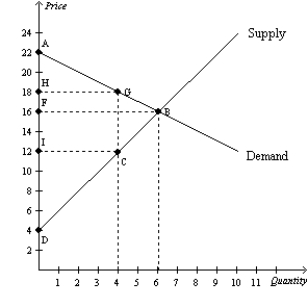 -Refer to Figure 7-24. If 6 units of the good are produced and sold, then
 (Multiple Choice)
4.9/5 (80)
(80) Scenario 7-1
Suppose market demand is given by the equation  -Refer to Scenario 7-1. If the market equilibrium price falls from $10 to $5, what is the change in total consumer surplus in the market?
 (Short Answer)
4.9/5 (81)
(81) If Rosa is willing to pay $450 for hockey tickets and has consumer surplus of $175, the price of the tickets is $625.
(True/False)
4.8/5 (66)
(66) If the government allowed a free market for transplant organs such as kidneys to exist, critics argue that such a market would
(Multiple Choice)
4.9/5 (73)
(73) In a competitive market, sales go to those producers who are willing to supply the product at the lowest price.
(True/False)
4.8/5 (70)
(70) Figure 7-1 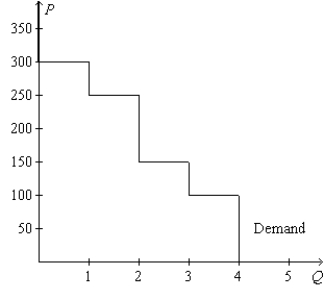 -Refer to Figure 7-1. If the price of the good is $250, then consumer surplus amounts to
 (Multiple Choice)
5.0/5 (76)
(76) Figure 7-19 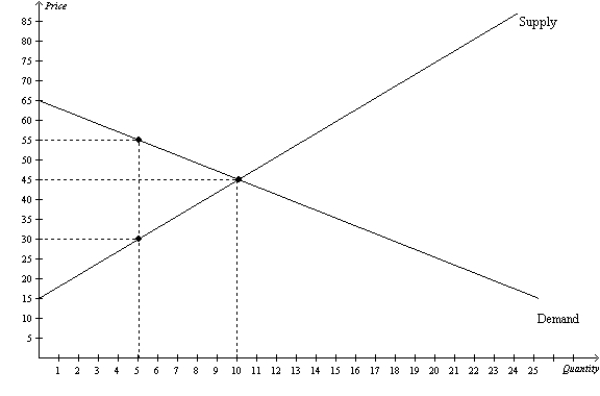 -Refer to Figure 7-19. At the equilibrium price, producer surplus is
 (Multiple Choice)
4.7/5 (64)
(64) ABC Company incurs a cost of 50 cents to produce a dozen eggs, while XYZ Company incurs a cost of 70 cents to produce a dozen eggs. Which of the following price increases would cause both companies to experience an increase in producer surplus?
(Multiple Choice)
4.8/5 (75)
(75) Suppose Larry, Moe, and Curly are bidding in an auction for a mint-condition video of Charlie Chaplin's first movie. Each has in mind a maximum amount that he will bid. This maximum is called
(Multiple Choice)
4.9/5 (74)
(74) Table 7-13
The only four producers in a market have the following costs:
Seller
Cost
Abbey
$30
Bev
$40
Carl
$55
Dale
$65
-Refer to Table 7-13. If the sellers bid against each other for the right to sell the good to a single consumer, then the good will sell for
(Multiple Choice)
4.8/5 (70)
(70) Figure 7-23  -Refer to Figure 7-23. If the price were P3, consumer surplus would be represented by the area
 (Multiple Choice)
4.7/5 (68)
(68) 
Filters
- Essay(0)
- Multiple Choice(0)
- Short Answer(0)
- True False(0)
- Matching(0)