



 Chat with AI
Exam 7: Consumers, Producers, and the Efficiency of Markets

Exam 1: Ten Principles of Economics455 Questions
Exam 2: Thinking Like an Economist643 Questions
Exam 3: Interdependence and the Gains From Trade547 Questions
Exam 4: The Market Forces of Supply and Demand693 Questions
Exam 5: Elasticity and Its Application626 Questions
Exam 6: Supply, Demand, and Government Policies668 Questions
Exam 7: Consumers, Producers, and the Efficiency of Markets547 Questions
Exam 8: Applications: the Costs of Taxation509 Questions
Exam 9: Application: International Trade521 Questions
Exam 10: Externalities543 Questions
Exam 11: Public Goods and Common Resources452 Questions
Exam 12: The Design of the Tax System664 Questions
Exam 13: The Costs of Production649 Questions
Exam 14: Firms in Competitive Markets604 Questions
Exam 15: Monopoly662 Questions
Exam 16: Monopolistic Competition649 Questions
Exam 17: Oligopoly522 Questions
Exam 18: The Markets for the Factors of Production592 Questions
Exam 19: Earnings and Discrimination511 Questions
Exam 20: Income Inequality and Poverty478 Questions
Exam 21: The Theory of Consumer Choice570 Questions
Exam 22: Frontiers in Microeconomics461 Questions
Exam 23: Measuring a Nation S Income547 Questions
Exam 24: Measuring the Cost of Living565 Questions
Exam 25: Production and Growth527 Questions
Exam 26: Saving, Investment, and the Financial System637 Questions
Exam 27: Tools of Finance534 Questions
Exam 28: Unemployment and Its Natural Rate701 Questions
Exam 29: The Monetary System540 Questions
Exam 30: Money Growth and Inflation504 Questions
Exam 31: Open-Economy Macroeconomics: Basic Concepts540 Questions
Exam 32: A Macroeconomic Theory of the Open Economy511 Questions
Exam 33: Aggregate Demand and Aggregate Supply572 Questions
Exam 34: The Influence of Monetary and Fiscal Policy on Aggregate Demand523 Questions
Exam 35: The Short-Run Tradeoff Between Inflation and Unemployment536 Questions
Exam 36: Six Debates Over Macroeconomic Policy354 Questions
Select questions type


According to many economists, government restrictions on ticket scalping do all of the following except
(Multiple Choice)
5.0/5  (87)
(87) Figure 7-9 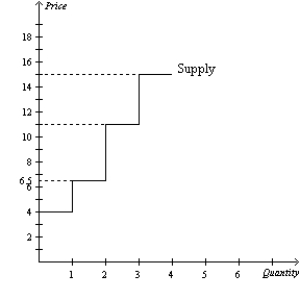 -Refer to Figure 7-9. If the price of the good is $14, then producer surplus is
 (Multiple Choice)
4.7/5 (82)
(82) Figure 7-33  -Refer to Figure 7-33. How much is total surplus in this market at the equilibrium price?
 (Essay)
4.8/5 (78)
(78) Even though participants in the economy are motivated by self-interest, the "invisible hand" of the marketplace guides this self-interest into promoting general economic well-being.
(True/False)
4.9/5 (77)
(77) Table 7-7 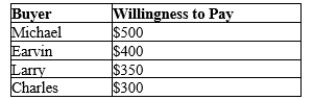 -Refer to Table 7-7. You have an extra ticket to the Midwest Regional Sweet 16 game in the men's NCAA basketball tournament. The table shows the willingness to pay of the four potential buyers in the market for a ticket to the game. You hold an auction to sell the ticket. Michael bids $410 for the ticket, and you sell him the ticket. What is his consumer surplus?
 (Multiple Choice)
4.8/5 (80)
(80) Table 7-3
The only four consumers in a market have the following willingness to pay for a good: 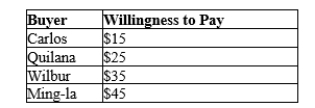 -Refer to Table 7-3. If there is only one unit of the good and if the buyers bid against each other for the right to purchase it, then the good will sell for
 (Multiple Choice)
4.8/5 (73)
(73) Figure 7-16 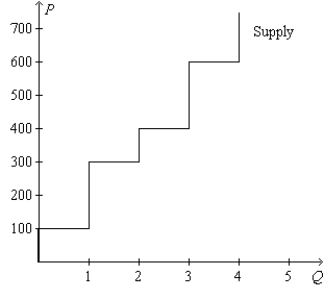 -Refer to Figure 7-16. If the price of the good is $600, then
 (Multiple Choice)
4.9/5 (74)
(74) A buyer is willing to buy a product at a price greater than or equal to his willingness to pay, but would refuse to buy a product at a price less than his willingness to pay.
(True/False)
4.7/5 (78)
(78) Figure 7-33
-Refer to Figure 7-33. Suppose demand shifts such that consumers wish to purchase 12 fewer units at every price. How much is total producer surplus in this market at the new equilibrium price?
-Refer to Figure 7-33. Suppose demand shifts such that consumers wish to purchase 12 fewer units at every price. How much is total producer surplus in this market at the new equilibrium price? (Essay)
4.8/5 (84)
(84) Figure 7-24 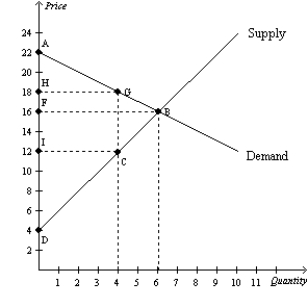 -Refer to Figure 7-24. If 6 units of the good are produced and sold, then
 (Multiple Choice)
5.0/5 (88)
(88) Table 7-14
Seller
Cost
LeBron
$700
Kobe
$600
Kevin
$450
Steve
$400
-Refer to Table 7-14. You want to hire a professional photographer to take pictures of your family. The table shows the costs of the four potential sellers in the local photography market. You take bids from the sellers. Who offers the winning bid, and what does he offer to charge for the photography session?
(Multiple Choice)
4.8/5 (82)
(82) In order to calculate consumer surplus in a market, we need to know willingness to pay and price.
(True/False)
4.9/5 (70)
(70) Suppose that Firms A and B each produce high-resolution computer monitors, but Firm A can do so at a lower cost. Cassie and David each want to purchase a high-resolution computer monitor, but David is willing to pay more than Cassie. Which of the following market outcomes is efficient?
(Multiple Choice)
4.8/5 (81)
(81) A drought in California destroys many red grapes. As a result of the drought, the consumer surplus in the market for red grapes
(Multiple Choice)
4.8/5 (83)
(83) Consumer surplus can be measured as the area between the demand curve and the supply curve.
(True/False)
4.8/5 (74)
(74) Table 7-2
This table refers to five possible buyers' willingness to pay for a case of Vanilla Coke. 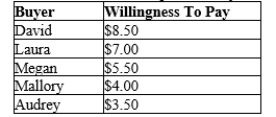 -Refer to Table 7-2. Which of the following is not true?
 (Multiple Choice)
4.8/5 (75)
(75) 
Filters
- Essay(0)
- Multiple Choice(0)
- Short Answer(0)
- True False(0)
- Matching(0)