



 Chat with AI
Exam 19: Earnings and Discrimination

Exam 1: Ten Principles of Economics455 Questions
Exam 2: Thinking Like an Economist645 Questions
Exam 3: Interdependence and the Gains From Trade550 Questions
Exam 4: The Market Forces of Supply and Demand693 Questions
Exam 5: Elasticity and Its Application625 Questions
Exam 6: Supply, Demand, and Government Policies671 Questions
Exam 7: Consumers, Producers, and the Efficiency of Markets547 Questions
Exam 8: Application: The Costs of Taxation507 Questions
Exam 9: Application: International Trade521 Questions
Exam 10: Externalities543 Questions
Exam 11: Public Goods and Common Resources453 Questions
Exam 12: The Design of the Tax System563 Questions
Exam 13: The Costs of Production649 Questions
Exam 14: Firms in Competitive Markets608 Questions
Exam 15: Monopoly662 Questions
Exam 16: Monopolistic Competition649 Questions
Exam 17: Oligopoly522 Questions
Exam 18: The Markets for the Factors of Production592 Questions
Exam 19: Earnings and Discrimination511 Questions
Exam 20: Income Inequality and Poverty478 Questions
Exam 21: The Theory of Consumer Choice568 Questions
Exam 22: Frontiers in Microeconomics461 Questions
Select questions type


Which of the following would be considered an investment in human capital?
(Multiple Choice)
5.0/5  (74)
(74) Studies of wages by labor economists indicate that measurable variables such as age, job characteristics, years of education, and years of experience account for
(Multiple Choice)
4.8/5 (87)
(87) Labor-market discrimination based solely on age is illegal in the United States.
(True/False)
4.8/5 (79)
(79) List three reasons why wages could be set above the equilibrium wage.
(Essay)
4.9/5 (84)
(84) Which of the following variables related to a worker's wage are the most difficult to measure?
(Multiple Choice)
4.7/5 (84)
(84) Between 1975 and 2011, the wage gap between men with a high school education and men with a college education increased. In particular, in 2011 men with a college degree earned about
(Multiple Choice)
4.8/5 (71)
(71) Superstars earn high incomes due to their ability to satisfy the demands of millions of people at once.
(True/False)
4.9/5 (86)
(86) Economists argue competitive markets provide a "natural remedy" to discriminatory wage practices. Which of the following is widely recognized as a potential limit to the effectiveness of that natural remedy?
(Multiple Choice)
4.8/5 (74)
(74) Nurses who work in hospitals often are required to work on weekends, whereas nurses who work in doctors' offices generally only work Monday through Friday. Hospital nurses who must work on weekends are usually paid more than nurses working in doctors' offices for the same work even if they have the same skills and education. This difference in pay is attributed to
(Multiple Choice)
4.8/5 (73)
(73) Figure 19-7 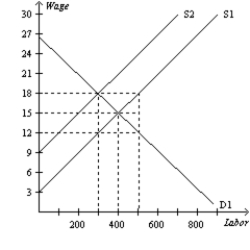 -Refer to Figure 19-7. The figure shows labor demand and labor supply in a non-unionized labor market. If the current labor demand is D1 and the current labor supply is S1, when a union is established in this market and succeeds in raising the wage to $18 per hour, what is the change in the number of workers employed?
 (Short Answer)
4.9/5 (83)
(83) Discrimination occurs when the marketplace offers different opportunities to similar individuals who differ only by
(Multiple Choice)
4.8/5 (95)
(95) Workers in a labor union typically are paid less than workers not in a labor union.
(True/False)
4.9/5 (78)
(78) One of the problems with calculating the true amount of discrimination that takes place in the market for labor is
(Multiple Choice)
4.8/5 (80)
(80) Over the past several years, the earnings gap between high-skilled and low-skilled workers has widened because (i)
International trade has altered the relative demand for skilled and unskilled labor.
(ii)
Changes in technology have altered the relative demand for skilled and unskilled labor.
(iii)
The return to education for men has decreased, whereas the return to education for women has increased.
(Multiple Choice)
5.0/5 (66)
(66) 
Filters
- Essay(0)
- Multiple Choice(0)
- Short Answer(0)
- True False(0)
- Matching(0)