



 Chat with AI
Exam 19: Earnings and Discrimination

Exam 1: Ten Principles of Economics455 Questions
Exam 2: Thinking Like an Economist645 Questions
Exam 3: Interdependence and the Gains From Trade550 Questions
Exam 4: The Market Forces of Supply and Demand693 Questions
Exam 5: Elasticity and Its Application625 Questions
Exam 6: Supply, Demand, and Government Policies671 Questions
Exam 7: Consumers, Producers, and the Efficiency of Markets547 Questions
Exam 8: Application: The Costs of Taxation507 Questions
Exam 9: Application: International Trade521 Questions
Exam 10: Externalities543 Questions
Exam 11: Public Goods and Common Resources453 Questions
Exam 12: The Design of the Tax System563 Questions
Exam 13: The Costs of Production649 Questions
Exam 14: Firms in Competitive Markets608 Questions
Exam 15: Monopoly662 Questions
Exam 16: Monopolistic Competition649 Questions
Exam 17: Oligopoly522 Questions
Exam 18: The Markets for the Factors of Production592 Questions
Exam 19: Earnings and Discrimination511 Questions
Exam 20: Income Inequality and Poverty478 Questions
Exam 21: The Theory of Consumer Choice568 Questions
Exam 22: Frontiers in Microeconomics461 Questions
Select questions type


One reason why better-looking workers may have higher earnings is that physical attractiveness may enhance a worker's productivity for certain jobs, especially for those workers who deal with the public.
(True/False)
5.0/5  (91)
(91) Men and women tend to choose different types of occupations, and so
(Multiple Choice)
4.9/5 (88)
(88) Figure 19-3
The manufacturing labor market. 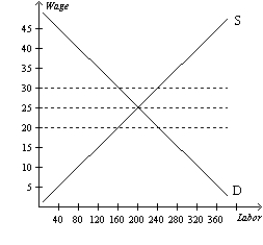 -Refer to Figure 19-3. Suppose the manufacturing labor market, which is non-unionized, is in equilibrium at a wage equal to $20. Suppose now that the AFL-CIO (a labor organization) organizes the workers in the manufacturing market and negotiates a wage of $30 per hour. After the workers become unionized, how many workers do manufacturing firms collectively hire?
 (Multiple Choice)
4.9/5 (76)
(76) Store clerks are known to have low wages. This is likely to reflect the fact that
(Multiple Choice)
4.8/5 (75)
(75) Which of these instances would constitute labor-market discrimination? Courtney and Nicole are identical in all of their labor-market characteristics except that Courtney earns a higher salary than Nicole because
(Multiple Choice)
4.9/5 (80)
(80) The wage difference between jobs that require education and those that don't
(Multiple Choice)
4.7/5 (75)
(75) Evidence from a 1988 study of the market for professional basketball players
(Multiple Choice)
5.0/5 (80)
(80) Consider two groups of workers of equal skill level and experience: those who collect garbage and those who stuff envelopes with campaign fliers. Which group is likely to be paid more and why?
(Essay)
4.9/5 (84)
(84) Which of the following can be used to help explain wage differences among different groups of workers?
(Multiple Choice)
4.8/5 (81)
(81) As a result of an increase in the earnings gap between skilled and unskilled jobs, the incentive to get a college education has been declining.
(True/False)
4.7/5 (75)
(75) One reason why better-looking workers may have higher earnings is that physical attractiveness is correlated with intelligence.
(True/False)
4.8/5 (86)
(86) Figure 19-7 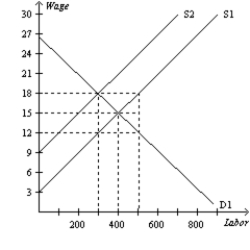 -Refer to Figure 19-7. The figure shows labor demand and labor supply in a non-unionized labor market. Suppose the current labor demand is D1 and the current labor supply is S1. If a firm in this market decided to pay its workers $18 per hour to increase the productivity of its workers, this firm would be paying a(n)
 (Short Answer)
4.7/5 (83)
(83) Figure 19-5 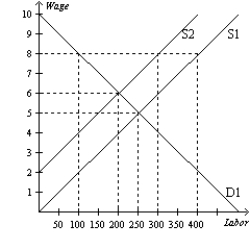 -Refer to Figure 19-5. Given demand for labor, D1, and supply of labor, S1, what are the equilibrium wage and quantity of labor?
 (Multiple Choice)
4.8/5 (77)
(77) What is the term for offering different opportunities to similar individuals who differ only by race, ethnic group, sex, age, or other personal characteristics?
(Short Answer)
5.0/5 (84)
(84) 
Filters
- Essay(0)
- Multiple Choice(0)
- Short Answer(0)
- True False(0)
- Matching(0)