



 Chat with AI
Exam 19: Earnings and Discrimination

Exam 1: Ten Principles of Economics455 Questions
Exam 2: Thinking Like an Economist645 Questions
Exam 3: Interdependence and the Gains From Trade550 Questions
Exam 4: The Market Forces of Supply and Demand693 Questions
Exam 5: Elasticity and Its Application625 Questions
Exam 6: Supply, Demand, and Government Policies671 Questions
Exam 7: Consumers, Producers, and the Efficiency of Markets547 Questions
Exam 8: Application: The Costs of Taxation507 Questions
Exam 9: Application: International Trade521 Questions
Exam 10: Externalities543 Questions
Exam 11: Public Goods and Common Resources453 Questions
Exam 12: The Design of the Tax System563 Questions
Exam 13: The Costs of Production649 Questions
Exam 14: Firms in Competitive Markets608 Questions
Exam 15: Monopoly662 Questions
Exam 16: Monopolistic Competition649 Questions
Exam 17: Oligopoly522 Questions
Exam 18: The Markets for the Factors of Production592 Questions
Exam 19: Earnings and Discrimination511 Questions
Exam 20: Income Inequality and Poverty478 Questions
Exam 21: The Theory of Consumer Choice568 Questions
Exam 22: Frontiers in Microeconomics461 Questions
Select questions type


Figure 19-5 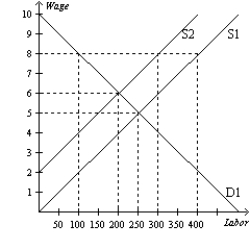 -Refer to Figure 19-5. Given demand for labor, D1, and supply of labor, S2, which of the following could be considered an efficiency wage?
 (Multiple Choice)
4.9/5  (78)
(78) Why is a construction worker never likely to earn as much as a famous athlete?
(Multiple Choice)
4.9/5 (78)
(78) When comparing the salaries of a superstar CPA and a superstar golfer,
(Multiple Choice)
4.8/5 (86)
(86) Artie and Angelina attended the same university, graduated with the same degree and grade point average, and are equally productive in their identical new jobs. Still, Angelina's salary is 10% lower than Artie's salary. One can conclude that Angelina likely suffers from
(Short Answer)
4.9/5 (79)
(79) If an older worker earns less than a younger worker for the same job, we have proof of age discrimination.
(True/False)
4.9/5 (83)
(83) Figure 19-6 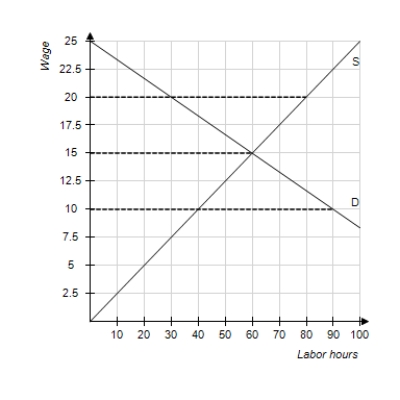 -Refer to Figure 19-6. This figure depicts labor demand and supply for the widget industry. The market equilibrium wage is $15. If the minimum wage in the economy is $10, how many hours of labor will be demanded from firms in the widget industry?
 (Multiple Choice)
4.8/5 (78)
(78) The difference in wages that results from nonmonetary characteristics of different jobs is called the
(Short Answer)
5.0/5 (77)
(77) Jobs that involve pleasant work, as opposed to jobs that involve unpleasant work, usually pay
(Multiple Choice)
4.9/5 (93)
(93) Which of the following is an example of a compensating differential?
(Multiple Choice)
4.9/5 (80)
(80) When robots are used to replace workers on a factory production line, the wage gap between skilled and unskilled workers
(Multiple Choice)
4.9/5 (71)
(71) When employers sort employment applications into high-ability and low-ability people based on whether or not the applicant has a college degree (irrespective of major), they are providing evidence in support of the
(Multiple Choice)
4.8/5 (70)
(70) Evaluate the following statement: "The gender pay gap provides evidence of widespread, severe, ongoing discrimination by employers and fellow workers."
(Essay)
4.7/5 (81)
(81) Which of the following moves the wage above its equilibrium value?
(Multiple Choice)
4.8/5 (98)
(98) Which of these instances would constitute labor-market discrimination? Henry receives a higher wage than Ryan. Henry and Ryan are identical in all of their labor-market characteristics except that
(Multiple Choice)
4.7/5 (90)
(90) One hypothesis to explain the changing gap in wages between unskilled and skilled workers in the United States is that international trade has altered the relative demands for skilled and unskilled workers.
(True/False)
4.9/5 (74)
(74) List the productivity factors that may explain the differences in pay between men and women in similar occupations. Do any of these factors arise as a result of cultural or social traditions? If so, describe how changes in social relationships will affect the pay gap over time.
(Essay)
4.8/5 (68)
(68) 
Filters
- Essay(0)
- Multiple Choice(0)
- Short Answer(0)
- True False(0)
- Matching(0)