



 Chat with AI
Exam 19: Earnings and Discrimination

Exam 1: Ten Principles of Economics455 Questions
Exam 2: Thinking Like an Economist645 Questions
Exam 3: Interdependence and the Gains From Trade550 Questions
Exam 4: The Market Forces of Supply and Demand693 Questions
Exam 5: Elasticity and Its Application625 Questions
Exam 6: Supply, Demand, and Government Policies671 Questions
Exam 7: Consumers, Producers, and the Efficiency of Markets547 Questions
Exam 8: Application: The Costs of Taxation507 Questions
Exam 9: Application: International Trade521 Questions
Exam 10: Externalities543 Questions
Exam 11: Public Goods and Common Resources453 Questions
Exam 12: The Design of the Tax System563 Questions
Exam 13: The Costs of Production649 Questions
Exam 14: Firms in Competitive Markets608 Questions
Exam 15: Monopoly662 Questions
Exam 16: Monopolistic Competition649 Questions
Exam 17: Oligopoly522 Questions
Exam 18: The Markets for the Factors of Production592 Questions
Exam 19: Earnings and Discrimination511 Questions
Exam 20: Income Inequality and Poverty478 Questions
Exam 21: The Theory of Consumer Choice568 Questions
Exam 22: Frontiers in Microeconomics461 Questions
Select questions type


Which of the following is not an example of a compensating differential? Job A pays more than Job B because Job A requires
(Multiple Choice)
4.9/5  (78)
(78) Scenario 19-2
Travis, a student at a community college, is considering what he should do for summer employment. Two recruiters show up at his school in search of summer workers. Recruiter A is looking for workers to help a disaster relief agency distribute food aid in Africa. Recruiter B is looking for custodial help to clean motel rooms in a motel located near the entrance to a famous national park.
-Refer to Scenario 19-2. Travis is carefully considering the options that each recruiter presents. On the basis of knowledge obtained in his economics class, Travis concludes that
(Multiple Choice)
4.7/5 (88)
(88) Figure 19-7 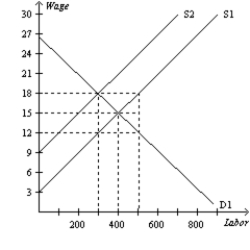 -Refer to Figure 19-7. The figure shows labor demand and labor supply in a non-unionized labor market. If the current labor demand is D1 and the current labor supply is S1, what is the equilibrium wage and quantity of labor?
 (Short Answer)
4.9/5 (71)
(71) Scenario 19-6
Suppose that in the competitive market for auto repair, firms prefer to hire men rather than women. Assume that the women applying for positions have the same skills, experience, and work ethic as the men. As a result of this discrimination, the demand for women is lower than it otherwise would be.
-Refer to Scenario 19-6. What conclusion can you draw about women's wages compared to men's wages in this industry?
(Short Answer)
4.8/5 (75)
(75) The signaling theory of education maintains that workers who complete specific levels of education signal their high productivity to potential employers.
(True/False)
4.7/5 (90)
(90) When an employer pays the cost of educating a worker, it is likely that the employer
(Multiple Choice)
4.7/5 (77)
(77) Scenario 19-4
Assume that the labor market for barbers is competitive and that it is differentiated into two groups: barbers who are bald (or going bald) and those who have a full head of hair. Assume that the barbers in this market have identical hair-cutting ability, regardless of whether they are bald or not. Currently the equilibrium wage in the bald barber market is lower than that in the nonbald market. Further assume that the market for haircuts is competitive.
-Refer to Scenario 19-4. If some consumers in the market for haircuts have a strong preference for having their hair cut by a barber who is not going bald, then
(Multiple Choice)
4.9/5 (65)
(65) About what proportion of the variation of wages across workers is explained by factors that can be measured? What are the other factors that explain wage differences but are difficult to measure?
(Essay)
4.9/5 (82)
(82) Studies of discrimination in baseball suggest that black players
(Multiple Choice)
4.8/5 (88)
(88) If we were to observe above-equilibrium wages in a particular labor market, then a possible explanation might be that
(Multiple Choice)
4.8/5 (62)
(62) Human capital refers to the physical tools and equipment that workers use on their jobs to enhance their productivity.
(True/False)
4.9/5 (77)
(77) Chris just completed his college degree from a prestigious university. He did not go to school to become more productive. Rather, he went to school and completed his degree to convey his innate productivity to employers. To which theory of education does he subscribe?
(Short Answer)
4.8/5 (74)
(74) The organized withdrawal of labor from a firm by a union is called
(Multiple Choice)
4.7/5 (96)
(96) Which of the following would tend to lessen the wage gap between a country's skilled and unskilled workers?
(Multiple Choice)
4.8/5 (74)
(74) Economists have found evidence that differences in wages can be explained by
(Multiple Choice)
4.9/5 (81)
(81) When comparing average wages for black and white men in the United States, wages paid to black men have been about 20 percent less than those paid to white men.
(True/False)
4.8/5 (80)
(80) Is measuring the effect of discrimination on wages relatively easy or relatively difficult? Explain?
(Essay)
4.7/5 (91)
(91) Tiffany has just graduated from Stanford University and has applied for a job as an engineer at a manufacturing plant. The manufacturer decides to offer Tiffany a job because it perceives she's gained valuable skills while at Stanford. To which of the following views of education does the manufacturer subscribe?
(Multiple Choice)
4.8/5 (75)
(75) 
Filters
- Essay(0)
- Multiple Choice(0)
- Short Answer(0)
- True False(0)
- Matching(0)