



 Chat with AI
Exam 19: Earnings and Discrimination

Exam 1: Ten Principles of Economics455 Questions
Exam 2: Thinking Like an Economist645 Questions
Exam 3: Interdependence and the Gains From Trade550 Questions
Exam 4: The Market Forces of Supply and Demand693 Questions
Exam 5: Elasticity and Its Application625 Questions
Exam 6: Supply, Demand, and Government Policies671 Questions
Exam 7: Consumers, Producers, and the Efficiency of Markets547 Questions
Exam 8: Application: The Costs of Taxation507 Questions
Exam 9: Application: International Trade521 Questions
Exam 10: Externalities543 Questions
Exam 11: Public Goods and Common Resources453 Questions
Exam 12: The Design of the Tax System563 Questions
Exam 13: The Costs of Production649 Questions
Exam 14: Firms in Competitive Markets608 Questions
Exam 15: Monopoly662 Questions
Exam 16: Monopolistic Competition649 Questions
Exam 17: Oligopoly522 Questions
Exam 18: The Markets for the Factors of Production592 Questions
Exam 19: Earnings and Discrimination511 Questions
Exam 20: Income Inequality and Poverty478 Questions
Exam 21: The Theory of Consumer Choice568 Questions
Exam 22: Frontiers in Microeconomics461 Questions
Select questions type


When comparing average wages for male and female workers in the United States, wages paid to females have been about 40 percent less than those paid to male workers.
(True/False)
4.9/5  (77)
(77) George and Brad are waiters at a local restaurant. The female customers prefer to be seated at the tables that George waits on because they think George is better looking than Brad. If George earns more than Brad because of his better looks, this is an example of
(Multiple Choice)
5.0/5 (87)
(87) Which of the following might explain the beauty premium found by labor economists Hamermesh and Biddle?
(Multiple Choice)
5.0/5 (79)
(79) Firms that operate in competitive product markets and choose to practice discrimination in hiring workers
(Multiple Choice)
4.9/5 (82)
(82) Major league baseball players get paid more than minor league baseball players because of
(Multiple Choice)
4.8/5 (66)
(66) Empirical evidence suggests that ability, effort, and chance are not likely to be significant contributors to wage differences.
(True/False)
4.8/5 (72)
(72) Gerald earns a higher salary than his brother Peter because Gerald went to law school and is a lawyer, whereas Peter dropped out of college to work as a mechanic. The difference in salary illustrates a compensating differential.
(True/False)
4.9/5 (87)
(87) Coal mining is a dangerous and dirty job. Suppose someone developed new machinery that made coal mining safer and cleaner; at the same time, suppose it made coal miners more productive. We would expect that the wages of coal miners would
(Multiple Choice)
4.7/5 (83)
(83) Politicians often point to wage differentials as evidence of labor-market discrimination against ethnic minorities and women; however, economists argue against this approach because people differ in the amount of human capital they have and the kinds of work they are willing and able to do.
(True/False)
4.9/5 (82)
(82) Compensating differentials are differences in wages related to the characteristics of a job.
(True/False)
4.8/5 (85)
(85) Public school teachers are known to have low wages. Which of the following would push the teachers' wages lower?
(Multiple Choice)
5.0/5 (88)
(88) Figure 19-6 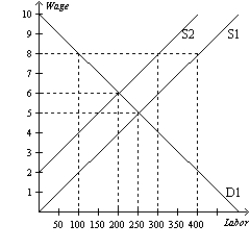 -Refer to Figure 19-6. Given demand, D1, and supply, S2, how many workers are unemployed if a minimum wage of $8 per hour is imposed on this market?
 (Short Answer)
4.9/5 (78)
(78) If unskilled labor is relatively plentiful and cheap in many foreign countries, then as the United States expands its trade with these foreign countries, the domestic demand for
(Multiple Choice)
4.8/5 (82)
(82) It is likely that, if we could measure the quality as well as the quantity of education,
(Multiple Choice)
4.7/5 (89)
(89) 
Filters
- Essay(0)
- Multiple Choice(0)
- Short Answer(0)
- True False(0)
- Matching(0)