



 Chat with AI
Exam 19: Earnings and Discrimination

Exam 1: Ten Principles of Economics455 Questions
Exam 2: Thinking Like an Economist645 Questions
Exam 3: Interdependence and the Gains From Trade550 Questions
Exam 4: The Market Forces of Supply and Demand693 Questions
Exam 5: Elasticity and Its Application625 Questions
Exam 6: Supply, Demand, and Government Policies671 Questions
Exam 7: Consumers, Producers, and the Efficiency of Markets547 Questions
Exam 8: Application: The Costs of Taxation507 Questions
Exam 9: Application: International Trade521 Questions
Exam 10: Externalities543 Questions
Exam 11: Public Goods and Common Resources453 Questions
Exam 12: The Design of the Tax System563 Questions
Exam 13: The Costs of Production649 Questions
Exam 14: Firms in Competitive Markets608 Questions
Exam 15: Monopoly662 Questions
Exam 16: Monopolistic Competition649 Questions
Exam 17: Oligopoly522 Questions
Exam 18: The Markets for the Factors of Production592 Questions
Exam 19: Earnings and Discrimination511 Questions
Exam 20: Income Inequality and Poverty478 Questions
Exam 21: The Theory of Consumer Choice568 Questions
Exam 22: Frontiers in Microeconomics461 Questions
Select questions type


Scenario 19-7
Mark works full time at a large accounting firm. Mark has been at the firm for four years but has not been given a promotion, even though newer employees have already been promoted. Mark believes he is a victim of labor-market discrimination, and threatens to hire a lawyer to sue the company.
-Refer to Scenario 19-7. Which of the following would strengthen Mark's case against his employer?
(Multiple Choice)
4.9/5  (79)
(79) Hunter is an ambitious, competitive person who has always tried to be the best at everything he does. Consider the following job options facing Hunter and choose the option that will likely afford him the highest wage.
(Multiple Choice)
5.0/5 (84)
(84) Table 19-2 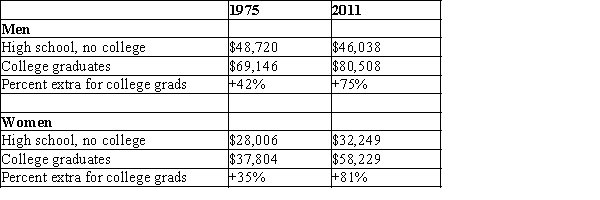 Source: US Census Bureau and Mankiw's calculations
-Refer to Table 19-2. In 2011, on average how much more income would a man with a college degree earn than a man with a high school degree?
Source: US Census Bureau and Mankiw's calculations
-Refer to Table 19-2. In 2011, on average how much more income would a man with a college degree earn than a man with a high school degree? (Short Answer)
4.9/5 (80)
(80) Which of the following is not an example of a compensating differential?
(Multiple Choice)
4.7/5 (83)
(83) Daryn and Nick work for two different companies, but each performs the same job working on a loading dock. Daryn, however, earns a higher salary than his friend Nick The difference in salary could illustrate union wages if Daryn's annual salary is covered by a collective bargaining agreement and Nick's is not.
(True/False)
4.8/5 (72)
(72) Evidence of differences in average wages of women compared to men
(Multiple Choice)
4.9/5 (80)
(80) On average, electricians who work on dangerous high-voltage power lines earn more per hour than similarly skilled electricians who don't work on dangerous high-voltage power lines. The difference in pay is attributed to
(Multiple Choice)
4.9/5 (81)
(81) Which of the following statements accurately explains the superstar phenomenon in wages?
(Multiple Choice)
4.9/5 (73)
(73) Certain factors that are probably important in determining wages are nevertheless difficult to measure. Consequently, labor economists find those factors difficult to incorporate into their studies of labor markets and wages. Those factors include
(Multiple Choice)
4.8/5 (74)
(74) Which of the following statements can be called a productivity-revealing theory?
(Multiple Choice)
4.8/5 (83)
(83) Politicians often point to wage differentials as evidence of labor market discrimination against ethnic minorities and women. Economists, however, argue against this approach because
(Multiple Choice)
4.9/5 (71)
(71) Which of the following is not a consequence of above-equilibrium wages in a labor market?
(Multiple Choice)
4.8/5 (66)
(66) A group of firms working together and acting as a supplier of a product is called a cartel. A group of employees working together and acting as a single supplier of labor is called a
(Short Answer)
4.7/5 (85)
(85) Figure 19-4 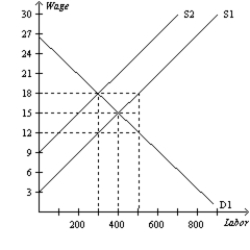 -Refer to Figure 19-4. If a union is successful in reducing supply from S1 to S2, the wage will
 (Multiple Choice)
4.9/5 (85)
(85) Education and on-the-job training are sources of human capital.
(True/False)
4.9/5 (89)
(89) 
Filters
- Essay(0)
- Multiple Choice(0)
- Short Answer(0)
- True False(0)
- Matching(0)