



 Chat with AI
Exam 19: Earnings and Discrimination

Exam 1: Ten Principles of Economics455 Questions
Exam 2: Thinking Like an Economist645 Questions
Exam 3: Interdependence and the Gains From Trade550 Questions
Exam 4: The Market Forces of Supply and Demand693 Questions
Exam 5: Elasticity and Its Application625 Questions
Exam 6: Supply, Demand, and Government Policies671 Questions
Exam 7: Consumers, Producers, and the Efficiency of Markets547 Questions
Exam 8: Application: The Costs of Taxation507 Questions
Exam 9: Application: International Trade521 Questions
Exam 10: Externalities543 Questions
Exam 11: Public Goods and Common Resources453 Questions
Exam 12: The Design of the Tax System563 Questions
Exam 13: The Costs of Production649 Questions
Exam 14: Firms in Competitive Markets608 Questions
Exam 15: Monopoly662 Questions
Exam 16: Monopolistic Competition649 Questions
Exam 17: Oligopoly522 Questions
Exam 18: The Markets for the Factors of Production592 Questions
Exam 19: Earnings and Discrimination511 Questions
Exam 20: Income Inequality and Poverty478 Questions
Exam 21: The Theory of Consumer Choice568 Questions
Exam 22: Frontiers in Microeconomics461 Questions
Select questions type


Which of the following is an example of a compensating differential?
(Multiple Choice)
4.8/5  (86)
(86) Which of the following factors does not affect the value of a worker's marginal product?
(Multiple Choice)
4.9/5 (71)
(71) Figure 19-6 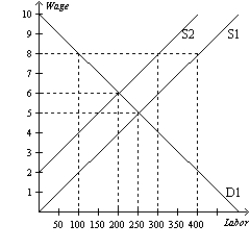 -Refer to Figure 19-6. Given demand, D1, and supply, S1, how much more do workers earn per hour if the supply curve shifts to S2?
 (Short Answer)
4.9/5 (68)
(68) Adam and Bob are identical twins who attended grammar school through high school together. Adam got a job after high school, and Bob got a job after graduating from college. Adam earns $36,000 a year, and Bob earns $69,000 a year. Select the best explanation for this wage difference.
(Multiple Choice)
4.9/5 (78)
(78) According to economic historians, streetcars in southern cities in the early 1900s were racially segregated because the owners of the firms believed that segregation raised the firms' profits.
(True/False)
4.8/5 (81)
(81) The superstar phenomenon explains why professional athletes earn more than amateur athletes.
(True/False)
4.8/5 (89)
(89) Which of the following is not an example of a compensating differential?
(Multiple Choice)
4.9/5 (72)
(72) Nancy and Sheila are both loan officers who graduated from the same university with bachelors' degrees in economics, and achieved similar performance reviews. Nancy started working one year before Sheila. If Nancy earns a higher annual salary than Sheila because she has more experience, the employer is
(Multiple Choice)
4.8/5 (83)
(83) A prestigious private high school requires each of its teachers to have a Ph.D. in the subject they teach. This requirement is likely to
(Multiple Choice)
5.0/5 (73)
(73) Superstars arise in markets in which every customer in the market is able to enjoy the good supplied by the
(Short Answer)
4.8/5 (79)
(79) Figure 19-2 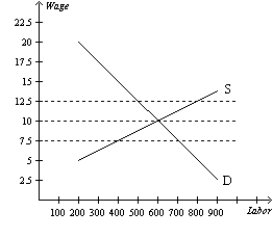 -Refer to Figure 19-2. This figure depicts labor demand and supply in a nonunionized labor market. If the minimum wage were $7.50, employment in this market would be
 (Multiple Choice)
4.7/5 (87)
(87) The signaling theory of education suggests that when people earn a college degree they do not become more productive, but they do signal their high ability to prospective employers.
(True/False)
5.0/5 (94)
(94) Since measurable factors such as years of experience and years of education explain less than half of the variation in wages, ability, effort, and chance must play a significant role in determining wages.
(True/False)
4.7/5 (85)
(85) Other things equal, one would predict that market wages would be relatively high when
(Multiple Choice)
4.7/5 (81)
(81) Some discriminatory hiring practices can be expected, even if markets are competitive, as a result of
(Multiple Choice)
4.9/5 (82)
(82) Paul and David work for the same company and have the same job title, education, work experience, and are equally skilled at what they do. Paul works the night shift and is paid $60,000 a year, while David works a regular day shift and is paid $55,000 a year. Which of the following is the best explanation for why Paul earns more than David?
(Multiple Choice)
4.8/5 (76)
(76) Philip is an average contractor in town, and he earns $40,000 a year. Billy is the best contractor in town, and he earns $480,000 a year. Philip's contracting services
(Multiple Choice)
4.8/5 (75)
(75) Explain the role that consumers play in perpetuating discrimination in labor markets.
(Essay)
4.8/5 (58)
(58) 
Filters
- Essay(0)
- Multiple Choice(0)
- Short Answer(0)
- True False(0)
- Matching(0)