



 Chat with AI
Exam 19: Earnings and Discrimination

Exam 1: Ten Principles of Economics455 Questions
Exam 2: Thinking Like an Economist645 Questions
Exam 3: Interdependence and the Gains From Trade550 Questions
Exam 4: The Market Forces of Supply and Demand693 Questions
Exam 5: Elasticity and Its Application625 Questions
Exam 6: Supply, Demand, and Government Policies671 Questions
Exam 7: Consumers, Producers, and the Efficiency of Markets547 Questions
Exam 8: Application: The Costs of Taxation507 Questions
Exam 9: Application: International Trade521 Questions
Exam 10: Externalities543 Questions
Exam 11: Public Goods and Common Resources453 Questions
Exam 12: The Design of the Tax System563 Questions
Exam 13: The Costs of Production649 Questions
Exam 14: Firms in Competitive Markets608 Questions
Exam 15: Monopoly662 Questions
Exam 16: Monopolistic Competition649 Questions
Exam 17: Oligopoly522 Questions
Exam 18: The Markets for the Factors of Production592 Questions
Exam 19: Earnings and Discrimination511 Questions
Exam 20: Income Inequality and Poverty478 Questions
Exam 21: The Theory of Consumer Choice568 Questions
Exam 22: Frontiers in Microeconomics461 Questions
Select questions type


Table 19-1 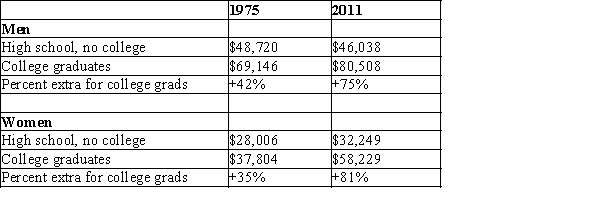 Source: US Census Bureau and Mankiw's calculations
-Refer to Table 19-1. Economists suspect that the increase in the earnings gap between skilled and unskilled workers is likely due to
Source: US Census Bureau and Mankiw's calculations
-Refer to Table 19-1. Economists suspect that the increase in the earnings gap between skilled and unskilled workers is likely due to (Multiple Choice)
4.7/5  (78)
(78) Westland and Oceania have just started to trade with each other. Westland exports goods produced with skilled labor and imports goods made with unskilled labor from Oceania. Over time, we would expect that in Oceania the wages of unskilled workers will
(Multiple Choice)
4.8/5 (63)
(63) According to proponents of the signaling theory of education,
(Multiple Choice)
4.7/5 (91)
(91) All differences in wages that are not accounted for by differences in human-capital investment are likely to be a result of discrimination.
(True/False)
4.9/5 (79)
(79) Other things equal, a particular job will likely pay a higher wage if it involves
(Multiple Choice)
4.8/5 (79)
(79) Bob, the manager and owner of a small company, believes in the theory of efficiency wages. As such, Bob would be most likely to agree with which of the following quotes?
(Multiple Choice)
4.8/5 (70)
(70) George and Susan work at the same brewery. George works in advertising. Susan works as a forewoman in the bottling plant. George is paid more than Susan.
(Multiple Choice)
4.8/5 (75)
(75) Workers whose skills become obsolete as a result of technological change are often paid a lower wage as a result of
(Multiple Choice)
4.8/5 (85)
(85) Why do college graduates earn more in wages than workers with only a high school diploma?
(Short Answer)
4.9/5 (69)
(69) Which of the following statements represents the idea behind signaling in education?
(Multiple Choice)
4.9/5 (73)
(73) Which of the following is not an example of capital used in production?
(Multiple Choice)
4.8/5 (87)
(87) Scenario 19-3
In the small town of Hamilton, Montana, there is a local hardware store called Eddy's Hardware. There are only two types of workers who apply for jobs at Eddy's Hardware: cowboys and farm boys. Local politicians have received numerous complaints that Eddy's Hardware is practicing wage discrimination against farm boys. Eddy's Hardware denies the complaint and says the store is only trying to maximize profit.
-Refer to Scenario 19-3. Which of the following statements would strengthen the discrimination complaint against Eddy's Hardware?
(Multiple Choice)
4.9/5 (71)
(71) Some economists argue that changes in U.S. trade flows have altered the gap between wages of skilled and unskilled workers. Explain.
(Essay)
4.7/5 (93)
(93) Which of the following statements is true of wages, educational attainment, and gender?
(Multiple Choice)
4.8/5 (67)
(67) Which of the following does not describe the hypothesis that changes in technology have altered the relative demand for skilled and unskilled labor?
(Multiple Choice)
4.7/5 (77)
(77) Figure 19-6 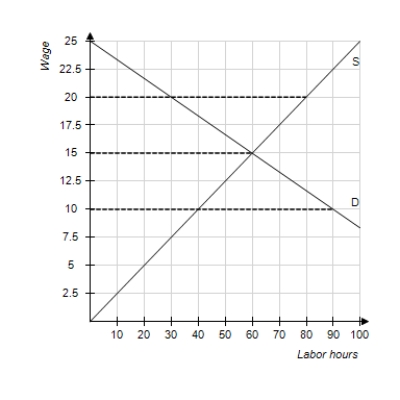 -Refer to Figure 19-6. This figure depicts labor demand and supply for the widget industry. The equilibrium market wage is $15. If a labor union forms within the widget industry and subsequently negotiates an hourly wage of $20.00, how many hours of labor will be demanded by the widget industry?
 (Multiple Choice)
4.8/5 (79)
(79) 
Filters
- Essay(0)
- Multiple Choice(0)
- Short Answer(0)
- True False(0)
- Matching(0)