



 Chat with AI
Exam 22: Frontiers in Microeconomics

Exam 1: Ten Principles of Economics455 Questions
Exam 2: Thinking Like an Economist645 Questions
Exam 3: Interdependence and the Gains From Trade550 Questions
Exam 4: The Market Forces of Supply and Demand693 Questions
Exam 5: Elasticity and Its Application625 Questions
Exam 6: Supply, Demand, and Government Policies671 Questions
Exam 7: Consumers, Producers, and the Efficiency of Markets547 Questions
Exam 8: Application: The Costs of Taxation507 Questions
Exam 9: Application: International Trade521 Questions
Exam 10: Externalities543 Questions
Exam 11: Public Goods and Common Resources453 Questions
Exam 12: The Design of the Tax System563 Questions
Exam 13: The Costs of Production649 Questions
Exam 14: Firms in Competitive Markets608 Questions
Exam 15: Monopoly662 Questions
Exam 16: Monopolistic Competition649 Questions
Exam 17: Oligopoly522 Questions
Exam 18: The Markets for the Factors of Production592 Questions
Exam 19: Earnings and Discrimination511 Questions
Exam 20: Income Inequality and Poverty478 Questions
Exam 21: The Theory of Consumer Choice568 Questions
Exam 22: Frontiers in Microeconomics461 Questions
Select questions type


Suppose that an economics professor selects two students, Audrey and Michael, to participate in a classroom experiment. The professor gives Audrey twenty $1 bills. Audrey must pick an allocation of the twenty $1 bills to offer to Michael. If Michael accepts the allocation, each student keeps his or her portion of the money. If Michael rejects the allocation, the professor keeps the $20, and each student receives nothing. Audrey selects $19 for herself and $1 for Michael. Based on the studies of human decision making, which of the following statements is correct?
(Multiple Choice)
4.8/5  (82)
(82) When asymmetric information affects a relationship between two parties, it is always the case that
(Multiple Choice)
4.8/5 (86)
(86) Economic experiments show that people care more about winning a game than about its intrinsic fairness.
(True/False)
4.9/5 (79)
(79) Which of the following is an attempt to reduce the problem of asymmetric information?
(Multiple Choice)
4.9/5 (96)
(96) Narrative 22-1
Katie owns a boutique that sells high-end women's clothing and accessories. Shana works part-time at the boutique and frequently is the only employee in this small store. Katie pays Shana a wage that is higher than the market wage for this type of job. When the store is not full of customers, Shana diligently works on displays and cleans to keep the store looking its best. Magda is a customer in the store who asks Shana's opinion on the quality of some jeans she is considering purchasing. Even though she's had several other customers return them due to flaws, Shana tells Magda the quality is great. Belinda is another customer who is returning a necklace without revealing that she lost a gem from it while wearing it.
-Refer to Narrative 22-1. Which of the ladies is the victim of an adverse selection problem?
(Multiple Choice)
4.9/5 (65)
(65) Table 22-15
Diane, Henry, and Linda are voting for who to promote. They can only promote one candidate. Their preferences are given in the table below.  -Refer to Table 22-15. Which of the following statements is correct regarding the Condorcet paradox and the results of pairwise voting by Henry, Diane, and Linda?
 (Multiple Choice)
4.9/5 (79)
(79) Budweiser typically purchases several 30 second advertising spots during the Super Bowl at a very high cost. Miller Brewing Co. typically does not advertise during the Super Bowl. Which of the following is correct?
(Multiple Choice)
4.8/5 (85)
(85) A survey of 1,500 frequent restaurant patrons revealed that, Chang Cheng, a local Chinese restaurant, offers high-quality food at low prices. Based on one dining experience, a restaurant critic gave Chang Cheng a poor review, saying the food was not very good. As a result, you decide not to dine at Chang Cheng. This decision is an example of which of the following systematic mistakes that people make when making decisions?
(Multiple Choice)
4.7/5 (79)
(79) Valerie prefers A to B and she prefers B to C. If Valerie's preferences are transitive, then she prefers A to C.
(True/False)
4.9/5 (79)
(79) Table 22-1
Three friends -- Linda, Stephanie, and Jamie -- are deciding where to go together for vacation. They all agree that they should go to one of three places: France, Greece, or Italy. They also agree that they will have two pairwise votes to determine where to go on vacation, with the majority determining the outcome on each vote. The first, second, and third choices for each person are as indicated in the table below.  -Refer to Table 22-1. If the first vote pits France against Italy and the second vote pits Greece against the winner of the first vote, then the outcome is as follows:
 (Multiple Choice)
5.0/5 (76)
(76) Table 22-10
The town of Franklin is facing a severe budget shortage. The town administrator has proposed four options to balance the budget: increase property taxes (taxes), cut the school arts budget (arts), turn off half of the streetlights in the town (streetlights), reduce police patrols (police). Exactly one of the four choices will prevail, and the choice will be made by way of pairwise voting, with the majority determining the outcome on each vote. The preferences of the voters are summarized in the table below. 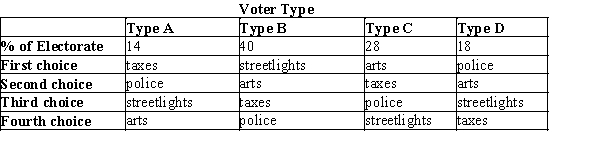 -Refer to Table 22-10. If the town administrator asks voters to choose first between reducing police patrols and increasing taxes, and then between the winner of the first vote and cutting the school arts budget, and then between the winner of the second vote and turning off half of the streetlights, which choice will win the final vote?
 (Multiple Choice)
4.8/5 (71)
(71) Studies of human decision-making have found that people do not give enough weight to a small number of vivid observations.
(True/False)
4.9/5 (80)
(80) Table 22-14
Amy, Beth, and Connie are on a hiring committee. They have interviewed 3 candidates identified by their last names and are going to vote on which one is hired.  '
-Refer to Table 22-14. What would the results of a Borda Count vote be?
'
-Refer to Table 22-14. What would the results of a Borda Count vote be? (Multiple Choice)
4.8/5 (88)
(88) One way that employers respond to the moral-hazard problem is by monitoring their employees.
(True/False)
4.9/5 (81)
(81) Political leaders are always aiming for an optimal combination of efficiency and equality.
(True/False)
4.9/5 (84)
(84) The failure of majority rule to produce transitive preferences for society is called the
(Short Answer)
4.9/5 (85)
(85) Table 22-9 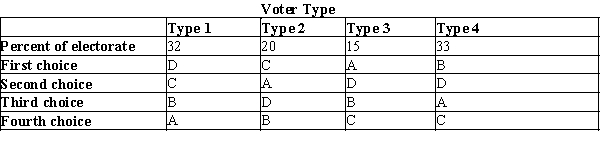 -Refer to Table 22-9. The table shows the preferences of four types of voters over four possible outcomes: A, B, C, D. In addition, the table shows the percentage of voters of each type. Given pairwise voting in which voters choose first between A and B, then between the winner of the first vote and C, and finally between the winner of the second vote and D, which outcome would win?
 (Multiple Choice)
4.8/5 (82)
(82) Scenario 22-6
Shana owns a boutique that sells high-end women's clothing and accessories. Katie works part-time at the boutique and frequently is the only employee in this small store. Shana pays Katie a wage that is higher than the market wage for this type of job. When the store is not full of customers, Katie diligently works on displays and cleans to keep the store looking its best. Belinda is a customer in the store who asks Katie's opinion on the quality of some jeans she is considering purchasing. Katie tells her the quality is great even though she's had several other customers return them due to flaws. Magda is another customer who is returning a necklace without volunteering that a gem is missing.
-Refer to Scenario 22-6. Suppose Shana is tired of all of the problems with the brand of jeans she carries and decides to carry a different, higher quality brand instead. She is concerned that her customers will not trust the quality of the new brand so she offers a 60 day money-back guarantee. The action taken by Shana is called
(Short Answer)
4.9/5 (83)
(83) 
Filters
- Essay(0)
- Multiple Choice(0)
- Short Answer(0)
- True False(0)
- Matching(0)