



 Chat with AI
Exam 22: Frontiers in Microeconomics

Exam 1: Ten Principles of Economics455 Questions
Exam 2: Thinking Like an Economist645 Questions
Exam 3: Interdependence and the Gains From Trade550 Questions
Exam 4: The Market Forces of Supply and Demand693 Questions
Exam 5: Elasticity and Its Application625 Questions
Exam 6: Supply, Demand, and Government Policies671 Questions
Exam 7: Consumers, Producers, and the Efficiency of Markets547 Questions
Exam 8: Application: The Costs of Taxation507 Questions
Exam 9: Application: International Trade521 Questions
Exam 10: Externalities543 Questions
Exam 11: Public Goods and Common Resources453 Questions
Exam 12: The Design of the Tax System563 Questions
Exam 13: The Costs of Production649 Questions
Exam 14: Firms in Competitive Markets608 Questions
Exam 15: Monopoly662 Questions
Exam 16: Monopolistic Competition649 Questions
Exam 17: Oligopoly522 Questions
Exam 18: The Markets for the Factors of Production592 Questions
Exam 19: Earnings and Discrimination511 Questions
Exam 20: Income Inequality and Poverty478 Questions
Exam 21: The Theory of Consumer Choice568 Questions
Exam 22: Frontiers in Microeconomics461 Questions
Select questions type


Peter was recently hired as a salesman for a national consulting firm. His job involves spending a significant portion of his time out of the office visiting prospects and attending conferences. His firm is paying him a wage that is higher than the equilibrium wage, but he receives much of his income in quarterly bonuses based on how much he sells.
(Multiple Choice)
4.9/5  (83)
(83) Table 22-2
Three longtime friends-Allen, Brian, and Cody-are deciding how they will spend their Sunday afternoon. They all agree that they should do one of three things: go to a movie, play golf, or go to a baseball game. They also agree that they will have two pairwise votes to determine how to spend their afternoon, with the majority determining the outcome on each vote. The first, second, and third choices for each person are as indicated in the table below.  -Refer to Table 22-2. Which of the following statements is correct?
 (Multiple Choice)
4.8/5 (65)
(65) Harold has always driven cars made by Universal Motors. The last two Universal Motors cars that Harold purchased have had major engine problems resulting in Harold incurring significant cost. Consumer Reports has consistently given Universal Motors poor ratings. Still, Harold plans to purchase another Universal Motors car next fall. Harold's behavior is an example of which systematic mistake that people make?
(Essay)
4.8/5 (63)
(63) Scenario 22-1
Esteban and Michaela own an apartment building. They hire Nico to manage the building and deal with tenants' complaints. They also hire Ted to make any necessary repairs to the apartments or the common area and they hire Rex to be the door guard at night.
-Refer to Scenario 22-1. Which of the following statements is correct?
(Multiple Choice)
5.0/5 (73)
(73) Herbert Simon, one of the first social scientists to combine the study of economics and psychology, suggested that humans should be viewed as
(Multiple Choice)
4.8/5 (70)
(70) According to behavioral economics, participants in a half-marathon are likely to have trained
(Multiple Choice)
4.7/5 (80)
(80) Scenario 22-6
Shana owns a boutique that sells high-end women's clothing and accessories. Katie works part-time at the boutique and frequently is the only employee in this small store. Shana pays Katie a wage that is higher than the market wage for this type of job. When the store is not full of customers, Katie diligently works on displays and cleans to keep the store looking its best. Belinda is a customer in the store who asks Katie's opinion on the quality of some jeans she is considering purchasing. Katie tells her the quality is great even though she's had several other customers return them due to flaws. Magda is another customer who is returning a necklace without volunteering that a gem is missing.
-Refer to Scenario 22-6. What is the term for the type of wage Shana pays Katie?
(Short Answer)
4.9/5 (77)
(77) A street vendor sells a replica of a pair of designer shoes to a young woman who believes the shoes are authentic. The street vendor is engaging in
(Multiple Choice)
4.9/5 (84)
(84) According to behavioral economics, if people taking an exam were asked to guess the score they would receive, it would be most likely that
(Multiple Choice)
4.8/5 (82)
(82) Explain the Condorcet paradox. To which type of voting system does it apply?
(Essay)
4.9/5 (83)
(83) Which of the following practices are, at least in part, attempts to reduce moral hazard problems?
(Multiple Choice)
4.9/5 (74)
(74) Table 22-21
The following table shows the number of voters preferring various amounts of spending to develop a river to make it more attractive for canoeing and kayaking. 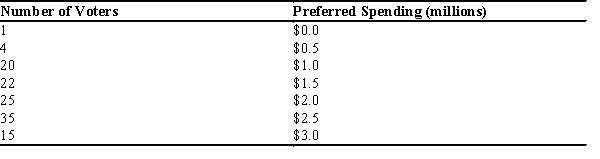 -Refer to Table 22-21. Suppose on election day that the voters with a preference for less than $1.5 million do not show up to vote on a choice to spend either $2 million or $2.5 million. In this case, what is the preferred spending amount of the median voter (among those who actually cast a vote)?
 (Multiple Choice)
4.9/5 (90)
(90) Lindsay and Tim are playing the ultimatum game starting with $100. Based on the coin toss, Lindsay is the player to propose a division of the $100. If Lindsay acts as economic theory assumes, she should propose that
(Short Answer)
4.8/5 (75)
(75) Table 22-7
Suppose that residents of a town are asked to vote on the best way to improve the safety of an intersection. The three choices are: a stoplight, a 4-way stop, and a 2-way stop. The voters are divided into three groups based on their preferences.
Voter Type  -Refer to Table 22-7. Based on the information in the table, which of the following statements is true?
 (Multiple Choice)
4.9/5 (85)
(85) Advocates of a tax on soda and other sugary drinks argue that such a tax
(Multiple Choice)
4.9/5 (64)
(64) Bob is planning to sell his home. In preparation for the sale, he paints all of the ceilings in his house to cover up water stains from his leaking roof so that potential buyers will be unaware of this problem. This is an example of
(Multiple Choice)
4.8/5 (81)
(81) Bill and Bev are playing the ultimatum game, starting with $50. A coin flip results in Bev being the one to propose a division of the $50. If Bev acts as economic theory assumes, she should propose that
(Multiple Choice)
4.8/5 (79)
(79) The field of behavioral economics applies the methods of economics to study how government works.
(True/False)
4.8/5 (87)
(87) The Condorcet voting paradox shows that outcomes based on dictatorial preferences do not always obey the property of transitivity.
(True/False)
4.9/5 (78)
(78) Economic theory assumes people are always rational. Yet observation indicates that people do not always behave rationally. Which of the following is not a systematic mistake people make in their decisionmaking?
(Multiple Choice)
4.8/5 (81)
(81) 
Filters
- Essay(0)
- Multiple Choice(0)
- Short Answer(0)
- True False(0)
- Matching(0)