



 Chat with AI
Exam 22: Frontiers in Microeconomics

Exam 1: Ten Principles of Economics455 Questions
Exam 2: Thinking Like an Economist645 Questions
Exam 3: Interdependence and the Gains From Trade550 Questions
Exam 4: The Market Forces of Supply and Demand693 Questions
Exam 5: Elasticity and Its Application625 Questions
Exam 6: Supply, Demand, and Government Policies671 Questions
Exam 7: Consumers, Producers, and the Efficiency of Markets547 Questions
Exam 8: Application: The Costs of Taxation507 Questions
Exam 9: Application: International Trade521 Questions
Exam 10: Externalities543 Questions
Exam 11: Public Goods and Common Resources453 Questions
Exam 12: The Design of the Tax System563 Questions
Exam 13: The Costs of Production649 Questions
Exam 14: Firms in Competitive Markets608 Questions
Exam 15: Monopoly662 Questions
Exam 16: Monopolistic Competition649 Questions
Exam 17: Oligopoly522 Questions
Exam 18: The Markets for the Factors of Production592 Questions
Exam 19: Earnings and Discrimination511 Questions
Exam 20: Income Inequality and Poverty478 Questions
Exam 21: The Theory of Consumer Choice568 Questions
Exam 22: Frontiers in Microeconomics461 Questions
Select questions type


Scenario 22-3
At issue in a particular city vote is how much to spend, per person, on road repair next year. Among the 10,000 voters, 2,900 prefer to spend $500 per person, but no more; 2,200 prefer to spend $600 per person, but no more; 1,900 prefer to spend $800 per person, but no more; 1,600 prefer to spend $1,200 but no more, and 1,400 prefer to spend $1,400 per person, but no more.
-Refer to Scenario 22-3. If there is a vote on whether to spend $600 per person or $800 per person, the median voter will vote to spend
(Multiple Choice)
4.9/5  (78)
(78) Table 22-23
The town of Franklin is facing a severe budget shortage. The town administrator has proposed four options to balance the budget: increase property taxes (taxes), cut the school arts budget (arts), turn off half of the streetlights in the town (streetlights), reduce police patrols (police). Exactly one of the four choices will prevail, and the choice will be made by way of pairwise voting, with the majority determining the outcome on each vote. The preferences of the voters are summarized in the table below. 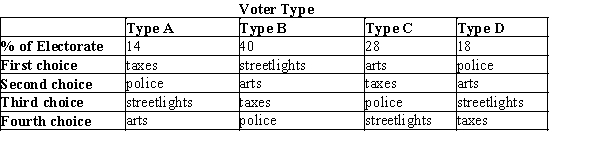 -Refer to Table 22-23. If a Borda count is used, which option will win?
 (Short Answer)
4.9/5 (86)
(86) Evidence from experiments in which real people play the ultimatum game supports the idea that people care about fairness as well as about maximization of their personal wealth.
(True/False)
4.8/5 (69)
(69) What is the name of the mathematical result showing that no voting system can simultaneously satisfy the properties of unanimity, transitivity, independence of irrelevant alternatives, and no dictators?
(Multiple Choice)
4.9/5 (93)
(93) Martha routinely has her prescriptions filled at her local SVC pharmacy. Each time that Martha goes to pick up a prescription, there is some problem and Martha has to return to the pharmacy later to get the prescription. Martha finds these return trips very annoying and time-consuming, but continues to request that her doctor send her prescriptions to this pharmacy even though there are several other options in her town. Which of the following is correct?
(Multiple Choice)
4.8/5 (62)
(62) The buyer runs a risk of being sold a good of low quality when there is
(Multiple Choice)
4.8/5 (83)
(83) Studies of human decision making reveal several systematic mistakes people make. Which of the following is not an example of one of these mistakes?
(Multiple Choice)
4.8/5 (78)
(78) The classic example of adverse selection is the market for used cars.
(True/False)
4.9/5 (78)
(78) The field of economics in which the tools of economics are used to understand the functioning of government is
(Short Answer)
4.8/5 (89)
(89) Students of microeconomic principles often say they are going to study "tonight," because the only way to pass the exam is to study some every night. When "tonight" comes, some students choose to do something else. Come exam day, these students do not do well on their exam. This observation is an example of how people
(Multiple Choice)
4.7/5 (74)
(74) Table 22-13
A high school Spanish class and their teacher are planning to take a Spring Break trip abroad but they have to decide where to go. They have narrowed the options to: Spain, Mexico, Ecuador, and Costa Rica. The voters' preferences are shown in the table below. 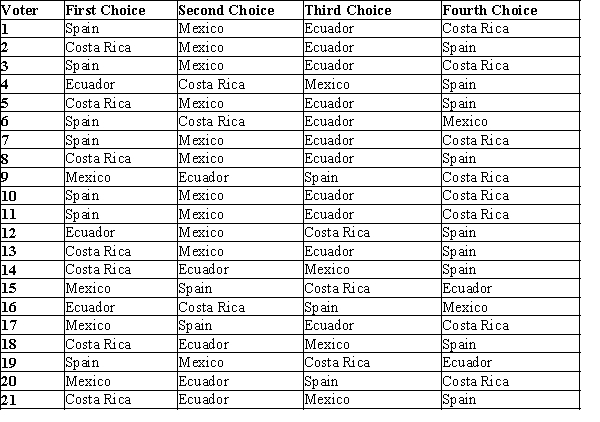 -Refer to Table 22-13. In a pairwise election between Mexico and Ecuador and then a second election between the winner and Costa Rica, which countries are chosen?
 (Multiple Choice)
5.0/5 (70)
(70) According to behavioral economics, an employee will likely
(Multiple Choice)
4.9/5 (80)
(80) The median voter theorem states that majority-rule political systems will produce policies that are most preferable for the median voter.
(True/False)
4.8/5 (83)
(83) Insurance companies charge annual premiums to collect revenue, which they then use to pay customers who file claims for damages they incur. As a result of the moral hazard problem (1) what is the effect on the percentage of policy holders making claims, and (2) what is the effect on the average premium charged when compared to a world with no moral hazard problem?
(Multiple Choice)
4.9/5 (75)
(75) The moral-hazard problem and the desire of firms to lessen that problem serve as a plausible explanation for a firm paying above-equilibrium wages to its workers.
(True/False)
4.9/5 (71)
(71) Table 22-22
The town of Fairview is considering a renovation to the high school. The voters in Fairview have different preferences on the budget for the renovation as displayed below. 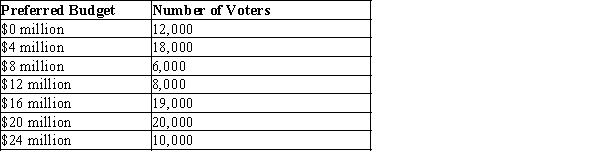 -Refer to Table 22-22. If there is a vote between a budget of $16 million and $20 million and voter vote for the budget nearest their preferred budget, then the median voter will vote to spend
 (Multiple Choice)
4.8/5 (85)
(85) The Condorcet voting paradox demonstrates that democratic outcomes do not always obey the property of
(Multiple Choice)
4.7/5 (83)
(83) Table 22-3
Three family members -- Seamus, Maeve, and Siobhan -- are deciding what type of movie to attend. The three choices are an action adventure, comedy, or horror. The first, second, and third choices for each person are as indicated in the table below.  -Refer to Table 22-3. Suppose the three decide to make the decision based on pairwise majority voting. If they first choose between Action and Horror and then choose between the winner of the first vote and Comedy, which movie alternative will win?
 (Multiple Choice)
5.0/5 (76)
(76) Economic theory assumes that voters, politicians, and other political participants are largely motivated by
(Multiple Choice)
4.8/5 (74)
(74) Table 22-17 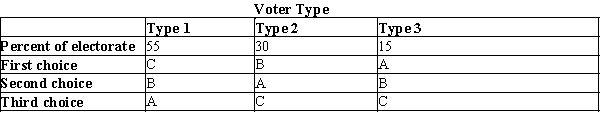 -Refer to Table 22-17. The table shows the preferences of three types of voters over three possible outcomes: A, B, and C. The table also shows the percentage of voters of each type. Based on this information, which voter type is the median voter?
 (Multiple Choice)
4.8/5 (70)
(70) 
Filters
- Essay(0)
- Multiple Choice(0)
- Short Answer(0)
- True False(0)
- Matching(0)