



 Chat with AI
Exam 22: Frontiers in Microeconomics

Exam 1: Ten Principles of Economics455 Questions
Exam 2: Thinking Like an Economist645 Questions
Exam 3: Interdependence and the Gains From Trade550 Questions
Exam 4: The Market Forces of Supply and Demand693 Questions
Exam 5: Elasticity and Its Application625 Questions
Exam 6: Supply, Demand, and Government Policies671 Questions
Exam 7: Consumers, Producers, and the Efficiency of Markets547 Questions
Exam 8: Application: The Costs of Taxation507 Questions
Exam 9: Application: International Trade521 Questions
Exam 10: Externalities543 Questions
Exam 11: Public Goods and Common Resources453 Questions
Exam 12: The Design of the Tax System563 Questions
Exam 13: The Costs of Production649 Questions
Exam 14: Firms in Competitive Markets608 Questions
Exam 15: Monopoly662 Questions
Exam 16: Monopolistic Competition649 Questions
Exam 17: Oligopoly522 Questions
Exam 18: The Markets for the Factors of Production592 Questions
Exam 19: Earnings and Discrimination511 Questions
Exam 20: Income Inequality and Poverty478 Questions
Exam 21: The Theory of Consumer Choice568 Questions
Exam 22: Frontiers in Microeconomics461 Questions
Select questions type


Arrow's impossibility theorem is "disturbing" in the sense that it proves that
(Multiple Choice)
4.8/5  (78)
(78) The Condorcet paradox shows that there is no scheme for aggregating individual preferences into a valid set of social preferences.
(True/False)
4.8/5 (88)
(88) Which of the following is not an example of a principal trying to solve the moral-hazard problem? The principal
(Multiple Choice)
4.8/5 (89)
(89) If individuals behave irrationally in some circumstances, why do economists typically assume that they behave rationally?
(Multiple Choice)
4.9/5 (81)
(81) An example of asymmetric information is when a seller of a house knows more than the buyer about the house's condition.
(True/False)
4.9/5 (90)
(90) Which of the following is an example of informational asymmetry?
(Multiple Choice)
4.9/5 (88)
(88) An implication of the median voter theorem is that, in a race between Republicans and Democrats,
(Multiple Choice)
4.7/5 (89)
(89) On car insurance policies, Countrywide Insurance Company offers drivers an option: Policy 1 features a deductible of $1,000, and it requires a driver to pay an annual premium of $500. Policy 2 features a deductible of $250, and it requires a driver to pay an annual premium of $1,000.
(Multiple Choice)
4.8/5 (77)
(77) Table 22-9 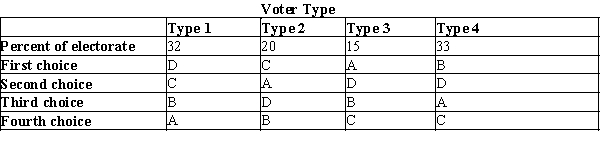 -Refer to Table 22-9. The table shows the preferences of four types of voters over four possible outcomes: A, B, C, D. In addition, the table shows the percentage of voters of each type. Based on this information, which of the following statements is false?
 (Multiple Choice)
4.9/5 (79)
(79) The two major problems caused by asymmetric information are the moral-hazard problem and the principal-agent problem.
(True/False)
4.8/5 (85)
(85) Which of the following relationships involves asymmetric information?
(Multiple Choice)
4.9/5 (74)
(74) A person's tendency to smoke a cigarette after promising himself that he will quit is an example of the behavioral economics insight that people are inconsistent over time
(True/False)
4.9/5 (82)
(82) Economist Kenneth Arrow wrote a famous book in 1951 in which he took up the question,
(Multiple Choice)
4.8/5 (62)
(62) Table 22-11
Five voters must choose from among four options: A, B, C, or D. Each voter's preferences are summarized in the table below. Options higher in the table are more preferred by the voter.  -Refer to Table 22-11. If the vote were conducted according to a modified Borda count system where each person's first choice receives 10 points, second choice 5 points, third choice 3 points and fourth choice 1 point, the result would be that
 (Multiple Choice)
4.7/5 (88)
(88) Table 22-23
The town of Franklin is facing a severe budget shortage. The town administrator has proposed four options to balance the budget: increase property taxes (taxes), cut the school arts budget (arts), turn off half of the streetlights in the town (streetlights), reduce police patrols (police). Exactly one of the four choices will prevail, and the choice will be made by way of pairwise voting, with the majority determining the outcome on each vote. The preferences of the voters are summarized in the table below. 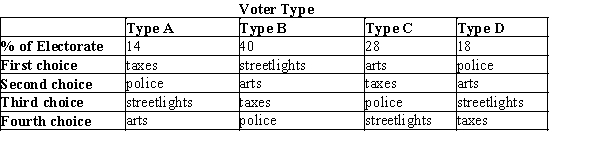 -Refer to Table 22-23. If the town administrator asks the people to first choose between cutting the arts program and turning off half of the streetlights, and then choose between the winner of the first election and reducing police patrols, and then choose between the winner of the second election and increasing taxes, which option will win each vote?
 (Short Answer)
4.7/5 (60)
(60) When a jeweler sells a low quality diamond to a young man who believes the diamond is the highest quality, she is engaging in
(Multiple Choice)
4.9/5 (84)
(84) Which of the following sets of preferences can not satisfy the property of transitivity?
(Multiple Choice)
4.9/5 (104)
(104) The majority of Americans, when asked how many states they could name, think they could name all fifty. However, when they are asked to do so, very few are able to come up with all fifty. This is an example of which systematic mistake that people make?
(Short Answer)
4.9/5 (72)
(72) Table 22-16
The Johnson family is planning a vacation and, though Mr. and Mrs. Johnson will be paying for the trip, they have decided to use a democratic voting process to choose their destination. The family members' preferences are reflected in the table below. 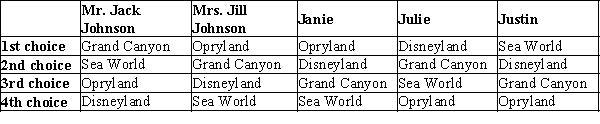 -Refer to Table 22-16. If the family uses a Borda count to make their decision, what is their vacation destination?
 (Multiple Choice)
4.7/5 (90)
(90) 
Filters
- Essay(0)
- Multiple Choice(0)
- Short Answer(0)
- True False(0)
- Matching(0)