



 Chat with AI
Exam 22: Frontiers in Microeconomics

Exam 1: Ten Principles of Economics455 Questions
Exam 2: Thinking Like an Economist645 Questions
Exam 3: Interdependence and the Gains From Trade550 Questions
Exam 4: The Market Forces of Supply and Demand693 Questions
Exam 5: Elasticity and Its Application625 Questions
Exam 6: Supply, Demand, and Government Policies671 Questions
Exam 7: Consumers, Producers, and the Efficiency of Markets547 Questions
Exam 8: Application: The Costs of Taxation507 Questions
Exam 9: Application: International Trade521 Questions
Exam 10: Externalities543 Questions
Exam 11: Public Goods and Common Resources453 Questions
Exam 12: The Design of the Tax System563 Questions
Exam 13: The Costs of Production649 Questions
Exam 14: Firms in Competitive Markets608 Questions
Exam 15: Monopoly662 Questions
Exam 16: Monopolistic Competition649 Questions
Exam 17: Oligopoly522 Questions
Exam 18: The Markets for the Factors of Production592 Questions
Exam 19: Earnings and Discrimination511 Questions
Exam 20: Income Inequality and Poverty478 Questions
Exam 21: The Theory of Consumer Choice568 Questions
Exam 22: Frontiers in Microeconomics461 Questions
Select questions type


Table 22-9 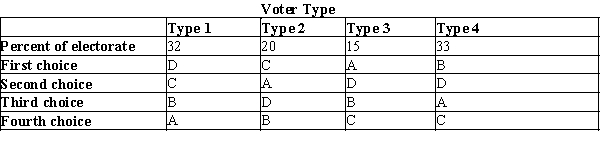 -Refer to Table 22-9. The table shows the preferences of four types of voters over four possible outcomes: A, B, C, and D. In addition, the table shows the percentage of voters of each type. Suppose a Borda count election is held in which each voter ranks the four outcomes, giving 1 point to last place, 2 points to second to last, 3 points to the second best, and 4 points to the best. In this case, which outcome would win?
 (Multiple Choice)
4.9/5  (96)
(96) Which of the following is not an example of asymmetric information?
(Multiple Choice)
4.9/5 (72)
(72) People interpret evidence to confirm beliefs they already hold. This statement is an example of which of the following systematic mistakes that people make?
(Multiple Choice)
4.7/5 (73)
(73) Table 22-25
Sophie, Huan, and Santiago are lost with no map or GPS available. They come to an intersection at which they can turn left, turn right, or continue going straight. Their preferences are summarized in the table.  -Refer to Table 22-25. The travelers decide to conduct pairwise voting with the majority determining the outcome of each vote to decide their next move. If they first choose between going left and going straight, and then choose between the winner of the first vote and going right, which direction will they go?
 (Short Answer)
4.7/5 (81)
(81) Riley travels a great deal, and over the past several years he has read dozens of reviews of hotel chains, all of which rave about the clean rooms and great service at Comeon Inns. Last month, Riley checked into a room at a Comeon Inn for the first time, only to find the room filthy and the service lousy. He decided the Comeon Inn chain is inferior to other hotel chains.
(Multiple Choice)
5.0/5 (81)
(81) Based on studies of human decision making, many people care more about the fairness of a game than about their personal winnings.
(True/False)
4.8/5 (83)
(83) Based on the studies of human decision making, which of the following statements is correct?
(Multiple Choice)
4.9/5 (73)
(73) Which of the following is not an example of an adverse selection problem?
(Multiple Choice)
5.0/5 (77)
(77) Table 22-7
Suppose that residents of a town are asked to vote on the best way to improve the safety of an intersection. The three choices are: a stoplight, a 4-way stop, and a 2-way stop. The voters are divided into three groups based on their preferences.
Voter Type  -Refer to Table 22-7. If the vote were conducted according to a Borda count system where each person's first choice receives 3 points, second choice 2 points, and third choice 1 point, the result would be
 (Multiple Choice)
4.9/5 (72)
(72) Table 22-24
The citizens of Mayville are having a severe budget shortage and are faced with eliminating athletics from the town high school. The town administrator has determined that the town can afford to maintain one sport. Exactly one of the three choices will prevail, and the choice will be made by way of pairwise voting, with the majority determining the outcome on each vote. The preferences of the voters are summarized in the table below. 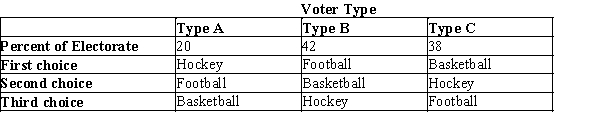 -Refer to Table 22-24. If the town administrator asks voters to choose first between basketball and football and then between the winner of the first vote and hockey, which sport will win the final vote?
 (Short Answer)
4.9/5 (89)
(89) Arrow's impossibility theorem shows that no voting system can satisfy which of the following properties?
(Multiple Choice)
4.9/5 (83)
(83) In the field of study called political economy, economists make use of insights from the field of psychology.
(True/False)
4.8/5 (82)
(82) The problem that results from an agent, who is imperfectly monitored by the principal, engaging in dishonest or otherwise undesirable behavior is called
(Short Answer)
5.0/5 (78)
(78) Assume there are nine voters in a certain small town and let x = the preferred number of dollars spent per person per month on garbage collection. For Voters 1, 2 3, and 4, x = $10; for Voter 5, x = $15; for Voter , x = $18; and for Voters 6, 7, 8 and 9, x = $20. The median voter is
(Multiple Choice)
4.9/5 (80)
(80) When an individual purchases health insurance and knows more about her family medical history than the insurance company, this is an example of adverse selection.
(True/False)
4.8/5 (76)
(76) Table 22-24
The citizens of Mayville are having a severe budget shortage and are faced with eliminating athletics from the town high school. The town administrator has determined that the town can afford to maintain one sport. Exactly one of the three choices will prevail, and the choice will be made by way of pairwise voting, with the majority determining the outcome on each vote. The preferences of the voters are summarized in the table below.
-Refer to Table 22-24. If the town administrator asks voters to choose first between hockey and basketball and then between the winner of the first vote and football, which sport will win the final vote?
-Refer to Table 22-24. If the town administrator asks voters to choose first between hockey and basketball and then between the winner of the first vote and football, which sport will win the final vote? (Short Answer)
4.9/5 (74)
(74) Assume there are nine voters in a certain small town and let x = the preferred number of dollars spent per person per month on garbage collection. For Voters 1, 2, and 3, x = $10; for Voter 4, x = $15; for Voter 5, x = $18; and for Voters 6, 7, 8 and 9, x = $20. Based on these preferences, which of these dollar amounts will win over any one of the others?
(Multiple Choice)
4.9/5 (95)
(95) Which of the following offers an explanation as to why the principal-agent problem exists for a firm?
(Multiple Choice)
4.7/5 (81)
(81) Table 22-15
Diane, Henry, and Linda are voting for who to promote. They can only promote one candidate. Their preferences are given in the table below.  -Refer to Table 22-15. If elections were held where voters choose either Fred or Beth, and then choose either the winner or Mary, what would the results be?
 (Multiple Choice)
4.8/5 (96)
(96) 
Filters
- Essay(0)
- Multiple Choice(0)
- Short Answer(0)
- True False(0)
- Matching(0)