



 Chat with AI
Exam 22: Frontiers in Microeconomics

Exam 1: Ten Principles of Economics455 Questions
Exam 2: Thinking Like an Economist645 Questions
Exam 3: Interdependence and the Gains From Trade550 Questions
Exam 4: The Market Forces of Supply and Demand693 Questions
Exam 5: Elasticity and Its Application625 Questions
Exam 6: Supply, Demand, and Government Policies671 Questions
Exam 7: Consumers, Producers, and the Efficiency of Markets547 Questions
Exam 8: Application: The Costs of Taxation507 Questions
Exam 9: Application: International Trade521 Questions
Exam 10: Externalities543 Questions
Exam 11: Public Goods and Common Resources453 Questions
Exam 12: The Design of the Tax System563 Questions
Exam 13: The Costs of Production649 Questions
Exam 14: Firms in Competitive Markets608 Questions
Exam 15: Monopoly662 Questions
Exam 16: Monopolistic Competition649 Questions
Exam 17: Oligopoly522 Questions
Exam 18: The Markets for the Factors of Production592 Questions
Exam 19: Earnings and Discrimination511 Questions
Exam 20: Income Inequality and Poverty478 Questions
Exam 21: The Theory of Consumer Choice568 Questions
Exam 22: Frontiers in Microeconomics461 Questions
Select questions type


Signaling is an action taken by an uninformed party to induce an informed party to reveal information.
(True/False)
4.9/5  (81)
(81) A mother gives her teenage daughter two choices: spend 20 minutes cleaning her room today or spend 25 minutes cleaning her room tomorrow. The same mother gives her same daughter two additional choices: clean out the garage for 20 minutes next Tuesday or 25 minutes next Wednesday. According to economic theory,
(Multiple Choice)
4.8/5 (93)
(93) In his 1951 book Social Choice and Individual Values, Arrow's perfect voting system satisfies all of the following properties except
(Multiple Choice)
4.9/5 (90)
(90) A person who makes decisions that are "merely good enough" is called a(n)
(Multiple Choice)
4.9/5 (67)
(67) Arrow's impossibility theorem states that the majority rule fails to produce transitive preferences for society.
(True/False)
4.8/5 (88)
(88) Table 22-20
The table below shows the preferred city budget (in millions) for
in the city of Springfield. 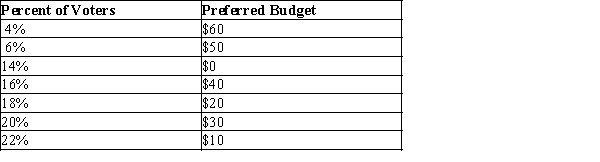 -Refer to Table 22-20. In an election, each voter will select the budget closest to his or her most preferred budget. Using this information, what is the most preferred budget of the median voter?
 (Multiple Choice)
4.8/5 (67)
(67) If A is preferred to B and C is preferred to D, then B must be preferred to C to satisfy transitivity.
(True/False)
4.8/5 (68)
(68) An insurance company that writes automobile policies tries to separate safe drivers from risky drivers by offering policies that feature different deductibles and different premiums. This practice is best described as an example of
(Multiple Choice)
4.8/5 (72)
(72) Suppose the voters in a small country are choosing between two options, A and B. After the voting is complete it is discovered that option A received 100% of the votes with option B receiving no votes. After the vote, however, the country's leader decides that option B is better for the people and implements B rather than A. The voting system in this country fails which of Arrow's properties of a desirable voting system?
(Multiple Choice)
4.9/5 (88)
(88) Table 22-19
The 600 voters of Appleton are deciding by majority rule how much to spend on a new library. 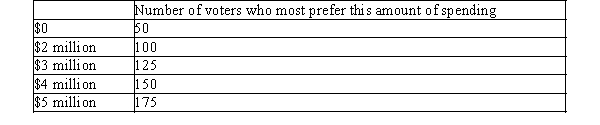 -Refer to Table 22-19. The median voter prefers to spend
 (Multiple Choice)
4.9/5 (68)
(68) Table 22-5
The citizens of Anytown will decide whether to build a new library, a recreation center, or an arena. Exactly one of the three choices will prevail, and the choice will be made by way of pairwise voting, with the majority determining the outcome on each vote. The preferences of the voters are summarized in the table below. 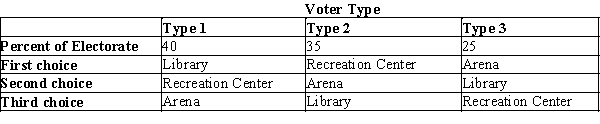 -Refer to Table 22-5. If (1) the first vote pits "library" against "recreation center," and (2) the second vote pits "arena" against the winner of the first vote, then the outcome is as follows:
 (Multiple Choice)
4.8/5 (67)
(67) Which of the following is not an example of a principal-agent relationship?
(Multiple Choice)
4.9/5 (98)
(98) A driver knows more than his auto insurer about how cautiously he drives. This is an example of
(Multiple Choice)
4.8/5 (90)
(90) In economics, a difference in access to relevant knowledge is called a(n)
(Multiple Choice)
4.9/5 (87)
(87) Economists use basic psychological insights in the field of study called
(Multiple Choice)
4.8/5 (78)
(78) Condorcet explained his paradox in a 1951 book called Social Choice and Individual Values.
(True/False)
4.8/5 (86)
(86) Suppose there are 3 possible outcomes to a vote: A, B, and C. If voters prefer A to B, B to C, and C to A, which of the following concepts are violated?
(Multiple Choice)
4.9/5 (76)
(76) 
Filters
- Essay(0)
- Multiple Choice(0)
- Short Answer(0)
- True False(0)
- Matching(0)