



 Chat with AI
Exam 22: Frontiers in Microeconomics

Exam 1: Ten Principles of Economics455 Questions
Exam 2: Thinking Like an Economist645 Questions
Exam 3: Interdependence and the Gains From Trade550 Questions
Exam 4: The Market Forces of Supply and Demand693 Questions
Exam 5: Elasticity and Its Application625 Questions
Exam 6: Supply, Demand, and Government Policies671 Questions
Exam 7: Consumers, Producers, and the Efficiency of Markets547 Questions
Exam 8: Application: The Costs of Taxation507 Questions
Exam 9: Application: International Trade521 Questions
Exam 10: Externalities543 Questions
Exam 11: Public Goods and Common Resources453 Questions
Exam 12: The Design of the Tax System563 Questions
Exam 13: The Costs of Production649 Questions
Exam 14: Firms in Competitive Markets608 Questions
Exam 15: Monopoly662 Questions
Exam 16: Monopolistic Competition649 Questions
Exam 17: Oligopoly522 Questions
Exam 18: The Markets for the Factors of Production592 Questions
Exam 19: Earnings and Discrimination511 Questions
Exam 20: Income Inequality and Poverty478 Questions
Exam 21: The Theory of Consumer Choice568 Questions
Exam 22: Frontiers in Microeconomics461 Questions
Select questions type


Scenario 22-4
Three members of the DiCarlo family, Vinny, Maria, and Franki, are choosing the entree for a large family reunion. Their options are: spaghetti, ravioli, lasagne, and pizza. Vinny prefers spaghetti over lasagne, lasagne over ravioli, and ravioli over pizza. Maria prefers ravioli over spaghetti, spaghetti over pizza, and pizza over lasagne. Frankie prefers pizza over ravioli, ravioli over lasagne, and lasagne over spaghetti.
-Refer to Scenario 22-4. Maria recommends using a vote by majority rule and proposes first choosing between spaghetti and lasagne, then choosing between the winner of the first vote and ravioli, and finally choosing between the winner of the second vote and pizza. If everyone votes according to his or her preferences,
(Multiple Choice)
4.8/5  (76)
(76) One property of Kenneth Arrow's "perfect" voting system is that the ranking between any two outcomes A and B should not depend on whether some third outcome C is also available. Arrow called this property
(Multiple Choice)
4.7/5 (84)
(84) Table 22-15
Diane, Henry, and Linda are voting for who to promote. They can only promote one candidate. Their preferences are given in the table below.  -Refer to Table 22-15. If elections were held where voters choose either Beth or Mary, and then choose either the winner or Fred, what would the results be?
 (Multiple Choice)
4.8/5 (77)
(77) Table 22-18
The following table shows the preferences of four types of voters over four possible alternatives as well as the percentage of the electorate with the given preferences. 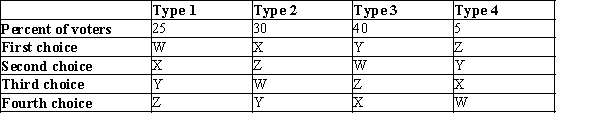 -Refer to Table 22-18. Suppose before any voting takes place that alternative W is eliminated as an option. If the voters first choose between alternatives X and Y in a majority vote, with the winner of that vote going against option Z in a majority vote, which alternative would win?
 (Multiple Choice)
4.8/5 (81)
(81) Scenario 22-4
Three members of the DiCarlo family, Vinny, Maria, and Franki, are choosing the entree for a large family reunion. Their options are: spaghetti, ravioli, lasagne, and pizza. Vinny prefers spaghetti over lasagne, lasagne over ravioli, and ravioli over pizza. Maria prefers ravioli over spaghetti, spaghetti over pizza, and pizza over lasagne. Frankie prefers pizza over ravioli, ravioli over lasagne, and lasagne over spaghetti.
-Refer to Scenario 22-4. If, before any votes were cast, ravioli was eliminated from the choices and the vote were conducted according to a Borda count system where each person's first choice receives 3 points, second choice 2 points, and third choice 1 point, the election winner would be
(Multiple Choice)
5.0/5 (73)
(73) Adverse selection can only occur when there is asymmetric information.
(True/False)
4.8/5 (69)
(69) Assume there are 4065 voters in a certain small town and let x = the preferred number of dollars charged monthly to support local parks. For Voters 1-1050, x = $10; for voters 1051-2121, x= $20, for voters 2122-3334, x = $30; for voters 3335-3998, x = $40; and for 3999-4065, x = $50. Based on these preferences, which of the dollar amounts will win over any of the others?
(Multiple Choice)
4.7/5 (78)
(78) You own an ice cream store and are concerned that an employee may be giving generous scoops to friends and relatives and smaller scoops to some other customers. This may be reducing sales. If you want your employee to stop giving larger scoops to friends and relatives, which of the following is not a good approach?
(Multiple Choice)
4.8/5 (89)
(89) Scenario 22-4
Three members of the DiCarlo family, Vinny, Maria, and Franki, are choosing the entree for a large family reunion. Their options are: spaghetti, ravioli, lasagne, and pizza. Vinny prefers spaghetti over lasagne, lasagne over ravioli, and ravioli over pizza. Maria prefers ravioli over spaghetti, spaghetti over pizza, and pizza over lasagne. Frankie prefers pizza over ravioli, ravioli over lasagne, and lasagne over spaghetti.
-Refer to Scenario 22-4. If the vote were conducted according to a Borda count system where each person's first choice receives 4 points, second choice 3 points, third choice 2 points, and fourth choice 1 point, the election winner would be
(Multiple Choice)
4.8/5 (88)
(88) Which of the following practices would indicate that an employer is trying to overcome a moral-hazard problem with his employees?
(Multiple Choice)
4.9/5 (79)
(79) Table 22-8
The citizens of Mayville are having a severe budget shortage and are faced with eliminating athletics from the town high school. The town administrator has determined that the town can afford to maintain one sport. Exactly one of the three choices will prevail, and the choice will be made by way of pairwise voting, with the majority determining the outcome on each vote. The preferences of the voters are summarized in the table below. 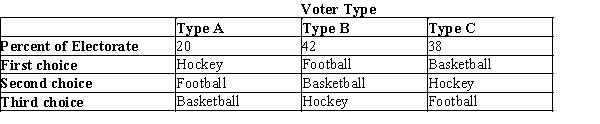 -Refer to Table 22-8. The town administrator is a huge basketball fan. If he wants to ensure that basketball is the winning sport, how should he set up the voting?
 (Multiple Choice)
4.8/5 (79)
(79) Arrow's impossibility theorem shows that it is impossible to find a better voting system than pairwise majority voting.
(True/False)
4.9/5 (82)
(82) Steve borrowed some money from Summit Bank, telling the loan officer that he intended to use the money to remodel his restaurant. After getting the loan, Steve and his girlfriend immediately took the money and went gambling in Vegas.
(Multiple Choice)
4.9/5 (96)
(96) Table 22-1
Three friends -- Linda, Stephanie, and Jamie -- are deciding where to go together for vacation. They all agree that they should go to one of three places: France, Greece, or Italy. They also agree that they will have two pairwise votes to determine where to go on vacation, with the majority determining the outcome on each vote. The first, second, and third choices for each person are as indicated in the table below.  -Refer to Table 22-1. If the first vote pits France against Greece and the second vote pits Italy against the winner of the first vote, then the outcome is as follows:
 (Multiple Choice)
4.8/5 (86)
(86) 
Filters
- Essay(0)
- Multiple Choice(0)
- Short Answer(0)
- True False(0)
- Matching(0)