



 Chat with AI
Exam 22: Frontiers in Microeconomics

Exam 1: Ten Principles of Economics455 Questions
Exam 2: Thinking Like an Economist645 Questions
Exam 3: Interdependence and the Gains From Trade550 Questions
Exam 4: The Market Forces of Supply and Demand693 Questions
Exam 5: Elasticity and Its Application625 Questions
Exam 6: Supply, Demand, and Government Policies671 Questions
Exam 7: Consumers, Producers, and the Efficiency of Markets547 Questions
Exam 8: Application: The Costs of Taxation507 Questions
Exam 9: Application: International Trade521 Questions
Exam 10: Externalities543 Questions
Exam 11: Public Goods and Common Resources453 Questions
Exam 12: The Design of the Tax System563 Questions
Exam 13: The Costs of Production649 Questions
Exam 14: Firms in Competitive Markets608 Questions
Exam 15: Monopoly662 Questions
Exam 16: Monopolistic Competition649 Questions
Exam 17: Oligopoly522 Questions
Exam 18: The Markets for the Factors of Production592 Questions
Exam 19: Earnings and Discrimination511 Questions
Exam 20: Income Inequality and Poverty478 Questions
Exam 21: The Theory of Consumer Choice568 Questions
Exam 22: Frontiers in Microeconomics461 Questions
Select questions type


Your friend tells you that her dad just suffered from a stroke because his blood pressure and cholesterol were too high. You know that your own father also has high blood pressure so you become worried that he will also have a stroke. This is an example of which systematic mistake that people make?
(Essay)
4.7/5  (78)
(78) The assertion that the median voter is "king" refers directly to the result established by the
(Multiple Choice)
4.9/5 (87)
(87) Table 22-6 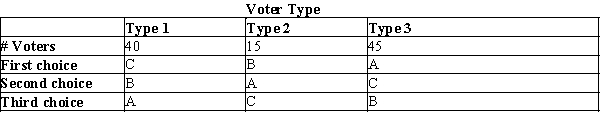 -Refer to Table 22-6. The table shows the preferences of 100 voters over three possible outcomes: A, B, and C. In pairwise majority voting in which voters choose first between A and B and then choose between the winner of the first vote and C,
 (Multiple Choice)
4.8/5 (81)
(81) Table 22-2
Three longtime friends-Allen, Brian, and Cody-are deciding how they will spend their Sunday afternoon. They all agree that they should do one of three things: go to a movie, play golf, or go to a baseball game. They also agree that they will have two pairwise votes to determine how to spend their afternoon, with the majority determining the outcome on each vote. The first, second, and third choices for each person are as indicated in the table below.  -Refer to Table 22-2. If Allen, Brian, and Cody use a Borda count, rather than pairwise majority voting, to decide how to spend their afternoon, then they will
 (Multiple Choice)
4.7/5 (73)
(73) The Condorcet paradox demonstrates that the result of a majority vote may be affected by
(Multiple Choice)
4.9/5 (69)
(69) Domingo is a contestant on a trivia quiz show. For every state capital he can correctly identify, he will win $1,000. However, before identifying any capitals, he must decide how many he thinks he can correctly identify. If he cannot identify as many as he has wagered, Domingo will not win any money. Suppose Domingo says that he can correctly identify 42 state capitals for a potential payoff of $42,000. According to studies of human decision-making, what is most likely to happen?
(Multiple Choice)
4.8/5 (74)
(74) When one party is better informed about an economic situation than another party, economists describe the problem as one of
(Multiple Choice)
4.7/5 (87)
(87) Table 22-7
Suppose that residents of a town are asked to vote on the best way to improve the safety of an intersection. The three choices are: a stoplight, a 4-way stop, and a 2-way stop. The voters are divided into three groups based on their preferences.
Voter Type  -Refer to Table 22-7. If the first vote pits a 2-way stop against a 4-way stop and the second vote pits a stoplight against the winner of the first vote, then the outcome is as follows:
 (Multiple Choice)
4.9/5 (74)
(74) Narrative 22-1
Katie owns a boutique that sells high-end women's clothing and accessories. Shana works part-time at the boutique and frequently is the only employee in this small store. Katie pays Shana a wage that is higher than the market wage for this type of job. When the store is not full of customers, Shana diligently works on displays and cleans to keep the store looking its best. Magda is a customer in the store who asks Shana's opinion on the quality of some jeans she is considering purchasing. Even though she's had several other customers return them due to flaws, Shana tells Magda the quality is great. Belinda is another customer who is returning a necklace without revealing that she lost a gem from it while wearing it.
-Refer to Narrative 22-1. Which of the ladies is a principal?
(Multiple Choice)
4.8/5 (78)
(78) Table 22-18
The following table shows the preferences of four types of voters over four possible alternatives as well as the percentage of the electorate with the given preferences. 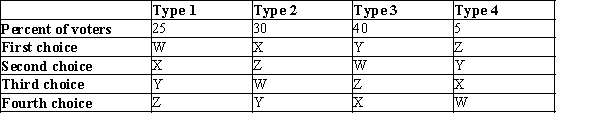 -Refer to Table 22-18. Suppose voters first choose in a majority vote between W and X. Second, voters choose in a majority vote between the winner of the first vote and Y. Third, voters choose in a majority vote between the winner of the second vote and Z. Which alternative will win?
 (Multiple Choice)
4.9/5 (85)
(85) Table 22-9 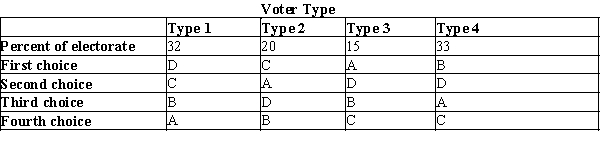 -Refer to Table 22-9. The table shows the preferences of four types of voters over four possible outcomes: A, B, C, and D. In addition, the table shows the percentage of voters of each type. Suppose that, for some reason, D is eliminated as a possible option. Using a Borda count election, with 3 points for the best choice, 2 points for the second best choice, and 1 point for the last choice, which outcome would win this election?
 (Multiple Choice)
4.9/5 (89)
(89) Which of the following is a reason to think that government action may not be valuable to improve market outcomes with asymmetric information?
(Multiple Choice)
4.9/5 (77)
(77) Which of the following is best explained with behavioral economics rather than traditional economics?
(Multiple Choice)
4.9/5 (88)
(88) Scenario 22-5
A wireless telephone service provider offers three service plans to its consumers.  -Refer to Scenario 22-5. By offering consumers these choices and allowing them to select the plan that best meets their needs, the wireless service provider is engaging in
 (Short Answer)
4.9/5 (77)
(77) 
Filters
- Essay(0)
- Multiple Choice(0)
- Short Answer(0)
- True False(0)
- Matching(0)