



 Chat with AI
Exam 22: Frontiers in Microeconomics

Exam 1: Ten Principles of Economics455 Questions
Exam 2: Thinking Like an Economist645 Questions
Exam 3: Interdependence and the Gains From Trade550 Questions
Exam 4: The Market Forces of Supply and Demand693 Questions
Exam 5: Elasticity and Its Application625 Questions
Exam 6: Supply, Demand, and Government Policies671 Questions
Exam 7: Consumers, Producers, and the Efficiency of Markets547 Questions
Exam 8: Application: The Costs of Taxation507 Questions
Exam 9: Application: International Trade521 Questions
Exam 10: Externalities543 Questions
Exam 11: Public Goods and Common Resources453 Questions
Exam 12: The Design of the Tax System563 Questions
Exam 13: The Costs of Production649 Questions
Exam 14: Firms in Competitive Markets608 Questions
Exam 15: Monopoly662 Questions
Exam 16: Monopolistic Competition649 Questions
Exam 17: Oligopoly522 Questions
Exam 18: The Markets for the Factors of Production592 Questions
Exam 19: Earnings and Discrimination511 Questions
Exam 20: Income Inequality and Poverty478 Questions
Exam 21: The Theory of Consumer Choice568 Questions
Exam 22: Frontiers in Microeconomics461 Questions
Select questions type


The suggestion that people are "satisficers" is similar to the view that people
(Multiple Choice)
4.9/5  (77)
(77) When new professors are hired, their job performance is monitored closely. If they meet their institution's standards, they will eventually receive tenure. After receiving tenure, professors' job performance is less closely monitored, and they become difficult to fire. Tenure thus creates
(Multiple Choice)
4.7/5 (84)
(84) Table 22-6 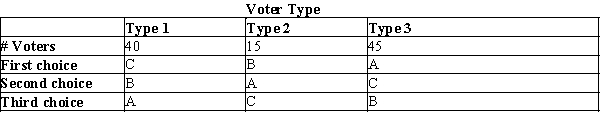 -Refer to Table 22-6. The table shows the preferences of 100 voters over three possible outcomes: A, B, and C. If a Borda count election were held among these voters, giving three points to each voter's first choice, two points to the second choice, and one point to the last choice, which outcome would win the election?
 (Multiple Choice)
4.9/5 (72)
(72) The problem that arises when one person performs a task on behalf of another person is called
(Multiple Choice)
4.9/5 (76)
(76) Which of the following relationships involves asymmetric information?
(Multiple Choice)
4.9/5 (83)
(83) Scenario 22-6
Shana owns a boutique that sells high-end women's clothing and accessories. Katie works part-time at the boutique and frequently is the only employee in this small store. Shana pays Katie a wage that is higher than the market wage for this type of job. When the store is not full of customers, Katie diligently works on displays and cleans to keep the store looking its best. Belinda is a customer in the store who asks Katie's opinion on the quality of some jeans she is considering purchasing. Katie tells her the quality is great even though she's had several other customers return them due to flaws. Magda is another customer who is returning a necklace without volunteering that a gem is missing.
-Refer to Scenario 22-6. Which of the ladies, if any, is committing a moral hazard?
(Short Answer)
4.9/5 (85)
(85) Which of the following events best exemplifies the concept of signaling?
(Multiple Choice)
4.8/5 (86)
(86) Table 22-16
The Johnson family is planning a vacation and, though Mr. and Mrs. Johnson will be paying for the trip, they have decided to use a democratic voting process to choose their destination. The family members' preferences are reflected in the table below. 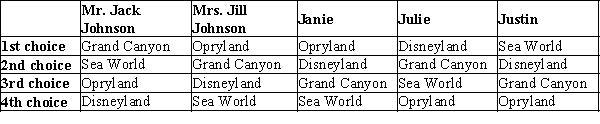 -Refer to Table 22-16. Suppose that before the family can arrive at their decision, Opryland announced that it will be closed for the season due to flooding. If the family uses a Borda count, their vacation destination will be
 (Multiple Choice)
4.9/5 (86)
(86) Table 22-4
The fortunate residents of Anytown have a budget surplus. The mayor decided that it is only fair to have the residents vote on what to do with the surplus. The mayor has narrowed the options down to three possible projects: a playground, a library, or a swimming pool. The voters fall into three categories and have preferences as illustrated in the table. 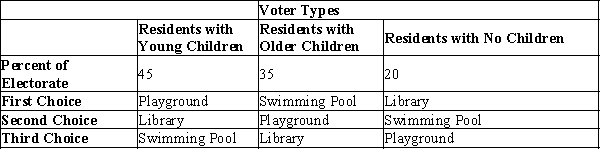 -Refer to Table 22-4. If the mayor asks the residents to choose between the playground and the swimming pool using pairwise voting,
 (Multiple Choice)
4.8/5 (71)
(71) Table 22-5
The citizens of Anytown will decide whether to build a new library, a recreation center, or an arena. Exactly one of the three choices will prevail, and the choice will be made by way of pairwise voting, with the majority determining the outcome on each vote. The preferences of the voters are summarized in the table below. 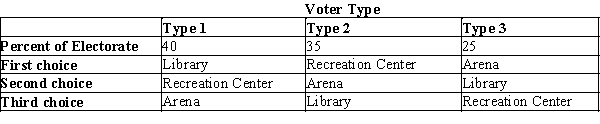 -Refer to Table 22-5. If the citizens of Anytown use a Borda count, rather than pairwise majority voting, to decide what to build, then they will build a new
 (Multiple Choice)
4.7/5 (63)
(63) As an alternative to pairwise majority voting, each voter could be asked to rank the possible outcomes, giving 1 point to her lowest choice, 2 points to her second-lowest choice, 3 points to her third-lowest choice, and so on. This voting method is called a(n)
(Multiple Choice)
4.9/5 (67)
(67) Arrow's impossibility theorem demonstrates the impossibility of the median voter theorem.
(True/False)
5.0/5 (71)
(71) In corporations, which of the following are agents but not principals?
(Multiple Choice)
4.8/5 (72)
(72) Maria and Jose installed a "nanny-camera" in their home so that they can view how the nanny is interacting with their children while they are at work. What type of problem are they trying to combat?
(Short Answer)
4.9/5 (85)
(85) In economics, a difference in access to relevant knowledge is called a behavioral asymmetry.
(True/False)
4.8/5 (74)
(74) Scenario 22-3
At issue in a particular city vote is how much to spend, per person, on road repair next year. Among the 10,000 voters, 2,900 prefer to spend $500 per person, but no more; 2,200 prefer to spend $600 per person, but no more; 1,900 prefer to spend $800 per person, but no more; 1,600 prefer to spend $1,200 but no more, and 1,400 prefer to spend $1,400 per person, but no more.
-Refer to Scenario 22-3. If there is a vote on whether to spend $800 per person or $1,200 per person, the median voter will vote to spend
(Multiple Choice)
4.9/5 (86)
(86) If A is preferred to B and B is preferred to C, then we would expect A to be preferred to C. This property is called
(Short Answer)
4.8/5 (94)
(94) 
Filters
- Essay(0)
- Multiple Choice(0)
- Short Answer(0)
- True False(0)
- Matching(0)