



 Chat with AI
Exam 2: Thinking Like an Economist

Exam 1: Ten Principles of Economics455 Questions
Exam 2: Thinking Like an Economist645 Questions
Exam 3: Interdependence and the Gains From Trade550 Questions
Exam 4: The Market Forces of Supply and Demand693 Questions
Exam 5: Elasticity and Its Application625 Questions
Exam 6: Supply, Demand, and Government Policies671 Questions
Exam 7: Consumers, Producers, and the Efficiency of Markets547 Questions
Exam 8: Application: The Costs of Taxation507 Questions
Exam 9: Application: International Trade521 Questions
Exam 10: Externalities543 Questions
Exam 11: Public Goods and Common Resources453 Questions
Exam 12: The Design of the Tax System563 Questions
Exam 13: The Costs of Production649 Questions
Exam 14: Firms in Competitive Markets608 Questions
Exam 15: Monopoly662 Questions
Exam 16: Monopolistic Competition649 Questions
Exam 17: Oligopoly522 Questions
Exam 18: The Markets for the Factors of Production592 Questions
Exam 19: Earnings and Discrimination511 Questions
Exam 20: Income Inequality and Poverty478 Questions
Exam 21: The Theory of Consumer Choice568 Questions
Exam 22: Frontiers in Microeconomics461 Questions
Select questions type


Figure 2-18
Relationship between Price and Restaurant Meals 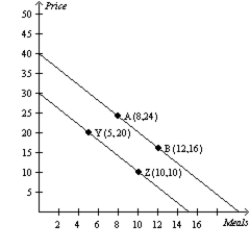 -Refer to Figure 2-18. The slope of the line containing points Y and Z is
 (Multiple Choice)
4.9/5  (71)
(71) Figure 2-21 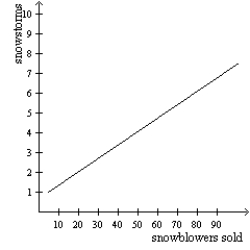 -Refer to Figure 2-21. According to the graph, snowstorms
 (Multiple Choice)
5.0/5 (65)
(65) When a production possibilities frontier is bowed outward, the opportunity cost of one good in terms of the other is constant.
(True/False)
4.9/5 (78)
(78) The effects of foreign competition on the U.S. textile industry would be studied by a microeconomist rather than a macroeconomist.
(True/False)
4.8/5 (89)
(89) Which of the following concepts cannot be illustrated by the production possibilities frontier?
(Multiple Choice)
5.0/5 (74)
(74) Sometimes economists disagree because their scientific judgments differ. Which of the following instances best reflects this source of disagreement?
(Multiple Choice)
4.9/5 (82)
(82) Figure 2-9
Panel (a)
Panel (b) 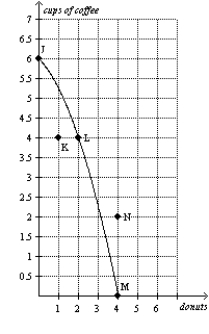
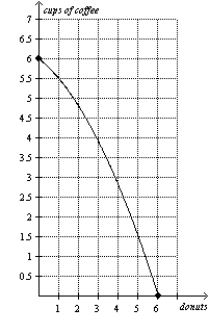 -Refer to Figure 2-9, Panel (a). The opportunity cost of moving from point J to point L is
 (Multiple Choice)
4.7/5 (79)
(79) Which of the following steps does an economist take when studying the economy?
(Multiple Choice)
4.7/5 (74)
(74) Suppose price is measured along the vertical axis on a graph. When price changes, there will be a
(Multiple Choice)
4.8/5 (66)
(66) Albert Einstein once made the following observation about science:
(Multiple Choice)
4.8/5 (93)
(93) Figure 2-14 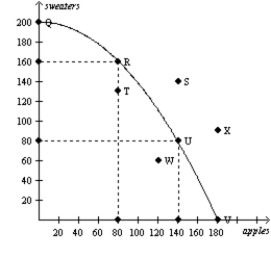 Consider the production possibilities curve for a country that can produce sweaters, apples (in bushels), or a combination of the two
-Refer to Figure 2-14. The opportunity cost of moving from point U to point R is
Consider the production possibilities curve for a country that can produce sweaters, apples (in bushels), or a combination of the two
-Refer to Figure 2-14. The opportunity cost of moving from point U to point R is (Multiple Choice)
4.9/5 (74)
(74) Figure 2-9
Panel (a)
Panel (b)
-Refer to Figure 2-9, Panel (a). To gain 2 donuts by moving from point L to point M, society must sacrifice
-Refer to Figure 2-9, Panel (a). To gain 2 donuts by moving from point L to point M, society must sacrifice (Multiple Choice)
4.8/5 (60)
(60) Figure 2-13 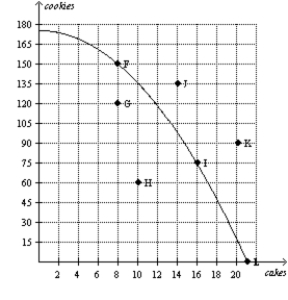 -Refer to Figure 2-13. Which points are not currently attainable but could become achievable for this economy if there is an improvement in technology?
 (Multiple Choice)
4.9/5 (74)
(74) In surveys of professional economists, fourteen propositions were endorsed by an overwhelming majority of respondents.
(True/False)
4.7/5 (84)
(84) When constructing a production possibilities frontier, which of the following assumptions is not made?
(Multiple Choice)
4.8/5 (87)
(87) Figure 2-16 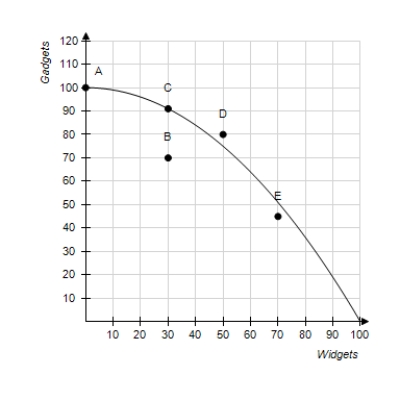 -Refer to Figure 2-16. Inefficient production is represented by which point(s)?
 (Multiple Choice)
4.7/5 (70)
(70) When a variable that is not named on either axis of a graph changes, we read the change as a movement along the curve.
(True/False)
4.8/5 (76)
(76) 
Filters
- Essay(0)
- Multiple Choice(0)
- Short Answer(0)
- True False(0)
- Matching(0)