



 Chat with AI
Exam 2: Thinking Like an Economist

Exam 1: Ten Principles of Economics455 Questions
Exam 2: Thinking Like an Economist645 Questions
Exam 3: Interdependence and the Gains From Trade550 Questions
Exam 4: The Market Forces of Supply and Demand693 Questions
Exam 5: Elasticity and Its Application625 Questions
Exam 6: Supply, Demand, and Government Policies671 Questions
Exam 7: Consumers, Producers, and the Efficiency of Markets547 Questions
Exam 8: Application: The Costs of Taxation507 Questions
Exam 9: Application: International Trade521 Questions
Exam 10: Externalities543 Questions
Exam 11: Public Goods and Common Resources453 Questions
Exam 12: The Design of the Tax System563 Questions
Exam 13: The Costs of Production649 Questions
Exam 14: Firms in Competitive Markets608 Questions
Exam 15: Monopoly662 Questions
Exam 16: Monopolistic Competition649 Questions
Exam 17: Oligopoly522 Questions
Exam 18: The Markets for the Factors of Production592 Questions
Exam 19: Earnings and Discrimination511 Questions
Exam 20: Income Inequality and Poverty478 Questions
Exam 21: The Theory of Consumer Choice568 Questions
Exam 22: Frontiers in Microeconomics461 Questions
Select questions type


Using the outline below, draw a circular-flow diagram representing the interactions between households and firms in a simple economy. Explain briefly the various parts of the diagram. 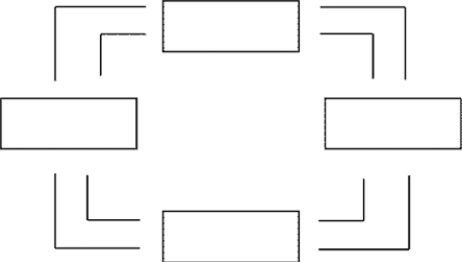
(Essay)
4.7/5  (88)
(88) In the circular flow diagram, who owns the factors of production and consumes all of the goods and services produced?
(Short Answer)
4.8/5 (81)
(81) The effects of borrowing by the federal government would be studied by a microeconomist rather than a macroeconomist.
(True/False)
4.8/5 (86)
(86) Which of the following transactions does not take place in the markets for factors of production in the circular-flow diagram?
(Multiple Choice)
4.9/5 (78)
(78) Which of the following transactions takes place in the markets for the factors of production in the circular-flow diagram?
(Multiple Choice)
4.8/5 (87)
(87) Figure 2-8 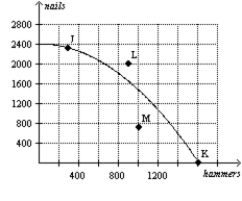 -Refer to Figure 2-8. Point K represents an outcome in which
 (Multiple Choice)
4.8/5 (80)
(80) Evaluating normative statements involves values as well as facts.
(True/False)
4.9/5 (84)
(84) The slope of a line passing through the points (15, 3) and (10, 6) is
(Multiple Choice)
4.8/5 (73)
(73) Figure 2-2 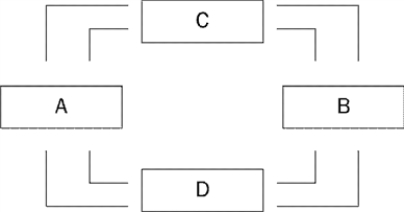 -Refer to Figure 2-2. If the owners of land, labor, and capital are represented by Box B of this circular-flow diagram, then
 (Multiple Choice)
5.0/5 (79)
(79) "Minimum wage laws result in unemployment" is a normative statement, while "the minimum wage should be higher" is a positive statement.
(True/False)
4.8/5 (84)
(84) Figure 2-13 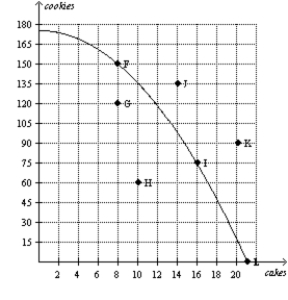 -Refer to Figure 2-13. Which of the following statements is true about point G for this economy?
 (Multiple Choice)
4.9/5 (87)
(87) Who would be more likely to study the effects of rent control on housing in New York City, a macroeconomist or a microeconomist?
(Short Answer)
4.8/5 (79)
(79) A survey of professional economists revealed that more than three-fourths of them agreed with fourteen economic propositions. Which of the following is not one of those propositions?
(Multiple Choice)
4.7/5 (86)
(86) Table 2-3
Production Possibilities for Footville 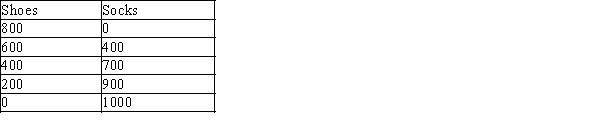 -Refer to Table 2-3. What is the opportunity cost to Footville of increasing the production of shoes from 400 to 600?
 (Multiple Choice)
4.8/5 (63)
(63) Which of the following is an example of a positive, as opposed to normative, statement?
(Multiple Choice)
4.9/5 (88)
(88) Figure 2-14 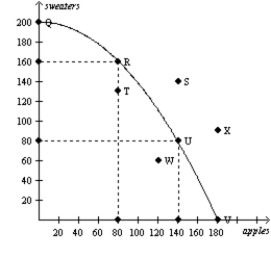 Consider the production possibilities curve for a country that can produce sweaters, apples (in bushels), or a combination of the two
-Refer to Figure 2-14. If this society moves from point U to point V,
Consider the production possibilities curve for a country that can produce sweaters, apples (in bushels), or a combination of the two
-Refer to Figure 2-14. If this society moves from point U to point V, (Multiple Choice)
4.8/5 (91)
(91) 
Filters
- Essay(0)
- Multiple Choice(0)
- Short Answer(0)
- True False(0)
- Matching(0)