



 Chat with AI
Exam 2: Thinking Like an Economist

Exam 1: Ten Principles of Economics455 Questions
Exam 2: Thinking Like an Economist645 Questions
Exam 3: Interdependence and the Gains From Trade550 Questions
Exam 4: The Market Forces of Supply and Demand693 Questions
Exam 5: Elasticity and Its Application625 Questions
Exam 6: Supply, Demand, and Government Policies671 Questions
Exam 7: Consumers, Producers, and the Efficiency of Markets547 Questions
Exam 8: Application: The Costs of Taxation507 Questions
Exam 9: Application: International Trade521 Questions
Exam 10: Externalities543 Questions
Exam 11: Public Goods and Common Resources453 Questions
Exam 12: The Design of the Tax System563 Questions
Exam 13: The Costs of Production649 Questions
Exam 14: Firms in Competitive Markets608 Questions
Exam 15: Monopoly662 Questions
Exam 16: Monopolistic Competition649 Questions
Exam 17: Oligopoly522 Questions
Exam 18: The Markets for the Factors of Production592 Questions
Exam 19: Earnings and Discrimination511 Questions
Exam 20: Income Inequality and Poverty478 Questions
Exam 21: The Theory of Consumer Choice568 Questions
Exam 22: Frontiers in Microeconomics461 Questions
Select questions type


When a production possibilities frontier is bowed outward, the opportunity cost of the first good in terms of the second good increases as more of the second good is produced.
(True/False)
4.8/5  (75)
(75) Which of the following statements about economic models is correct?
(Multiple Choice)
4.8/5 (76)
(76) Figure 2-15 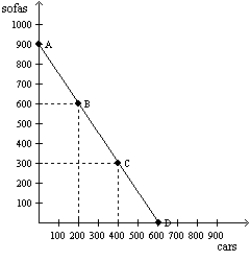 -Refer to Figure 2-15. Consider the production possibilities frontier for an economy that produces only sofas and cars. When society moves from point A to point B,
 (Multiple Choice)
4.9/5 (80)
(80) In the circular-flow diagram, firms produce goods and services using the factors of production.
(True/False)
4.8/5 (86)
(86) A production possibilities frontier will be bowed outward if some of the economy's resources are better suited to producing one good than another.
(True/False)
4.8/5 (89)
(89) In the markets for factors of production in the circular-flow diagram,
(Multiple Choice)
4.9/5 (76)
(76) When two variables move in opposite directions, the curve relating them is upward sloping, and we say the variables are positively related.
(True/False)
4.9/5 (88)
(88) Figure 2-17  -Refer to Figure 2-17. It is possible for this economy to produce 1000 shoes.
 (True/False)
4.9/5 (85)
(85) In the circular-flow diagram, factors of production are the goods and services produced by firms.
(True/False)
4.9/5 (92)
(92) Most economists agree that a large federal budget deficit has what type of effect on the economy?
(Short Answer)
4.8/5 (76)
(76) Figure 2-22 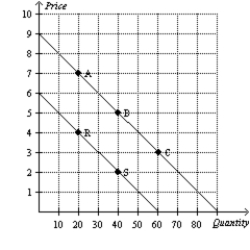 -Refer to Figure 2-22. Given that price is measured on the vertical axis, quantity is measured on the horizontal axis, and that the curves are downward-sloping, what type of curves are depicted here?
 (Short Answer)
4.8/5 (70)
(70) The most common data for testing economic theories come from
(Multiple Choice)
4.9/5 (76)
(76) Figure 2-8 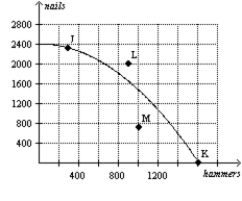 -Refer to Figure 2-8. To reach point L, the economy would have to
 (Multiple Choice)
4.9/5 (76)
(76) Some, but not all, government economists are employed within the administrative branch of government. Which of the following government agencies employs economists outside of the administrative branch?
(Multiple Choice)
5.0/5 (70)
(70) Economists devise theories, collect data, and then analyze these data in an attempt to verify or refute their theories.
(True/False)
4.9/5 (74)
(74) The production possibilities frontier provides an illustration of the principle that
(Multiple Choice)
4.7/5 (82)
(82) In the simple circular-flow diagram, the participants in the economy are
(Multiple Choice)
4.7/5 (82)
(82) Yi and Avik are both economists. Yi thinks that taxing consumption, rather than income, would result in higher household saving because income that is saved would not be taxed. Avik does not think that household saving would respond much to a change in the tax laws. In this example, Yi and Avik
(Multiple Choice)
4.9/5 (85)
(85) 
Filters
- Essay(0)
- Multiple Choice(0)
- Short Answer(0)
- True False(0)
- Matching(0)