



 Chat with AI
Exam 2: Thinking Like an Economist

Exam 1: Ten Principles of Economics455 Questions
Exam 2: Thinking Like an Economist645 Questions
Exam 3: Interdependence and the Gains From Trade550 Questions
Exam 4: The Market Forces of Supply and Demand693 Questions
Exam 5: Elasticity and Its Application625 Questions
Exam 6: Supply, Demand, and Government Policies671 Questions
Exam 7: Consumers, Producers, and the Efficiency of Markets547 Questions
Exam 8: Application: The Costs of Taxation507 Questions
Exam 9: Application: International Trade521 Questions
Exam 10: Externalities543 Questions
Exam 11: Public Goods and Common Resources453 Questions
Exam 12: The Design of the Tax System563 Questions
Exam 13: The Costs of Production649 Questions
Exam 14: Firms in Competitive Markets608 Questions
Exam 15: Monopoly662 Questions
Exam 16: Monopolistic Competition649 Questions
Exam 17: Oligopoly522 Questions
Exam 18: The Markets for the Factors of Production592 Questions
Exam 19: Earnings and Discrimination511 Questions
Exam 20: Income Inequality and Poverty478 Questions
Exam 21: The Theory of Consumer Choice568 Questions
Exam 22: Frontiers in Microeconomics461 Questions
Select questions type


When a government program is justified not on its merits but on the number of jobs it will create,
(Multiple Choice)
4.9/5  (68)
(68) John Maynard Keynes described economics as an easy subject at which very few excel. Which of the following is not one of the reasons Keynes gave for why so few people excel at the study of economics?
(Multiple Choice)
4.8/5 (82)
(82) One difference between a hypothetical benevolent king implementing the best policy and the president implementing the best policy in the real world is the president has to be concerned about
(Multiple Choice)
4.7/5 (92)
(92) Which of the following is an example of a normative, as opposed to positive, statement?
(Multiple Choice)
4.7/5 (74)
(74) Figure 2-14 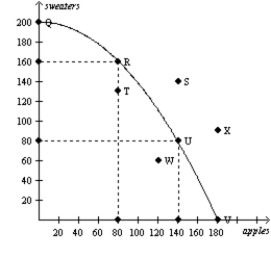 Consider the production possibilities curve for a country that can produce sweaters, apples (in bushels), or a combination of the two
-Refer to Figure 2-14. Which combination of points show production possibilities only achievable with improvements in technology or increases in resources?
Consider the production possibilities curve for a country that can produce sweaters, apples (in bushels), or a combination of the two
-Refer to Figure 2-14. Which combination of points show production possibilities only achievable with improvements in technology or increases in resources? (Multiple Choice)
4.7/5 (83)
(83) Which of the following is the best explanation for why President Harry Truman once said that he wanted to find a one-armed economist?
(Multiple Choice)
4.9/5 (74)
(74) Figure 2-10
Panel (a)
Panel (b) 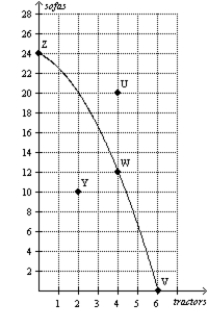
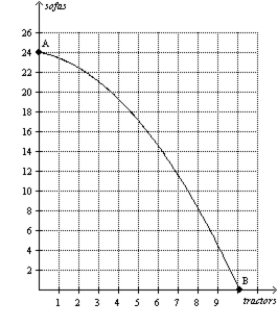 -Refer to Figure 2-10, Panel (a). To gain 2 tractors by moving from point W to point V, society must sacrifice
 (Multiple Choice)
4.8/5 (79)
(79) Figure 2-9
Panel (a)
Panel (b) 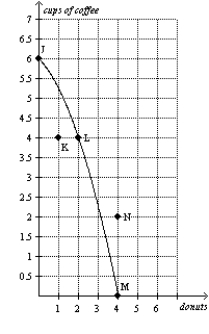
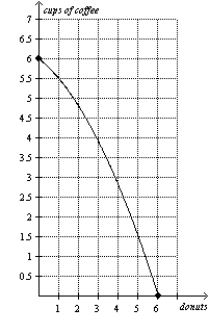 -Refer to Figure 2-9, Panel (a). The opportunity cost of moving from point K to point L is
 (Multiple Choice)
4.8/5 (86)
(86) Figure 2-3 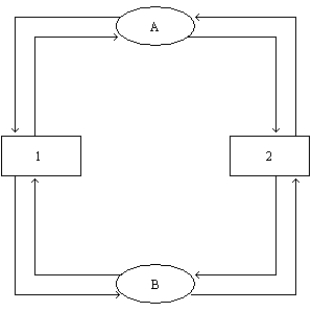 -Refer to Figure 2-3. What are two elements not included in this figure that could be included in a more complex model?
 (Short Answer)
4.8/5 (78)
(78) Figure 2-14 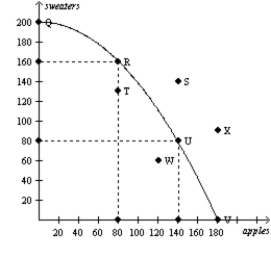 Consider the production possibilities curve for a country that can produce sweaters, apples (in bushels), or a combination of the two.
-Refer to Figure 2-14. Which point(s) on the graph show unemployment of resources?
Consider the production possibilities curve for a country that can produce sweaters, apples (in bushels), or a combination of the two.
-Refer to Figure 2-14. Which point(s) on the graph show unemployment of resources? (Short Answer)
4.8/5 (73)
(73) Which of the following allows you to provide information about the relationship between two variables?
(Multiple Choice)
4.8/5 (90)
(90) On a bowed production possibilities frontier, as you move down along the curve
(Multiple Choice)
5.0/5 (94)
(94) Which of the following is an example of a positive, as opposed to normative, statement?
(Multiple Choice)
4.8/5 (69)
(69) Figure 2-5 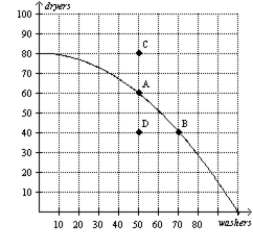 -Refer to Figure 2-5. This economy cannot currently produce 70 washers and 70 dryers because
 (Multiple Choice)
4.9/5 (93)
(93) Just like other scientific models, economic models simplify reality using
(Short Answer)
4.9/5 (89)
(89) 
Filters
- Essay(0)
- Multiple Choice(0)
- Short Answer(0)
- True False(0)
- Matching(0)