



 Chat with AI
Exam 2: Thinking Like an Economist

Exam 1: Ten Principles of Economics455 Questions
Exam 2: Thinking Like an Economist645 Questions
Exam 3: Interdependence and the Gains From Trade550 Questions
Exam 4: The Market Forces of Supply and Demand693 Questions
Exam 5: Elasticity and Its Application625 Questions
Exam 6: Supply, Demand, and Government Policies671 Questions
Exam 7: Consumers, Producers, and the Efficiency of Markets547 Questions
Exam 8: Application: The Costs of Taxation507 Questions
Exam 9: Application: International Trade521 Questions
Exam 10: Externalities543 Questions
Exam 11: Public Goods and Common Resources453 Questions
Exam 12: The Design of the Tax System563 Questions
Exam 13: The Costs of Production649 Questions
Exam 14: Firms in Competitive Markets608 Questions
Exam 15: Monopoly662 Questions
Exam 16: Monopolistic Competition649 Questions
Exam 17: Oligopoly522 Questions
Exam 18: The Markets for the Factors of Production592 Questions
Exam 19: Earnings and Discrimination511 Questions
Exam 20: Income Inequality and Poverty478 Questions
Exam 21: The Theory of Consumer Choice568 Questions
Exam 22: Frontiers in Microeconomics461 Questions
Select questions type


President Ronald Reagan once joked that a Trivial Pursuit game designed for economists would
(Multiple Choice)
4.7/5  (76)
(76) Figure 2-14 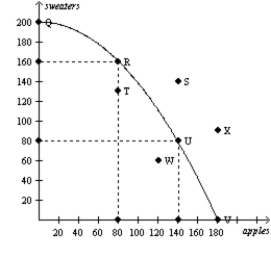 Consider the production possibilities curve for a country that can produce sweaters, apples (in bushels), or a combination of the two.
-Refer to Figure 2-14. Which point(s) on the graph is(are) unattainable given current resources and technology?
Consider the production possibilities curve for a country that can produce sweaters, apples (in bushels), or a combination of the two.
-Refer to Figure 2-14. Which point(s) on the graph is(are) unattainable given current resources and technology? (Short Answer)
4.7/5 (86)
(86) Congress relies on economists at the Congressional Budget Office to
(Multiple Choice)
4.9/5 (75)
(75) Figure 2-14 Consider the production possibilities curve for a country that can produce sweaters, apples (in bushels), or a combination of the two.
-Refer to Figure 2-14. What is the opportunity cost of moving from point T to point R?
Consider the production possibilities curve for a country that can produce sweaters, apples (in bushels), or a combination of the two.
-Refer to Figure 2-14. What is the opportunity cost of moving from point T to point R? (Short Answer)
5.0/5 (86)
(86) An outcome is said to be efficient if an economy is getting all it can from the scarce resources it has available.
(True/False)
4.9/5 (79)
(79) Figure 2-16 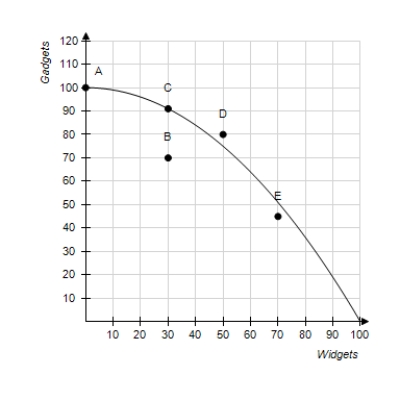 -Refer to Figure 2-16. The opportunity cost of obtaining approximately 10 additional gadgets by moving from point C to point A is
 (Multiple Choice)
4.7/5 (71)
(71) The inner loop of the circular-flow diagram represents the flows of inputs and outputs. Which of the following does not appear on the inner loop?
(Multiple Choice)
4.9/5 (74)
(74) Figure 2-1 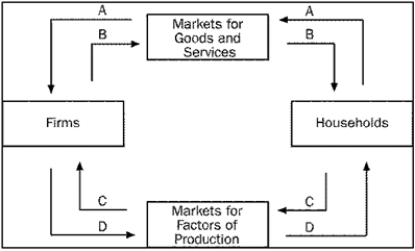 -Refer to Figure 2-1. Which arrow represents the flow of spending by households?
 (Multiple Choice)
4.9/5 (84)
(84) The circular-flow diagram explains, in general terms, how the economy is organized and how participants in the economy interact with one another.
(True/False)
4.7/5 (87)
(87) In the simple circular flow diagram, the flow of money from the firms to the markets for factors of production is called
(Multiple Choice)
4.8/5 (81)
(81) In the markets for goods and services in the circular flow diagram, households act as
(Short Answer)
4.8/5 (81)
(81) The slope of a horizontal line is infinite, and the slope of a vertical line is zero.
(True/False)
4.9/5 (72)
(72) Figure 2-2 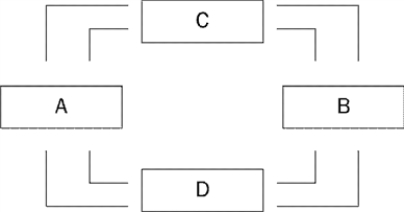 -Refer to Figure 2-2. Devin works as an attorney for a corporation and is paid a salary in exchange for the legal services he performs. Juan owns office buildings and rents his buildings to companies in exchange for rent payments. If Devin's income is represented by a flow of dollars from Box D to Box B of this circular-flow diagram, then Juan's income is represented by a flow of dollars
 (Multiple Choice)
4.9/5 (87)
(87) The art in scientific thinking -- whether in chemistry, economics, or biology -- is
(Multiple Choice)
4.9/5 (92)
(92) Almost all economists agree that local and state governments should
(Multiple Choice)
4.7/5 (73)
(73) Figure 2-5 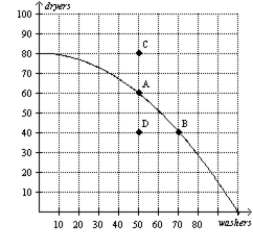 -Refer to Figure 2-5. The opportunity cost of obtaining 20 additional dryers by moving from point D to point A is
 (Multiple Choice)
4.9/5 (83)
(83) 
Filters
- Essay(0)
- Multiple Choice(0)
- Short Answer(0)
- True False(0)
- Matching(0)