



 Chat with AI
Exam 2: Thinking Like an Economist

Exam 1: Ten Principles of Economics455 Questions
Exam 2: Thinking Like an Economist645 Questions
Exam 3: Interdependence and the Gains From Trade550 Questions
Exam 4: The Market Forces of Supply and Demand693 Questions
Exam 5: Elasticity and Its Application625 Questions
Exam 6: Supply, Demand, and Government Policies671 Questions
Exam 7: Consumers, Producers, and the Efficiency of Markets547 Questions
Exam 8: Application: The Costs of Taxation507 Questions
Exam 9: Application: International Trade521 Questions
Exam 10: Externalities543 Questions
Exam 11: Public Goods and Common Resources453 Questions
Exam 12: The Design of the Tax System563 Questions
Exam 13: The Costs of Production649 Questions
Exam 14: Firms in Competitive Markets608 Questions
Exam 15: Monopoly662 Questions
Exam 16: Monopolistic Competition649 Questions
Exam 17: Oligopoly522 Questions
Exam 18: The Markets for the Factors of Production592 Questions
Exam 19: Earnings and Discrimination511 Questions
Exam 20: Income Inequality and Poverty478 Questions
Exam 21: The Theory of Consumer Choice568 Questions
Exam 22: Frontiers in Microeconomics461 Questions
Select questions type


Figure 2-17  -Refer to Figure 2-17. The opportunity cost of moving from point A to point B is zero.
 (True/False)
4.9/5  (87)
(87) Instead of conducting laboratory experiments to generate data to test their theories, economists often
(Multiple Choice)
4.8/5 (86)
(86) The production possibilities frontier shows the opportunity cost of one good as measured in terms of the other good.
(True/False)
4.8/5 (81)
(81) A survey of professional economists revealed that more than three-fourths of them agreed with a number of statements, including which of the following?
(Multiple Choice)
4.7/5 (78)
(78) Economists at the U.S. Department of the Treasury help design U.S. coins and paper money.
(True/False)
4.8/5 (87)
(87) In the circular-flow diagram, the two types of markets in which households and firms interact are the markets for goods and services and the markets for factors of production.
(True/False)
4.8/5 (79)
(79) Analysis of data on workers and those looking for work is conducted by economists at the
(Multiple Choice)
4.9/5 (71)
(71) The production possibilities frontier is a graph that shows the various combinations of output that an economy
(Multiple Choice)
4.8/5 (96)
(96) Assumptions can simplify the complex world and make it easier to understand.
(True/False)
4.8/5 (78)
(78) Figure 2-14 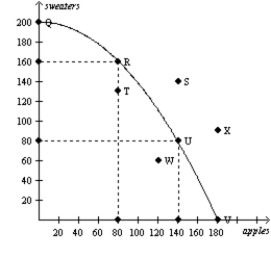 Consider the production possibilities curve for a country that can produce sweaters, apples (in bushels), or a combination of the two
-Refer to Figure 2-14. If this economy devotes all of its available resources to producing apples, then it will produce
Consider the production possibilities curve for a country that can produce sweaters, apples (in bushels), or a combination of the two
-Refer to Figure 2-14. If this economy devotes all of its available resources to producing apples, then it will produce (Multiple Choice)
4.8/5 (86)
(86) A survey which sought the opinion of professional economists on fourteen propositions about economic policy found that
(Multiple Choice)
4.8/5 (76)
(76) Figure 2-13 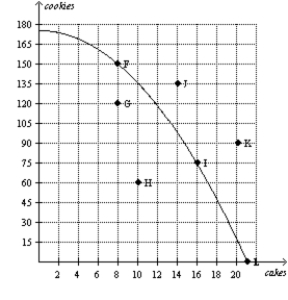 -Refer to Figure 2-13. One difference between points F and G is that
 (Multiple Choice)
4.9/5 (68)
(68) Economists may disagree about the validity of alternative positive theories about how the world works.
(True/False)
4.9/5 (80)
(80) Figure 2-2 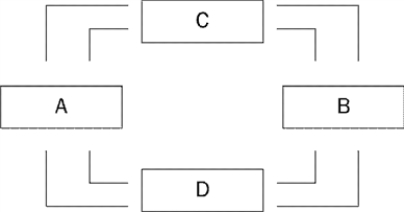 -Refer to Figure 2-2. Carla regularly buys fruits and vegetables at a grocery store. Roberto regularly pays a lawn-care company to mow his lawn. If the flow of fruits and vegetables from the grocery store to Carla is represented by an arrow from Box C to Box B of this circular-flow diagram, then the money paid by Roberto to the lawn-care company is represented by an arrow
 (Multiple Choice)
4.9/5 (86)
(86) The scientific method can be applied to the study of economics.
(True/False)
4.9/5 (86)
(86) Figure 2-6 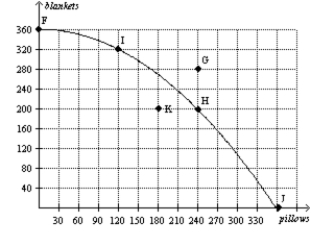 -Refer to Figure 2-6. If this economy devotes one-half of its available resources to the production of blankets and the other half to the production of pillows, it could produce
 (Multiple Choice)
4.7/5 (90)
(90) 
Filters
- Essay(0)
- Multiple Choice(0)
- Short Answer(0)
- True False(0)
- Matching(0)