



 Chat with AI
Exam 2: Thinking Like an Economist

Exam 1: Ten Principles of Economics455 Questions
Exam 2: Thinking Like an Economist645 Questions
Exam 3: Interdependence and the Gains From Trade550 Questions
Exam 4: The Market Forces of Supply and Demand693 Questions
Exam 5: Elasticity and Its Application625 Questions
Exam 6: Supply, Demand, and Government Policies671 Questions
Exam 7: Consumers, Producers, and the Efficiency of Markets547 Questions
Exam 8: Application: The Costs of Taxation507 Questions
Exam 9: Application: International Trade521 Questions
Exam 10: Externalities543 Questions
Exam 11: Public Goods and Common Resources453 Questions
Exam 12: The Design of the Tax System563 Questions
Exam 13: The Costs of Production649 Questions
Exam 14: Firms in Competitive Markets608 Questions
Exam 15: Monopoly662 Questions
Exam 16: Monopolistic Competition649 Questions
Exam 17: Oligopoly522 Questions
Exam 18: The Markets for the Factors of Production592 Questions
Exam 19: Earnings and Discrimination511 Questions
Exam 20: Income Inequality and Poverty478 Questions
Exam 21: The Theory of Consumer Choice568 Questions
Exam 22: Frontiers in Microeconomics461 Questions
Select questions type


Figure 2-11 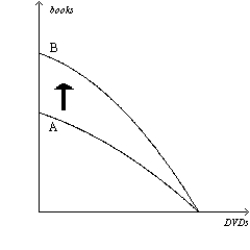 -Refer to Figure 2-11. Which of the following events would explain the shift of the production possibilities frontier from A to B?
 (Multiple Choice)
4.8/5  (94)
(94) The opportunity cost of something is what you give up to get it.
(True/False)
4.8/5 (97)
(97) When a production possibilities frontier is bowed outward, the opportunity cost of the second good in terms of the first good increases as more of the second good is produced.
(True/False)
4.7/5 (87)
(87) Figure 2-6 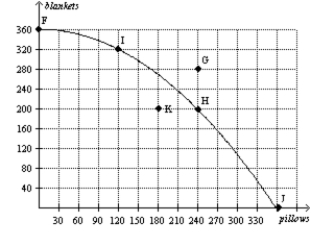 -Refer to Figure 2-6. The opportunity cost of this economy moving from point I to point H is
 (Multiple Choice)
4.9/5 (84)
(84) 
Filters
- Essay(0)
- Multiple Choice(0)
- Short Answer(0)
- True False(0)
- Matching(0)