



 Chat with AI
Exam 1: An Introduction to Life on Earth

Exam 1: An Introduction to Life on Earth91 Questions
Exam 2: Atoms, Molecules, and Life90 Questions
Exam 3: Biological Molecules98 Questions
Exam 4: Cell Structure and Function90 Questions
Exam 5: Cell Membrane Structure and Function96 Questions
Exam 6: Energy Flow in the Life of a Cell90 Questions
Exam 7: Capturing Solar Energy: Photosynthesis102 Questions
Exam 8: Harvesting Energy: Glycolysis and Cellular Respiration97 Questions
Exam 9: Cellular Reproduction133 Questions
Exam 10: Meiosis: the Basis of Sexual Reproduction104 Questions
Exam 11: Patterns of Inheritance98 Questions
Exam 12: DNA: The Molecule of Heredity97 Questions
Exam 13: Gene Expression and Regulation93 Questions
Exam 14: Biotechnology91 Questions
Exam 15: Principles of Evolution97 Questions
Exam 16: How Populations Evolve109 Questions
Exam 17: The Origin of Species89 Questions
Exam 18: The History of Life125 Questions
Exam 19: Systematics: Seeking Order Amid Diversity90 Questions
Exam 20: The Diversity of Prokaryotes and Viruses97 Questions
Exam 21: The Diversity of Protists102 Questions
Exam 22: The Diversity of Plants115 Questions
Exam 23: The Diversity of Fungi107 Questions
Exam 24: Animal Diversity I: Invertebrates101 Questions
Exam 25: Animal Diversity Ii: Vertebrates118 Questions
Exam 26: Animal Behavior116 Questions
Exam 27: Population Growth and Regulation114 Questions
Exam 28: Community Interactions125 Questions
Exam 29: Energy Flow and Nutrient Cycling in Ecosystems122 Questions
Exam 30: Earths Diverse Ecosystems126 Questions
Exam 31: Conserving Earths Biodiversity109 Questions
Exam 32: Homeostasis and the Organization of the Animal Body95 Questions
Exam 33: Circulation89 Questions
Exam 34: Respiration92 Questions
Exam 35: Nutrition and Digestion91 Questions
Exam 36: The Urinary System99 Questions
Exam 37: Defenses Against Disease104 Questions
Exam 38: Chemical Control of the Animal Body: the Endocrine System133 Questions
Exam 39: The Nervous System118 Questions
Exam 40: The Senses94 Questions
Exam 41: Action and Support: the Muscles and Skeleton90 Questions
Exam 42: Animal Reproduction120 Questions
Exam 43: Animal Development122 Questions
Exam 44: Plant Anatomy and Nutrient Transport95 Questions
Exam 45: Plant Reproduction and Development90 Questions
Exam 46: Plant Responses to the Environment87 Questions
Select questions type


You observe a plant on your windowsill that is growing at an angle toward the outside. This is an example of a living thing
(Multiple Choice)
4.8/5  (81)
(81) For the following question(s), choose the characteristic of a living organism that best corresponds to each statement. Selections may be used once, more than once, or not at all.
-A paramecium moves from direct light toward the dark.
(Multiple Choice)
4.8/5 (79)
(79) The main difference between an autotroph and a heterotroph is
(Multiple Choice)
4.9/5 (74)
(74) Francesco Redi designed an experiment to test the notion of spontaneous generation. He left the first jar of meat open to the air and covered the second jar. The first jar would be called the jar.
(Multiple Choice)
4.8/5 (87)
(87) All of the following are features of the scientific method EXCEPT
(Multiple Choice)
4.8/5 (81)
(81) Which of the following is an example of deductive reasoning?
(Multiple Choice)
4.7/5 (74)
(74) In evolutionary terms, which of the following cells is considered to be the most primitive?
(Multiple Choice)
4.9/5 (91)
(91) Which of the following is NOT a part of the community shown in this figure? 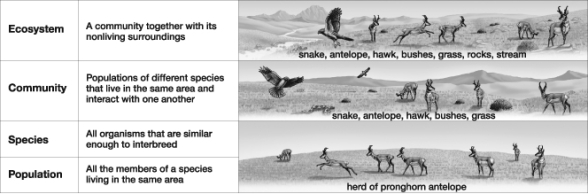
(Multiple Choice)
4.9/5 (79)
(79) A basic difference between a prokaryotic cell and a eukaryotic cell is that the prokaryotic cell
(Multiple Choice)
4.8/5 (85)
(85) An organism in the domain Eukarya is characterized by all of the following EXCEPT
(Multiple Choice)
4.8/5 (85)
(85) Which kingdom possesses unicellular animal-like species and unicellular plantlike species?
(Multiple Choice)
4.8/5 (82)
(82) Imagine that 1 milliliter of an experimental drug diluted in a saline solution is injected into 20 pregnant mice to determine possible side effects. Which of the following is a suitable control for this experiment?
(Multiple Choice)
4.9/5 (71)
(71) Which of the following statements about the Bacteria and Eukarya domains is TRUE?
(Multiple Choice)
4.8/5 (78)
(78) The three natural processes that underlie evolution are genetic variation, inheritance, and_________.
(Short Answer)
4.7/5 (72)
(72) To test the effect of vitamin D on growth, two groups of rats were raised under identical conditions and fed the same diet. One of the groups received daily injections of vitamin D. The other group received injections of saline, which did not contain vitamin D. All the rats were weighed weekly for 2 months. In this experiment, the control was the
(Multiple Choice)
4.8/5 (94)
(94) 
Filters
- Essay(0)
- Multiple Choice(0)
- Short Answer(0)
- True False(0)
- Matching(0)