



 Chat with AI
Exam 26: Animal Behavior

Exam 1: An Introduction to Life on Earth91 Questions
Exam 2: Atoms, Molecules, and Life90 Questions
Exam 3: Biological Molecules98 Questions
Exam 4: Cell Structure and Function90 Questions
Exam 5: Cell Membrane Structure and Function96 Questions
Exam 6: Energy Flow in the Life of a Cell90 Questions
Exam 7: Capturing Solar Energy: Photosynthesis102 Questions
Exam 8: Harvesting Energy: Glycolysis and Cellular Respiration97 Questions
Exam 9: Cellular Reproduction133 Questions
Exam 10: Meiosis: the Basis of Sexual Reproduction104 Questions
Exam 11: Patterns of Inheritance98 Questions
Exam 12: DNA: The Molecule of Heredity97 Questions
Exam 13: Gene Expression and Regulation93 Questions
Exam 14: Biotechnology91 Questions
Exam 15: Principles of Evolution97 Questions
Exam 16: How Populations Evolve109 Questions
Exam 17: The Origin of Species89 Questions
Exam 18: The History of Life125 Questions
Exam 19: Systematics: Seeking Order Amid Diversity90 Questions
Exam 20: The Diversity of Prokaryotes and Viruses97 Questions
Exam 21: The Diversity of Protists102 Questions
Exam 22: The Diversity of Plants115 Questions
Exam 23: The Diversity of Fungi107 Questions
Exam 24: Animal Diversity I: Invertebrates101 Questions
Exam 25: Animal Diversity Ii: Vertebrates118 Questions
Exam 26: Animal Behavior116 Questions
Exam 27: Population Growth and Regulation114 Questions
Exam 28: Community Interactions125 Questions
Exam 29: Energy Flow and Nutrient Cycling in Ecosystems122 Questions
Exam 30: Earths Diverse Ecosystems126 Questions
Exam 31: Conserving Earths Biodiversity109 Questions
Exam 32: Homeostasis and the Organization of the Animal Body95 Questions
Exam 33: Circulation89 Questions
Exam 34: Respiration92 Questions
Exam 35: Nutrition and Digestion91 Questions
Exam 36: The Urinary System99 Questions
Exam 37: Defenses Against Disease104 Questions
Exam 38: Chemical Control of the Animal Body: the Endocrine System133 Questions
Exam 39: The Nervous System118 Questions
Exam 40: The Senses94 Questions
Exam 41: Action and Support: the Muscles and Skeleton90 Questions
Exam 42: Animal Reproduction120 Questions
Exam 43: Animal Development122 Questions
Exam 44: Plant Anatomy and Nutrient Transport95 Questions
Exam 45: Plant Reproduction and Development90 Questions
Exam 46: Plant Responses to the Environment87 Questions
Select questions type


A bird flashing white patches underneath its wings is an example of what type of communication?
(Multiple Choice)
5.0/5  (83)
(83) Nesting geese will roll softballs (placed next to their nests by biologists) into their nests, perhaps because the balls resemble eggs that might have rolled out of the nest. This behavior is most likely
(Multiple Choice)
4.8/5 (86)
(86) Martha McClintock found that the menstrual cycles of female college roommates became synchronous after 6 months of living together. She also found that armpit odors from one group of women affected the menstrual cycles of other women who sniffed the odors. These findings might indicate that
(Multiple Choice)
4.8/5 (73)
(73) The greatest long-distance sound communication occurs among
(Multiple Choice)
4.9/5 (80)
(80) Two cats getting ready to fight puff up their fur to make themselves look larger. This is an example of
(Multiple Choice)
4.9/5 (81)
(81) In a classic experiment from the 1930s, a biologist conducted selective breeding experiments involving maze-running behavior in rats. He repeatedly bred together males and females that made the fewest mistakes, and he also bred together males and females that made the most mistakes. After eight generations, all mice that descended from ʺmaze -smartʺ parents were better at running the maze than all mice that descended from ʺmaze -dumbʺ parents. This study indicates that
(Multiple Choice)
4.8/5 (78)
(78) A strong association learned during a sensitive period of an animalʹs development is referred to as
(Multiple Choice)
4.8/5 (69)
(69) Viceroy butterflies, which are nontoxic, have color patterns that closely mimic those of monarch butterflies, which are toxic. When monarchs are common and viceroys are scarce in the same environment, viceroys are protected because birds cannot distinguish them from monarchs. If monarchs become scarce and viceroys much more common, what do you predict will happen?
(Essay)
4.8/5 (68)
(68) Animals use _________learning when they figure out how to solve a problem without prior experience with that problem.
(Short Answer)
4.9/5 (89)
(89) Which communication method is most effective over short distances?
(Multiple Choice)
4.9/5 (88)
(88) Social bonds between members of a group can be developed by_________ communication.
(Short Answer)
5.0/5 (76)
(76) If you teach your dog to sit by giving him a treat for every correct response, this is an example of
(Multiple Choice)
4.8/5 (74)
(74) A child touches a hot pot on a stove, burns his finger, and won?t touch another pot. This is an example of _________learning.
(Short Answer)
4.9/5 (87)
(87) Honeybees will sting a bear that is robbing their hive even though the bees will die after they sting the bear. This is an example of
(Multiple Choice)
4.8/5 (69)
(69) After eating at the new restaurant in town, you develop a mild case of food poisoning. Consequently, you never go back to that restaurant again. This is an example of
(Multiple Choice)
4.7/5 (82)
(82) When walking your male dog, you notice that he urinates on every vertical object in his path. His urine is used to ʺmarkʺ his territory and serves as a chemical signal to other dogs. What does the urine contain?
(Multiple Choice)
4.9/5 (78)
(78) Wolves are social animals that behave and communicate with each other through a variety of body movements. If a wolf who is initially aggressive as he moves through the pack encounters a more dominant individual, his behavior shifts. Which of the postures shown does he assume? 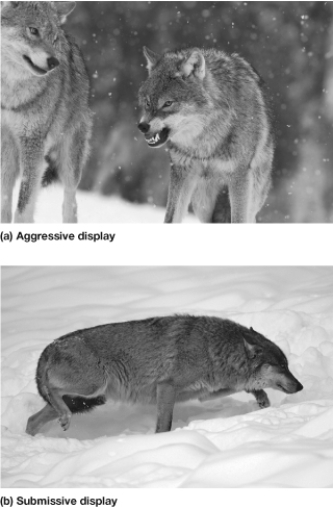
(Multiple Choice)
4.7/5 (89)
(89) 
Filters
- Essay(0)
- Multiple Choice(0)
- Short Answer(0)
- True False(0)
- Matching(0)