



 Chat with AI
Exam 40: The Senses

Exam 1: An Introduction to Life on Earth91 Questions
Exam 2: Atoms, Molecules, and Life90 Questions
Exam 3: Biological Molecules98 Questions
Exam 4: Cell Structure and Function90 Questions
Exam 5: Cell Membrane Structure and Function96 Questions
Exam 6: Energy Flow in the Life of a Cell90 Questions
Exam 7: Capturing Solar Energy: Photosynthesis102 Questions
Exam 8: Harvesting Energy: Glycolysis and Cellular Respiration97 Questions
Exam 9: Cellular Reproduction133 Questions
Exam 10: Meiosis: the Basis of Sexual Reproduction104 Questions
Exam 11: Patterns of Inheritance98 Questions
Exam 12: DNA: The Molecule of Heredity97 Questions
Exam 13: Gene Expression and Regulation93 Questions
Exam 14: Biotechnology91 Questions
Exam 15: Principles of Evolution97 Questions
Exam 16: How Populations Evolve109 Questions
Exam 17: The Origin of Species89 Questions
Exam 18: The History of Life125 Questions
Exam 19: Systematics: Seeking Order Amid Diversity90 Questions
Exam 20: The Diversity of Prokaryotes and Viruses97 Questions
Exam 21: The Diversity of Protists102 Questions
Exam 22: The Diversity of Plants115 Questions
Exam 23: The Diversity of Fungi107 Questions
Exam 24: Animal Diversity I: Invertebrates101 Questions
Exam 25: Animal Diversity Ii: Vertebrates118 Questions
Exam 26: Animal Behavior116 Questions
Exam 27: Population Growth and Regulation114 Questions
Exam 28: Community Interactions125 Questions
Exam 29: Energy Flow and Nutrient Cycling in Ecosystems122 Questions
Exam 30: Earths Diverse Ecosystems126 Questions
Exam 31: Conserving Earths Biodiversity109 Questions
Exam 32: Homeostasis and the Organization of the Animal Body95 Questions
Exam 33: Circulation89 Questions
Exam 34: Respiration92 Questions
Exam 35: Nutrition and Digestion91 Questions
Exam 36: The Urinary System99 Questions
Exam 37: Defenses Against Disease104 Questions
Exam 38: Chemical Control of the Animal Body: the Endocrine System133 Questions
Exam 39: The Nervous System118 Questions
Exam 40: The Senses94 Questions
Exam 41: Action and Support: the Muscles and Skeleton90 Questions
Exam 42: Animal Reproduction120 Questions
Exam 43: Animal Development122 Questions
Exam 44: Plant Anatomy and Nutrient Transport95 Questions
Exam 45: Plant Reproduction and Development90 Questions
Exam 46: Plant Responses to the Environment87 Questions
Select questions type


Explain how structures within the saccule would respond to descending in an elevator from the fifteenth floor to the third floor?
(Essay)
4.7/5  (78)
(78) Which type of receptor signals that your stomach is full after a big meal?
(Multiple Choice)
4.8/5 (82)
(82) The _________ear not only detects sound, but also detects gravity and movement.
(Short Answer)
4.9/5 (79)
(79) How does an insect see the world, as many separate images or as a single image?
(Essay)
4.9/5 (79)
(79) Olfactory dysfunction, or dysosmia, is a problem with the sense of smell. Technically, it is a deviation from the normal sensing and perception of odor molecules, or olfactory stimuli processing. There are several different forms of dysosmia, including anosmia (stimuli do not activate the olfactory bulb), parosmia (some odors are interpreted as other odors), and phantosmia (hallucinations of smells that are not there). Based on this information, what specific condition is indicated in a person who mistakenly perceives the smell of peppermint as the same as the smell of something that is rotten, foul, and decomposed?
(Multiple Choice)
4.9/5 (101)
(101) The hair cells in the_________ detect the direction of gravity.
(Multiple Choice)
4.9/5 (82)
(82) Human fingertips have the same number of touch receptors per square inch as the skin of the back.
(True/False)
4.9/5 (78)
(78) If you could monitor the activity from the photoreceptors of rods and cones in the retina during a dream, would you expect these cells to be producing electrical signals? Why?
(Multiple Choice)
5.0/5 (86)
(86) Optimal color vision occurs in the fovea, a depression in the retina where most of the_________are located.
(Short Answer)
4.7/5 (81)
(81) 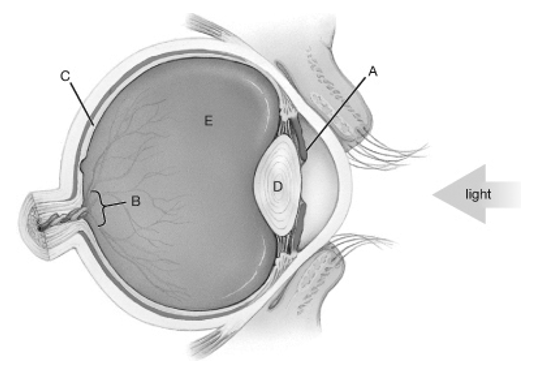 -Which part of the eye shown in the above figure changes shape to focus on objects at different distances?
 (Multiple Choice)
4.8/5 (93)
(93) All of the following are examples of mechanoreceptors EXCEPT
(Multiple Choice)
4.9/5 (74)
(74) 
Filters
- Essay(0)
- Multiple Choice(0)
- Short Answer(0)
- True False(0)
- Matching(0)