



 Chat with AI
Exam 42: Animal Reproduction

Exam 1: An Introduction to Life on Earth91 Questions
Exam 2: Atoms, Molecules, and Life90 Questions
Exam 3: Biological Molecules98 Questions
Exam 4: Cell Structure and Function90 Questions
Exam 5: Cell Membrane Structure and Function96 Questions
Exam 6: Energy Flow in the Life of a Cell90 Questions
Exam 7: Capturing Solar Energy: Photosynthesis102 Questions
Exam 8: Harvesting Energy: Glycolysis and Cellular Respiration97 Questions
Exam 9: Cellular Reproduction133 Questions
Exam 10: Meiosis: the Basis of Sexual Reproduction104 Questions
Exam 11: Patterns of Inheritance98 Questions
Exam 12: DNA: The Molecule of Heredity97 Questions
Exam 13: Gene Expression and Regulation93 Questions
Exam 14: Biotechnology91 Questions
Exam 15: Principles of Evolution97 Questions
Exam 16: How Populations Evolve109 Questions
Exam 17: The Origin of Species89 Questions
Exam 18: The History of Life125 Questions
Exam 19: Systematics: Seeking Order Amid Diversity90 Questions
Exam 20: The Diversity of Prokaryotes and Viruses97 Questions
Exam 21: The Diversity of Protists102 Questions
Exam 22: The Diversity of Plants115 Questions
Exam 23: The Diversity of Fungi107 Questions
Exam 24: Animal Diversity I: Invertebrates101 Questions
Exam 25: Animal Diversity Ii: Vertebrates118 Questions
Exam 26: Animal Behavior116 Questions
Exam 27: Population Growth and Regulation114 Questions
Exam 28: Community Interactions125 Questions
Exam 29: Energy Flow and Nutrient Cycling in Ecosystems122 Questions
Exam 30: Earths Diverse Ecosystems126 Questions
Exam 31: Conserving Earths Biodiversity109 Questions
Exam 32: Homeostasis and the Organization of the Animal Body95 Questions
Exam 33: Circulation89 Questions
Exam 34: Respiration92 Questions
Exam 35: Nutrition and Digestion91 Questions
Exam 36: The Urinary System99 Questions
Exam 37: Defenses Against Disease104 Questions
Exam 38: Chemical Control of the Animal Body: the Endocrine System133 Questions
Exam 39: The Nervous System118 Questions
Exam 40: The Senses94 Questions
Exam 41: Action and Support: the Muscles and Skeleton90 Questions
Exam 42: Animal Reproduction120 Questions
Exam 43: Animal Development122 Questions
Exam 44: Plant Anatomy and Nutrient Transport95 Questions
Exam 45: Plant Reproduction and Development90 Questions
Exam 46: Plant Responses to the Environment87 Questions
Select questions type


During the first half of the menstrual cycle, GnRH stimulates the release of FSH, which stimulates the growth of follicle cells to secrete increasing levels of___________ , which then stimulates the release of more GnRH, creating a positive feedback loop.
(Short Answer)
4.9/5  (75)
(75) The onset of puberty is triggered by maturation of the brain, which stimulates the hypothalamus to secrete
(Multiple Choice)
4.8/5 (80)
(80) Female salmon build nests in gravel river bottoms to lay eggs, which are then fertilized by male salmon that approach and deposit their sperm over the eggs. This is an example of
(Multiple Choice)
4.9/5 (86)
(86) The monthly shedding of the uterine lining is called ___________.
(Short Answer)
5.0/5 (82)
(82) 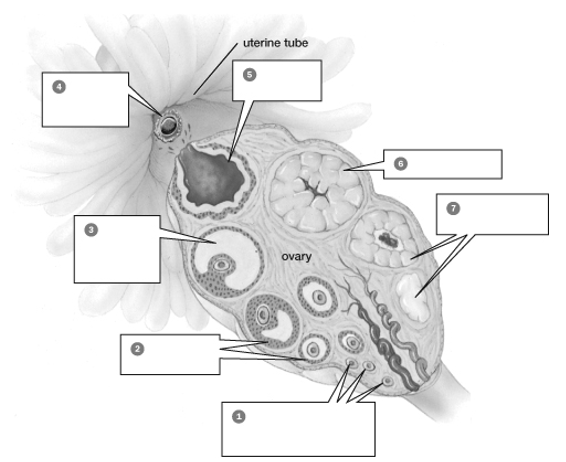 -The structure labeled 1 contains a
___________is the asexual process by which an organism grows a small version of itself on the body of the adult, which then pinches off when it is large enough to be independent.
(Multiple Choice)
4.8/5 (89)
(89) The presence of testosterone triggers the release of LH to produce more testosterone, as explained by negative feedback.
(True/False)
4.8/5 (72)
(72) HIV, which causes AIDS, can be cured by using broad-spectrum antibiotic therapy.
(True/False)
4.8/5 (78)
(78) During the process of ___________, aquatic species release large numbers of gametes into the water
(Short Answer)
4.8/5 (74)
(74) Animals that have internal fertilization without copulation often package their sperm in___________, which are inserted into the female.
(Short Answer)
4.7/5 (79)
(79) Sixty percent of the fluid in semen comes from the ___________; this fluid contains prostaglandins that stimulate uterine contractions to help transport the sperm.
(Short Answer)
4.8/5 (70)
(70) Around day 21 of the menstrual cycle, levels of the hormone ___________, which is produced by the corpus luteum, peak.
(Short Answer)
4.8/5 (84)
(84) The ___________is a tube that carries sperm from the epididymis to the urethra.
(Short Answer)
5.0/5 (88)
(88) Which of the following is the correct path sperm travel on their way to fertilize an egg?
(Multiple Choice)
4.7/5 (68)
(68) Why is it necessary for the testes to be in the scrotum to function properly?
(Multiple Choice)
4.9/5 (84)
(84) 
Filters
- Essay(0)
- Multiple Choice(0)
- Short Answer(0)
- True False(0)
- Matching(0)