



 Chat with AI
Exam 43: Animal Development

Exam 1: An Introduction to Life on Earth91 Questions
Exam 2: Atoms, Molecules, and Life90 Questions
Exam 3: Biological Molecules98 Questions
Exam 4: Cell Structure and Function90 Questions
Exam 5: Cell Membrane Structure and Function96 Questions
Exam 6: Energy Flow in the Life of a Cell90 Questions
Exam 7: Capturing Solar Energy: Photosynthesis102 Questions
Exam 8: Harvesting Energy: Glycolysis and Cellular Respiration97 Questions
Exam 9: Cellular Reproduction133 Questions
Exam 10: Meiosis: the Basis of Sexual Reproduction104 Questions
Exam 11: Patterns of Inheritance98 Questions
Exam 12: DNA: The Molecule of Heredity97 Questions
Exam 13: Gene Expression and Regulation93 Questions
Exam 14: Biotechnology91 Questions
Exam 15: Principles of Evolution97 Questions
Exam 16: How Populations Evolve109 Questions
Exam 17: The Origin of Species89 Questions
Exam 18: The History of Life125 Questions
Exam 19: Systematics: Seeking Order Amid Diversity90 Questions
Exam 20: The Diversity of Prokaryotes and Viruses97 Questions
Exam 21: The Diversity of Protists102 Questions
Exam 22: The Diversity of Plants115 Questions
Exam 23: The Diversity of Fungi107 Questions
Exam 24: Animal Diversity I: Invertebrates101 Questions
Exam 25: Animal Diversity Ii: Vertebrates118 Questions
Exam 26: Animal Behavior116 Questions
Exam 27: Population Growth and Regulation114 Questions
Exam 28: Community Interactions125 Questions
Exam 29: Energy Flow and Nutrient Cycling in Ecosystems122 Questions
Exam 30: Earths Diverse Ecosystems126 Questions
Exam 31: Conserving Earths Biodiversity109 Questions
Exam 32: Homeostasis and the Organization of the Animal Body95 Questions
Exam 33: Circulation89 Questions
Exam 34: Respiration92 Questions
Exam 35: Nutrition and Digestion91 Questions
Exam 36: The Urinary System99 Questions
Exam 37: Defenses Against Disease104 Questions
Exam 38: Chemical Control of the Animal Body: the Endocrine System133 Questions
Exam 39: The Nervous System118 Questions
Exam 40: The Senses94 Questions
Exam 41: Action and Support: the Muscles and Skeleton90 Questions
Exam 42: Animal Reproduction120 Questions
Exam 43: Animal Development122 Questions
Exam 44: Plant Anatomy and Nutrient Transport95 Questions
Exam 45: Plant Reproduction and Development90 Questions
Exam 46: Plant Responses to the Environment87 Questions
Select questions type


Mitotic cell divisions of the zygote are collectively called cleavage.
(True/False)
4.8/5  (84)
(84) A developing human is considered an embryo after__________ weeks.
(Multiple Choice)
4.9/5 (65)
(65) The developing fetus secretes chorionic gonadotropin only during the first 2 weeks of pregnancy.
(True/False)
4.9/5 (81)
(81) The proteins that bind to the DNA near regions where gene transcription begins are called
(Multiple Choice)
4.7/5 (76)
(76) 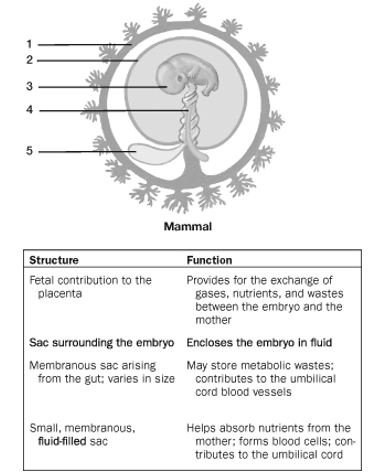 -The structure labeled 2 is the
Stem cells developed by inserting genes that regulate the transcription of specific genes into cells from an adult are __________cells.
(Multiple Choice)
4.9/5 (85)
(85) The mesoderm develops into the dermis of the skin and the skeleton.
(True/False)
4.8/5 (83)
(83) One characteristic of animal development is the specialization in both structure and function that cells undergo. This is called
(Multiple Choice)
4.8/5 (70)
(70) An embryo was exposed to a chemical early in its development. At birth, there is chromosomal damage to the circulatory system linked to the chemical exposure. What other organ systems should be examined for the same type of damage?
(Essay)
4.8/5 (76)
(76) German measles is a very mild infection, so why is vaccination against German measles required by most colleges?
(Essay)
4.8/5 (76)
(76) The most rapid differentiation in an embryo occurs during the first 2 months of pregnancy.
(True/False)
4.8/5 (71)
(71) Recent studies have shown that cells of the dorsal lip of the blastopore contain active__________genes that code for proteins that are able to induce the development of other cells.
(Short Answer)
4.9/5 (82)
(82) In species with direct development, fewer offspring are produced, but a higher proportion survives to adulthood.
(True/False)
4.8/5 (75)
(75) __________genes code for transcription factors that regulate the transcription of other genes.
(Short Answer)
4.9/5 (87)
(87) The blastocyst implants in the endometrium about 7 days after fertilization.
(True/False)
4.9/5 (73)
(73) __________is the developmental event that results in the formation of a primitive gut and the three tissue layers.
(Multiple Choice)
4.9/5 (72)
(72) 
Filters
- Essay(0)
- Multiple Choice(0)
- Short Answer(0)
- True False(0)
- Matching(0)