



 Chat with AI
Exam 45: Plant Reproduction and Development

Exam 1: An Introduction to Life on Earth91 Questions
Exam 2: Atoms, Molecules, and Life90 Questions
Exam 3: Biological Molecules98 Questions
Exam 4: Cell Structure and Function90 Questions
Exam 5: Cell Membrane Structure and Function96 Questions
Exam 6: Energy Flow in the Life of a Cell90 Questions
Exam 7: Capturing Solar Energy: Photosynthesis102 Questions
Exam 8: Harvesting Energy: Glycolysis and Cellular Respiration97 Questions
Exam 9: Cellular Reproduction133 Questions
Exam 10: Meiosis: the Basis of Sexual Reproduction104 Questions
Exam 11: Patterns of Inheritance98 Questions
Exam 12: DNA: The Molecule of Heredity97 Questions
Exam 13: Gene Expression and Regulation93 Questions
Exam 14: Biotechnology91 Questions
Exam 15: Principles of Evolution97 Questions
Exam 16: How Populations Evolve109 Questions
Exam 17: The Origin of Species89 Questions
Exam 18: The History of Life125 Questions
Exam 19: Systematics: Seeking Order Amid Diversity90 Questions
Exam 20: The Diversity of Prokaryotes and Viruses97 Questions
Exam 21: The Diversity of Protists102 Questions
Exam 22: The Diversity of Plants115 Questions
Exam 23: The Diversity of Fungi107 Questions
Exam 24: Animal Diversity I: Invertebrates101 Questions
Exam 25: Animal Diversity Ii: Vertebrates118 Questions
Exam 26: Animal Behavior116 Questions
Exam 27: Population Growth and Regulation114 Questions
Exam 28: Community Interactions125 Questions
Exam 29: Energy Flow and Nutrient Cycling in Ecosystems122 Questions
Exam 30: Earths Diverse Ecosystems126 Questions
Exam 31: Conserving Earths Biodiversity109 Questions
Exam 32: Homeostasis and the Organization of the Animal Body95 Questions
Exam 33: Circulation89 Questions
Exam 34: Respiration92 Questions
Exam 35: Nutrition and Digestion91 Questions
Exam 36: The Urinary System99 Questions
Exam 37: Defenses Against Disease104 Questions
Exam 38: Chemical Control of the Animal Body: the Endocrine System133 Questions
Exam 39: The Nervous System118 Questions
Exam 40: The Senses94 Questions
Exam 41: Action and Support: the Muscles and Skeleton90 Questions
Exam 42: Animal Reproduction120 Questions
Exam 43: Animal Development122 Questions
Exam 44: Plant Anatomy and Nutrient Transport95 Questions
Exam 45: Plant Reproduction and Development90 Questions
Exam 46: Plant Responses to the Environment87 Questions
Select questions type


Which of the following has a gametophyte that is an independent plant that dominates the life cycle and does NOT have a sporophyte that is an independent plant?
(Multiple Choice)
4.8/5  (89)
(89) Which of the following is TRUE for female reproductive structures in angiosperms?
(Multiple Choice)
4.8/5 (81)
(81) In north-central Florida, the cars, homes, streets, and ponds are covered with an impressive coating of bright yellow dust every spring. Upon closer, microscopic examination, the yellow ʺdustʺ turns out to be pollen grains. This area of Florida has pine trees, showy daytime-flowering plants, and often-unnoticed nighttime-flowering plants, with sweet-scented flowers, releasing pollen at the same time of year.
Based on this information, which group of plants do you think is responsible for the yellow pollen? Why?
(Multiple Choice)
4.8/5 (80)
(80) Both monocots and dicots protect their young shoots as they emerge from the soil. Describe how each group accomplishes this.
(Essay)
4.9/5 (73)
(73) A plant, such as an iris, that reproduces asexually most of the time probably
(Multiple Choice)
4.9/5 (88)
(88) In the life cycle of a fern, the large fern plant that we normally see is the
(Multiple Choice)
4.8/5 (88)
(88) In the ovule, which two cells (with a total of three nuclei) are fertilized?
(Essay)
5.0/5 (81)
(81) Why is fertilization in flowering plants called double fertilization?
(Essay)
4.9/5 (85)
(85) What is the evolutionary significance of a flower that has large, brightly colored petals?
(Multiple Choice)
4.9/5 (79)
(79) All of the following are processes that occur during angiosperm reproduction EXCEPT
(Multiple Choice)
4.7/5 (86)
(86) __________are modified leaves that are often brightly colored and scented to attract pollinators.
(Multiple Choice)
4.8/5 (85)
(85) Grass flowers lack petals and sepals. Which of the following statements is TRUE?
(Multiple Choice)
4.7/5 (87)
(87) Which of the following is ʺmaleʺ in the life cycle of angiosperms?
(Multiple Choice)
4.9/5 (78)
(78) Conifers do not have flowers to attract pollinators. Instead, fertilization occurs
(Multiple Choice)
4.8/5 (94)
(94) In the alternation of generations, what is formed when a spore germinates?
(Multiple Choice)
4.8/5 (72)
(72) The immature angiosperm pollen grain consists of a tube cell and a generative cell that will divide to produce__________ sperm cells.
(Multiple Choice)
4.9/5 (85)
(85) Based on the leaflike sepals in the flower shown in the figure and on the other visible characteristics, this flower is a(n) 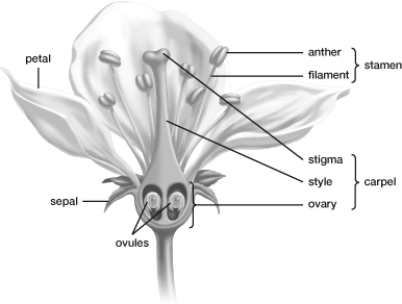
(Multiple Choice)
4.8/5 (72)
(72) In flowering plants, the sperm does not have to swim to the egg. The sperm reaches the eggs by
(Multiple Choice)
4.8/5 (86)
(86) 
Filters
- Essay(0)
- Multiple Choice(0)
- Short Answer(0)
- True False(0)
- Matching(0)