



 Chat with AI
Exam 18: Relativity and Black Holes

Exam 1: Thinking Like an Astronomer 97 Questions
Exam 2: Patterns in the Skymotions of Earth and the Moon101 Questions
Exam 3: Motion of Astronomical Bodies99 Questions
Exam 4: Gravity and Orbits100 Questions
Exam 5: Light100 Questions
Exam 6: The Tools of the Astronomer100 Questions
Exam 7: The Formation of Planetary Systems100 Questions
Exam 8: The Terrestrial Planets and Earths Moon100 Questions
Exam 9: Atmospheres of the Terrestrial Planets100 Questions
Exam 10: Worlds of Gas and Liquidthe Giant Planets100 Questions
Exam 11: Planetary Moons and Rings100 Questions
Exam 12: Dwarf Planets and Small Solar System Bodies100 Questions
Exam 13: Taking the Measure of Stars101 Questions
Exam 14: Our Starthe Sun100 Questions
Exam 15: The Interstellar Medium and Star Formation100 Questions
Exam 16: Evolution of Low-Mass Stars100 Questions
Exam 17: Evolution of High-Mass Stars100 Questions
Exam 18: Relativity and Black Holes97 Questions
Exam 19: Galaxies100 Questions
Exam 20: The Milky Waya Normal Spiral Galaxy100 Questions
Exam 21: The Expanding Universe98 Questions
Exam 22: Cosmology100 Questions
Exam 23: Large-Scale Structure in the Universe103 Questions
Exam 24: Life100 Questions
Select questions type


Muons are elementary particles that decay into other particles in about 2.2 microseconds.They are formed in the upper atmosphere of Earth from high-energy cosmic rays and can be detected on the ground even though they could travel only a few hundred meters before decaying, according to Newtonian physics.How does relativity explain that we can detect them on the ground? Explain both in our reference frame and in the frame of the muon.
(Essay)
4.8/5  (72)
(72) The phenomenon pictured in the figure below is an example of 
(Multiple Choice)
4.9/5 (91)
(91) The equivalence principle states that the gravitational mass is equal to the
(Multiple Choice)
4.8/5 (72)
(72) ________ is the result of mass distorting the fabric of spacetime.
(Multiple Choice)
4.7/5 (64)
(64) What is the equivalence principle? Describe a consequence of the equivalence principle for astronauts orbiting in the International Space Station.
(Essay)
5.0/5 (80)
(80) What will observers in different inertial frames of reference always agree on?
(Multiple Choice)
4.9/5 (71)
(71) Three identical photons are emitted by the three different stars shown in the figure below.Explain why an observer will ultimately see each photon as having a different wavelength. 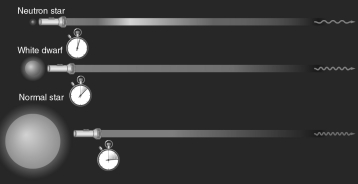
(Essay)
4.8/5 (79)
(79) We still use Newton's law of gravitation, even though Einstein's relativity is more correct, because
(Multiple Choice)
4.8/5 (72)
(72) One consequence of Einstein's ideas about the speed of light is that
(Multiple Choice)
4.9/5 (82)
(82) In the figure below, the astronaut cannot tell the difference between the two situations due to 
(Multiple Choice)
4.8/5 (80)
(80) What is the difference between the singularity and the event horizon of a black hole?
(Essay)
4.7/5 (85)
(85) Which of the following are the only observable properties of black holes?
(Multiple Choice)
4.9/5 (81)
(81) If the Sun were to be instantly replaced by a 1 MSUN black hole, the gravitational pull of the black hole on Earth would be
(Multiple Choice)
4.9/5 (78)
(78) Assume that a group of explorers traveled to the Orion Nebula, which is the nearest star-forming cloud and is at a distance of 1,300 light-years, using revolutionary technology that allowed them to travel at a speed of 0.99c.Observers back on Earth using Earth-bound clocks would say it took the explorers ________ to get there, but the explorers with their moving clocks would say it took them only ________ to get there.
(Multiple Choice)
4.8/5 (82)
(82) Explain how mass and compactness (that is, size and density) would affect the way an object distorts the fabric of spacetime.
(Essay)
4.9/5 (78)
(78) 
Filters
- Essay(0)
- Multiple Choice(0)
- Short Answer(0)
- True False(0)
- Matching(0)