



 Chat with AI
Exam 5: Light

Exam 1: Thinking Like an Astronomer 97 Questions
Exam 2: Patterns in the Skymotions of Earth and the Moon101 Questions
Exam 3: Motion of Astronomical Bodies99 Questions
Exam 4: Gravity and Orbits100 Questions
Exam 5: Light100 Questions
Exam 6: The Tools of the Astronomer100 Questions
Exam 7: The Formation of Planetary Systems100 Questions
Exam 8: The Terrestrial Planets and Earths Moon100 Questions
Exam 9: Atmospheres of the Terrestrial Planets100 Questions
Exam 10: Worlds of Gas and Liquidthe Giant Planets100 Questions
Exam 11: Planetary Moons and Rings100 Questions
Exam 12: Dwarf Planets and Small Solar System Bodies100 Questions
Exam 13: Taking the Measure of Stars101 Questions
Exam 14: Our Starthe Sun100 Questions
Exam 15: The Interstellar Medium and Star Formation100 Questions
Exam 16: Evolution of Low-Mass Stars100 Questions
Exam 17: Evolution of High-Mass Stars100 Questions
Exam 18: Relativity and Black Holes97 Questions
Exam 19: Galaxies100 Questions
Exam 20: The Milky Waya Normal Spiral Galaxy100 Questions
Exam 21: The Expanding Universe98 Questions
Exam 22: Cosmology100 Questions
Exam 23: Large-Scale Structure in the Universe103 Questions
Exam 24: Life100 Questions
Select questions type


Why do some stars in the sky appear blue, whereas other stars appear red?
(Multiple Choice)
4.9/5  (83)
(83) What does it mean to say that an object is in thermal equilibrium?
(Multiple Choice)
4.8/5 (61)
(61) Consider an incandescent lightbulb.If you wanted to turn a 10-W lightbulb into a 100-W lightbulb, how would you change the temperature of the filament inside the bulb?
(Multiple Choice)
4.8/5 (78)
(78) What different processes produce the patterns of light that can be viewed as: continuous spectra; emission spectra; and absorption spectra?
(Essay)
4.9/5 (68)
(68) How do the wavelength and frequency of red light compare to the wavelength and frequency of blue light?
(Multiple Choice)
4.8/5 (62)
(62) If the wavelength of a beam of light were to double, how would that affect its frequency?
(Multiple Choice)
4.9/5 (90)
(90) Which two quantities do we need to know in order to use the Stefan-Boltzmann law to determine a blackbody's total luminosity?
(Essay)
4.9/5 (61)
(61) The average red giant is about 1,000 times more luminous than the average main-sequence star.If both kinds of stars have about the same brightness in our night sky, how much farther away are the red giants compared to the main-sequence stars?
(Multiple Choice)
4.9/5 (78)
(78) In the figure below, which blackbody spectrum corresponds to the object with the highest temperature? 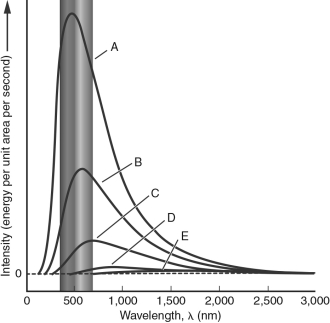
(Multiple Choice)
4.9/5 (87)
(87) If a lightbulb is moved twice as far away, its luminosity will be
(Multiple Choice)
4.8/5 (82)
(82) Imagine you see a street lamp that is 100 m away from you and is 10,000 times more luminous than a firefly.How close would you have to be to the firefly to make it look as bright as the street lamp?
(Essay)
4.9/5 (81)
(81) If the typical temperature of a red giant is 3000 K, at what wavelength is its radiation the brightest? Use the electromagnetic spectrum in the figure below to help you answer this question. 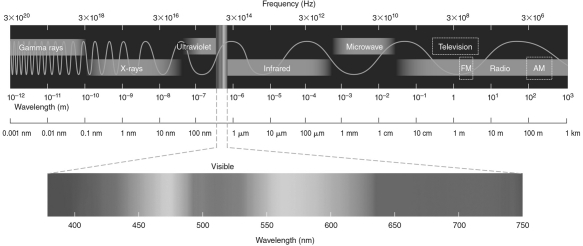
(Multiple Choice)
4.8/5 (76)
(76) If you find that the hydrogen alpha line in a star's spectrum occurs at a wavelength of 656.45 nm, what is the star's approximate radial velocity? Note that the rest wavelength of this line is 656.30 nm.
(Multiple Choice)
4.9/5 (93)
(93) The first five energy levels of hydrogen are E1 = 0 eV, E2 = 10.2 eV, E3 =12.1 eV, E4 =12.7 eV, and E5 = 13.1 eV.If the electron is in the n = 4 level, what energies can a single emitted photon have?
(Essay)
4.9/5 (82)
(82) As a blackbody's temperature increases, it also becomes ________ and ________.
(Multiple Choice)
4.8/5 (82)
(82) In the energy level diagram shown in the figure below, the electron is excited to the E4 energy level.If the electron transitions to an energy level giving off a photon, which level would produce a photon with the largest wavelength? 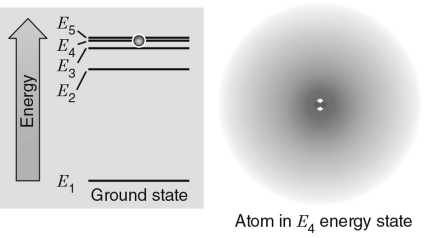
(Multiple Choice)
4.8/5 (75)
(75) 
Filters
- Essay(0)
- Multiple Choice(0)
- Short Answer(0)
- True False(0)
- Matching(0)