



 Chat with AI
Exam 2: The Production Possibility Model, Trade, and Globalization

Exam 1: Economics and Economic Reasoning158 Questions
Exam 2: The Production Possibility Model, Trade, and Globalization133 Questions
Exam 3: Economic Institutions163 Questions
Exam 4: Supply and Demand182 Questions
Exam 5: Using Supply and Demand163 Questions
Exam 6: Describing Supply and Demand: Elasticities216 Questions
Exam 7: Taxation and Government Intervention201 Questions
Exam 8: Market Failure Versus Government Failure197 Questions
Exam 9: Comparative Advantage, Exchange Rates, and Globalization118 Questions
Exam 10: International Trade Policy99 Questions
Exam 11: Production and Cost Analysis I194 Questions
Exam 12: Production and Cost Analysis II152 Questions
Exam 13: Perfect Competition170 Questions
Exam 14: Monopoly and Monopolistic Competition274 Questions
Exam 15: Oligopoly and Antitrust Policy142 Questions
Exam 16: Real-World Competition and Technology108 Questions
Exam 17: Work and the Labor Market150 Questions
Exam 18: Who Gets What the Distribution of Income131 Questions
Exam 19: The Logic of Individual Choice: the Foundation of Supply and Demand170 Questions
Exam 20: Game Theory, Strategic Decision Making, and Behavioral Economics103 Questions
Exam 21: Thinking Like a Modern Economist97 Questions
Exam 22: Behavioral Economics and Modern Economic Policy126 Questions
Exam 23: Microeconomic Policy, Economic Reasoning, and Beyond134 Questions
Exam 24: Economic Growth, Business Cycles, and Unemployment124 Questions
Exam 25: Measuring and Describing the Aggregate Economy229 Questions
Exam 26: The Keynesian Short-Run Policy Model: Demand-Side Policies220 Questions
Exam 27: The Classical Long-Run Policy Model: Growth and Supply-Side Policies133 Questions
Exam 28: The Financial Sector and the Economy214 Questions
Exam 29: Monetary Policy243 Questions
Exam 30: Financial Crises, Panics, and Unconventional Monetary Policy109 Questions
Exam 31: Deficits and Debt: the Austerity Debate150 Questions
Exam 32: The Fiscal Policy Dilemma119 Questions
Exam 33: Jobs and Unemployment78 Questions
Exam 34: Inflation, Deflation, and Macro Policy175 Questions
Exam 35: International Financial Policy211 Questions
Exam 36: Macro Policy in a Global Setting134 Questions
Exam 37: Structural Stagnation and Globalization125 Questions
Exam 38: Macro Policy in Developing Countries142 Questions
Select questions type


The Apple Watch was designed by Apple in the United States, manufactured in factories in Asia, and sold throughout the world. Many other firms, both American and foreign, began to try to develop alternatives to the Apple Watch. The Apple Watch is an example of American comparative advantage in:
(Multiple Choice)
4.9/5  (85)
(85) Refer to the graph below. 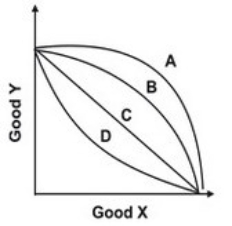 In which curve does the opportunity cost of an additional unit of good Y decrease as more units of good Y are produced?
 (Multiple Choice)
4.9/5 (74)
(74) If U.S. workers are paid $16 an hour and Indian workers are paid the equivalent of $4 an hour but U.S. workers can produce four times as many goods as Indian workers in the same amount of time:
(Multiple Choice)
5.0/5 (75)
(75) Which of the following is an example of the law of one price?
(Multiple Choice)
4.9/5 (59)
(59) Below is the production possibilities table for the country of Lavaland. \% resources devoted to production of tanks Number of tanks \% resources devoted to production of pizza Number of pizzas Row 0 0 100 15 20 4 80 14 40 7 60 12 60 9 40 9 80 11 20 5 100 12 0 0 (a)Use the information in the table to draw the production possibilities curve (PPC)for Lavaland.Put tanks on the horizontal axis.
(b)What is the cost to Lavaland of moving from point A to point B on its PPC? And of moving from point E to point F?
(c)What general economic principle is being illustrated by your answers to part (b)above? Explain.
(Essay)
4.9/5 (85)
(85) Suppose each of the following rows represents the choice faced by policy makers given the current set of U.S. institutions and technology. What is the opportunity cost of reducing unemployment from 8 percent to 4 percent? Unemployment Inflation 10 3 8 4 6 5 5 7 4 10
(Multiple Choice)
4.8/5 (81)
(81) The text attributes the growth of economies over the last 200 years largely to:
(Multiple Choice)
4.9/5 (80)
(80) In the graph shown, what change would increase production efficiency? 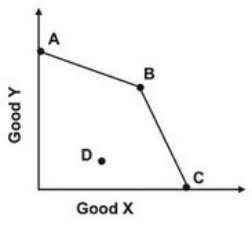
(Multiple Choice)
4.7/5 (74)
(74) Two nations with differing comparative advantages will be able to consume more if each produces the good for which the opportunity cost is highest and trades for the good for which opportunity cost is lowest.
(True/False)
4.8/5 (72)
(72) Refer to the graph shown. In the graph, the opportunity cost of good X in terms of good Y is: 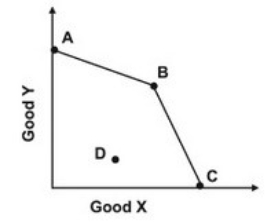
(Multiple Choice)
4.8/5 (87)
(87) Consider the table below, in which each production choice represents a point on a production possibility curve. Choice Eggs Rye A 10 0 B 8 10 C 6 20 D 4 30 E 2 40 F 0 50 This production possibility table could be graphed as a:
(Multiple Choice)
4.7/5 (75)
(75) If the principle of increasing marginal opportunity cost holds, the opportunity cost of producing each additional unit of a good should fall as production of that good rises.
(True/False)
4.8/5 (92)
(92) The production possibility curves of two countries are given below: Legaland Elmaland Chacolate Textiles Chaculate Textiles 30 0 60 0 20 20 30 15 15 30 20 20 0 60 0 30 Refer to the production possibility curves of the two countries. Without trade, the most each country could produce would be:
(Multiple Choice)
4.8/5 (69)
(69) Suppose that in Colombia one unit of labor can produce 8 tons of papayas or 2 tons of bananas and in Brazil, one unit of labor can produce either 2 tons of papayas or 4 tons of bananas. If each country has two units of labor, which of the following consumption combinations can be attained only with trade?
(Multiple Choice)
4.8/5 (69)
(69) Refer to the graph below. 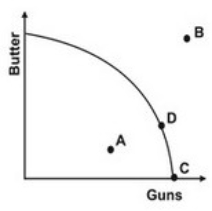 Given the production possibility curve, which point is unattainable?
 (Multiple Choice)
4.9/5 (80)
(80) The production possibility curves of two countries are given below: Legaland Elmaland Chacolate Textiles Chaculate Textiles 30 0 60 0 20 20 30 15 15 30 20 20 0 60 0 30 Refer to the production possibility curves of the two countries. If they specialized and traded, which of the following is the largest bundle each country could have?
(Multiple Choice)
4.9/5 (84)
(84) If a country takes advantage of the comparative advantage of some resources over others, its production possibility curve is likely to be:
(Multiple Choice)
4.8/5 (82)
(82) If a country has a comparative advantage in the production of a good, its resources are better suited to the production of that good than are the resources of other countries.
(True/False)
4.8/5 (84)
(84) The principle of increasing marginal opportunity cost holds in which of the following cases?
(Multiple Choice)
4.7/5 (83)
(83) 
Filters
- Essay(0)
- Multiple Choice(0)
- Short Answer(0)
- True False(0)
- Matching(0)