



 Chat with AI
Exam 2: The Production Possibility Model, Trade, and Globalization

Exam 1: Economics and Economic Reasoning158 Questions
Exam 2: The Production Possibility Model, Trade, and Globalization133 Questions
Exam 3: Economic Institutions163 Questions
Exam 4: Supply and Demand182 Questions
Exam 5: Using Supply and Demand163 Questions
Exam 6: Describing Supply and Demand: Elasticities216 Questions
Exam 7: Taxation and Government Intervention201 Questions
Exam 8: Market Failure Versus Government Failure197 Questions
Exam 9: Comparative Advantage, Exchange Rates, and Globalization118 Questions
Exam 10: International Trade Policy99 Questions
Exam 11: Production and Cost Analysis I194 Questions
Exam 12: Production and Cost Analysis II152 Questions
Exam 13: Perfect Competition170 Questions
Exam 14: Monopoly and Monopolistic Competition274 Questions
Exam 15: Oligopoly and Antitrust Policy142 Questions
Exam 16: Real-World Competition and Technology108 Questions
Exam 17: Work and the Labor Market150 Questions
Exam 18: Who Gets What the Distribution of Income131 Questions
Exam 19: The Logic of Individual Choice: the Foundation of Supply and Demand170 Questions
Exam 20: Game Theory, Strategic Decision Making, and Behavioral Economics103 Questions
Exam 21: Thinking Like a Modern Economist97 Questions
Exam 22: Behavioral Economics and Modern Economic Policy126 Questions
Exam 23: Microeconomic Policy, Economic Reasoning, and Beyond134 Questions
Exam 24: Economic Growth, Business Cycles, and Unemployment124 Questions
Exam 25: Measuring and Describing the Aggregate Economy229 Questions
Exam 26: The Keynesian Short-Run Policy Model: Demand-Side Policies220 Questions
Exam 27: The Classical Long-Run Policy Model: Growth and Supply-Side Policies133 Questions
Exam 28: The Financial Sector and the Economy214 Questions
Exam 29: Monetary Policy243 Questions
Exam 30: Financial Crises, Panics, and Unconventional Monetary Policy109 Questions
Exam 31: Deficits and Debt: the Austerity Debate150 Questions
Exam 32: The Fiscal Policy Dilemma119 Questions
Exam 33: Jobs and Unemployment78 Questions
Exam 34: Inflation, Deflation, and Macro Policy175 Questions
Exam 35: International Financial Policy211 Questions
Exam 36: Macro Policy in a Global Setting134 Questions
Exam 37: Structural Stagnation and Globalization125 Questions
Exam 38: Macro Policy in Developing Countries142 Questions
Select questions type


Refer to the graph below. 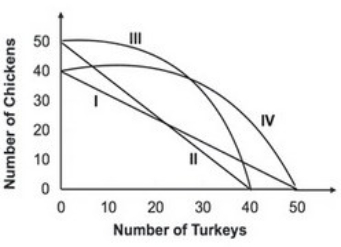 Suppose that the opportunity cost of producing 10 chickens is always 8 turkeys. Given this, the relevant production possibility curve must be:
 (Multiple Choice)
4.9/5  (80)
(80) Consider the following information, which provides percentage change in GDP per year: Per centuge increase in GDP 2012 -10.0 2013 -5.0 2014 -5.0 2015 4.0 2016 10.0
(Multiple Choice)
5.0/5 (78)
(78) If there is an inverse relationship between two variables, the graph relating the two variables will be:
(Multiple Choice)
5.0/5 (75)
(75) England has a relatively cool and cloudy climate that is ill suited for grape growing. It can produce 200 units of wine for every 400 units of cloth. Portugal, in contrast, has a relatively warm and sunny climate that is good for growing grapes. It can produce 200 units of wine for every 100 units of cloth. Which country has the higher opportunity cost of producing cloth?
(Multiple Choice)
4.9/5 (80)
(80) With the resources available, you can make the combinations of Ums and Umies (trinkets from a place called Bandarban)shown in the table. The opportunity cost of producing 60 Umies instead of 30 Umies is: Number af Ums Number af Umies 60 0 40 30 20 60 0 90
(Multiple Choice)
4.7/5 (71)
(71) If the hourly wage of U.S. workers is $16, the hourly wage of Mexican workers is $2, and U.S. workers produce 9 times as much output per hour as Mexican workers, then, all else equal, it would be efficient to locate production facilities in:
(Multiple Choice)
4.7/5 (88)
(88) If a production possibility curve representing a trade-off between a grade in English and a grade in math has a negative slope, we know that:
(Multiple Choice)
4.9/5 (77)
(77) Suppose that in Slovakia one unit of labor can produce either 16 tons of wheat or 32 tons of soy and in Poland one unit of labor can produce either 4 tons of wheat or 2 tons of soy. Given this information, which of the following statements is true?
(Multiple Choice)
4.9/5 (74)
(74) The Bahamas and India produce both pineapple and rice (both measured in tons).The table below illustrates their production possibilities. The Bahamas India Rice Pineapple Rice Pineapple 0 100 0 50 5 90 5 47.5 10 80 10 45 15 70 15 42.5 20 60 20 40 25 50 25 37.5 50 0 100 0 (a)In the Bahamas,what is the opportunity cost of a ton of pineapples,and of a ton of rice?
(b)In India,what is the opportunity cost of a ton of pineapple,and of a ton of rice?
(c)Which country has a comparative advantage in the production of pineapple?
(d)Show how if each country specialized in that good for which it has a comparative advantage and split the resulting production,each would be able to consume more than if they did not trade.
(Essay)
4.8/5 (68)
(68) Refer to the graph below. 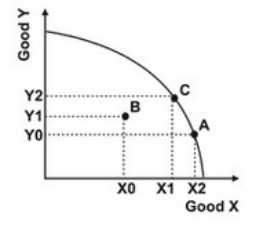 As you move from point A to point B:
 (Multiple Choice)
4.9/5 (81)
(81) Refer to the production possibility curve for Ricardia below. 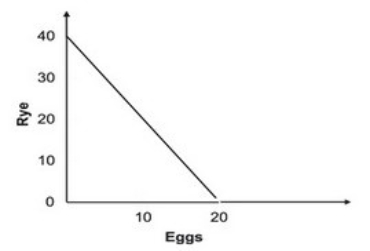 The graph indicates that with the resources and technology it has available, Ricardia:
 (Multiple Choice)
4.8/5 (80)
(80) Refer to the graph shown. 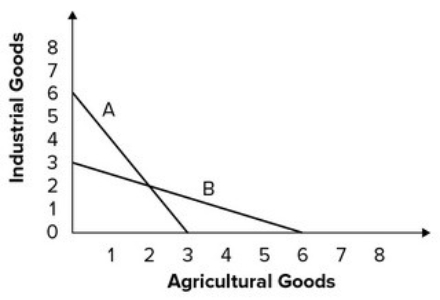 If Countries X and Y face the production possibility curves A and B, respectively, Country Y has a comparative advantage in the production of:
 (Multiple Choice)
4.8/5 (79)
(79) If the hourly wage of U.S. workers is $16, the hourly wage of Mexican workers is $2, and U.S. workers produce 5 times as much output per hour as Mexican workers, then, other things equal, it would be efficient to locate production facilities in:
(Multiple Choice)
4.9/5 (78)
(78) Which of the following is the best example of an economic precept?
(Multiple Choice)
4.8/5 (86)
(86) Investment in capital goods is one way to increase the standard of living in the future. Investment in capital goods, however, means that we must forgo consumption today. One of the trade-offs facing an economy is the balance of consumption today with that of the future. The following table shows such a trade-off. With this information we know that the opportunity cost of which of the following is the greatest? Current consumptinn Future conguptinn 800 100 750 260 650 340 600 380 550 400
(Multiple Choice)
4.8/5 (73)
(73) The morel is a prized mushroom that is often abundant in the Western United States in years after forest fires. Suppose two companies are buying morels from workers willing to find them. One company offers to pay workers $5.00 per pound, and the other company will pay workers only $4.00 per pound. Economists would say that:
(Multiple Choice)
4.7/5 (76)
(76) Two countries that specialize their production along the lines of comparative advantage and then trade with each other will be able to:
(Multiple Choice)
4.9/5 (96)
(96) The law of one price means that prices eventually will be the same in all countries and eventually countries will not have a reason to trade.
(True/False)
4.8/5 (83)
(83) 
Filters
- Essay(0)
- Multiple Choice(0)
- Short Answer(0)
- True False(0)
- Matching(0)