



 Chat with AI
Exam 9: Comparative Advantage, Exchange Rates, and Globalization

Exam 1: Economics and Economic Reasoning158 Questions
Exam 2: The Production Possibility Model, Trade, and Globalization133 Questions
Exam 3: Economic Institutions163 Questions
Exam 4: Supply and Demand182 Questions
Exam 5: Using Supply and Demand163 Questions
Exam 6: Describing Supply and Demand: Elasticities216 Questions
Exam 7: Taxation and Government Intervention201 Questions
Exam 8: Market Failure Versus Government Failure197 Questions
Exam 9: Comparative Advantage, Exchange Rates, and Globalization118 Questions
Exam 10: International Trade Policy99 Questions
Exam 11: Production and Cost Analysis I194 Questions
Exam 12: Production and Cost Analysis II152 Questions
Exam 13: Perfect Competition170 Questions
Exam 14: Monopoly and Monopolistic Competition274 Questions
Exam 15: Oligopoly and Antitrust Policy142 Questions
Exam 16: Real-World Competition and Technology108 Questions
Exam 17: Work and the Labor Market150 Questions
Exam 18: Who Gets What the Distribution of Income131 Questions
Exam 19: The Logic of Individual Choice: the Foundation of Supply and Demand170 Questions
Exam 20: Game Theory, Strategic Decision Making, and Behavioral Economics103 Questions
Exam 21: Thinking Like a Modern Economist97 Questions
Exam 22: Behavioral Economics and Modern Economic Policy126 Questions
Exam 23: Microeconomic Policy, Economic Reasoning, and Beyond134 Questions
Exam 24: Economic Growth, Business Cycles, and Unemployment124 Questions
Exam 25: Measuring and Describing the Aggregate Economy229 Questions
Exam 26: The Keynesian Short-Run Policy Model: Demand-Side Policies220 Questions
Exam 27: The Classical Long-Run Policy Model: Growth and Supply-Side Policies133 Questions
Exam 28: The Financial Sector and the Economy214 Questions
Exam 29: Monetary Policy243 Questions
Exam 30: Financial Crises, Panics, and Unconventional Monetary Policy109 Questions
Exam 31: Deficits and Debt: the Austerity Debate150 Questions
Exam 32: The Fiscal Policy Dilemma119 Questions
Exam 33: Jobs and Unemployment78 Questions
Exam 34: Inflation, Deflation, and Macro Policy175 Questions
Exam 35: International Financial Policy211 Questions
Exam 36: Macro Policy in a Global Setting134 Questions
Exam 37: Structural Stagnation and Globalization125 Questions
Exam 38: Macro Policy in Developing Countries142 Questions
Select questions type


Refer to the table shown. From this table we can conclude that: Cost (in euras) of praducing wine and on electric gener ator France Germany Wine 10 20 Electric Generator 10,000 30,000
(Multiple Choice)
4.9/5  (84)
(84) People with intellectual property rights are on the low end of the income distribution that is created from globalization.
(True/False)
4.8/5 (82)
(82) Suppose that the U.S. dollar buys 100 Japanese yen. Gold costs $500 per ounce in New York and 20,000 yen per ounce in Tokyo. What does the law of one price predict will happen?
(Multiple Choice)
4.9/5 (104)
(104) Production Possibility Schedules for Two South Pacific Island Nations Kiribati Tuvalu Mangues Cocanuts Mangues Cacanuts 300 0 1,200 0 200 400 800 1,200 100 800 400 2,400 0 1,200 0 3,600 In Tuvalu, the opportunity cost of producing one coconut (in terms of mangoes)is:
(Multiple Choice)
4.8/5 (78)
(78) One of the 10 sources of U.S. comparative advantage mentioned in the text is:
(Multiple Choice)
4.8/5 (69)
(69) Workers in education, healthcare and government sectors have:
(Multiple Choice)
4.8/5 (86)
(86) What is meant by the dollar-euro exchange rate? In what market is this rate determined? What factors will cause the dollar value of the euro to rise? What factors will cause the dollar value of the euro to fall?
(Essay)
4.9/5 (69)
(69) 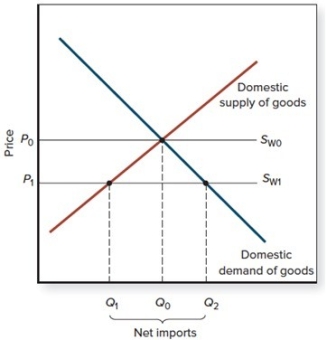
Suppose foreign shrimp prices drop by 32 percent and importers gain a 90 percent market share. From this information, what would economists strongly suspect about this industry?
(Multiple Choice)
4.8/5 (72)
(72) Why does the distribution of costs and benefits from trade sometimes result in calls for trade restrictions?
(Essay)
4.8/5 (84)
(84) A common economically unfounded fear held by laypeople is that:
(Multiple Choice)
4.7/5 (93)
(93) Which of the following statements correctly summarizes a difference between the layperson's and the economist's views of the net benefits of trade?
(Multiple Choice)
4.8/5 (70)
(70) Which of the following is eroding the U.S. comparative advantage?
(Multiple Choice)
4.9/5 (80)
(80) Production Possibility Schedules for Two South Pacific Island Nations Kiribati Tuvalu Mangues Cocanuts Mangues Cacanuts 300 0 1,200 0 200 400 800 1,200 100 800 400 2,400 0 1,200 0 3,600 In Kiribati, the opportunity cost of producing one mango (in terms of coconuts)is:
(Multiple Choice)
4.9/5 (66)
(66) The Mexican demand for American goods leads to the demand for:
(Multiple Choice)
5.0/5 (76)
(76) 
Filters
- Essay(0)
- Multiple Choice(0)
- Short Answer(0)
- True False(0)
- Matching(0)