



 Chat with AI
Exam 9: Comparative Advantage, Exchange Rates, and Globalization

Exam 1: Economics and Economic Reasoning158 Questions
Exam 2: The Production Possibility Model, Trade, and Globalization133 Questions
Exam 3: Economic Institutions163 Questions
Exam 4: Supply and Demand182 Questions
Exam 5: Using Supply and Demand163 Questions
Exam 6: Describing Supply and Demand: Elasticities216 Questions
Exam 7: Taxation and Government Intervention201 Questions
Exam 8: Market Failure Versus Government Failure197 Questions
Exam 9: Comparative Advantage, Exchange Rates, and Globalization118 Questions
Exam 10: International Trade Policy99 Questions
Exam 11: Production and Cost Analysis I194 Questions
Exam 12: Production and Cost Analysis II152 Questions
Exam 13: Perfect Competition170 Questions
Exam 14: Monopoly and Monopolistic Competition274 Questions
Exam 15: Oligopoly and Antitrust Policy142 Questions
Exam 16: Real-World Competition and Technology108 Questions
Exam 17: Work and the Labor Market150 Questions
Exam 18: Who Gets What the Distribution of Income131 Questions
Exam 19: The Logic of Individual Choice: the Foundation of Supply and Demand170 Questions
Exam 20: Game Theory, Strategic Decision Making, and Behavioral Economics103 Questions
Exam 21: Thinking Like a Modern Economist97 Questions
Exam 22: Behavioral Economics and Modern Economic Policy126 Questions
Exam 23: Microeconomic Policy, Economic Reasoning, and Beyond134 Questions
Exam 24: Economic Growth, Business Cycles, and Unemployment124 Questions
Exam 25: Measuring and Describing the Aggregate Economy229 Questions
Exam 26: The Keynesian Short-Run Policy Model: Demand-Side Policies220 Questions
Exam 27: The Classical Long-Run Policy Model: Growth and Supply-Side Policies133 Questions
Exam 28: The Financial Sector and the Economy214 Questions
Exam 29: Monetary Policy243 Questions
Exam 30: Financial Crises, Panics, and Unconventional Monetary Policy109 Questions
Exam 31: Deficits and Debt: the Austerity Debate150 Questions
Exam 32: The Fiscal Policy Dilemma119 Questions
Exam 33: Jobs and Unemployment78 Questions
Exam 34: Inflation, Deflation, and Macro Policy175 Questions
Exam 35: International Financial Policy211 Questions
Exam 36: Macro Policy in a Global Setting134 Questions
Exam 37: Structural Stagnation and Globalization125 Questions
Exam 38: Macro Policy in Developing Countries142 Questions
Select questions type


A currency has depreciated in value if it takes more of a foreign currency to buy it.
(True/False)
4.9/5  (81)
(81) 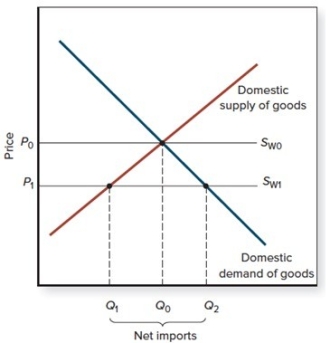
The decline in the price of American goods is due in part to:
(Multiple Choice)
4.8/5 (85)
(85) If countries decide they will no longer buy U.S. assets or lend to the United States:
(Multiple Choice)
4.8/5 (89)
(89) Refer to the table shown. Batswana Zimbabwe Gald Nickel Gold Nickel 0 300 0 90 60 200 18 60 120 100 36 30 180 0 54 0 In this example:
(Multiple Choice)
4.9/5 (79)
(79) We can conclude from the table shown that Spain has a comparative advantage in the production of tables.
Labar Input to Praduce Chairs and Tables Marncen Spain Chair 3 1 Table 10 5
(True/False)
4.8/5 (74)
(74) Economists and laypeople see the pros and cons of international trade in different ways. Which of the following is one of those ways?
(Multiple Choice)
4.8/5 (78)
(78) The country with a comparative advantage in the production of good X is the one that:
(Multiple Choice)
4.9/5 (79)
(79) The text calls the type of comparative advantage that is not easily changed, such as climate:
(Multiple Choice)
4.8/5 (71)
(71) The discovery of a significant new source of oil that can be exported will lead to:
(Multiple Choice)
4.8/5 (84)
(84) Refer to the graph shown.  Given these production possibility curves, you would suggest that:
 (Multiple Choice)
4.9/5 (80)
(80) If the world supply curve is SW1, and the country's exchange rate depreciates, 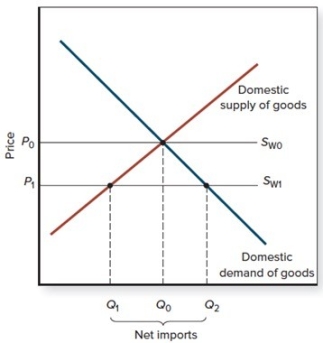
(Multiple Choice)
5.0/5 (66)
(66) The group that benefited the most from international trade has been people who:
(Multiple Choice)
4.8/5 (75)
(75) The text mentions 10 sources of U.S. comparative advantage. Which of the following is not one of them?
(Multiple Choice)
4.9/5 (75)
(75) If a country's exchange rate appreciates, the world price level:
(Multiple Choice)
4.8/5 (78)
(78) Explain the principle of comparative advantage.Does it tell us how the gains from trade will be distributed?
(Essay)
4.8/5 (88)
(88) 
Filters
- Essay(0)
- Multiple Choice(0)
- Short Answer(0)
- True False(0)
- Matching(0)