



 Chat with AI
Exam 13: Perfect Competition

Exam 1: Economics and Economic Reasoning158 Questions
Exam 2: The Production Possibility Model, Trade, and Globalization133 Questions
Exam 3: Economic Institutions163 Questions
Exam 4: Supply and Demand182 Questions
Exam 5: Using Supply and Demand163 Questions
Exam 6: Describing Supply and Demand: Elasticities216 Questions
Exam 7: Taxation and Government Intervention201 Questions
Exam 8: Market Failure Versus Government Failure197 Questions
Exam 9: Comparative Advantage, Exchange Rates, and Globalization118 Questions
Exam 10: International Trade Policy99 Questions
Exam 11: Production and Cost Analysis I194 Questions
Exam 12: Production and Cost Analysis II152 Questions
Exam 13: Perfect Competition170 Questions
Exam 14: Monopoly and Monopolistic Competition274 Questions
Exam 15: Oligopoly and Antitrust Policy142 Questions
Exam 16: Real-World Competition and Technology108 Questions
Exam 17: Work and the Labor Market150 Questions
Exam 18: Who Gets What the Distribution of Income131 Questions
Exam 19: The Logic of Individual Choice: the Foundation of Supply and Demand170 Questions
Exam 20: Game Theory, Strategic Decision Making, and Behavioral Economics103 Questions
Exam 21: Thinking Like a Modern Economist97 Questions
Exam 22: Behavioral Economics and Modern Economic Policy126 Questions
Exam 23: Microeconomic Policy, Economic Reasoning, and Beyond134 Questions
Exam 24: Economic Growth, Business Cycles, and Unemployment124 Questions
Exam 25: Measuring and Describing the Aggregate Economy229 Questions
Exam 26: The Keynesian Short-Run Policy Model: Demand-Side Policies220 Questions
Exam 27: The Classical Long-Run Policy Model: Growth and Supply-Side Policies133 Questions
Exam 28: The Financial Sector and the Economy214 Questions
Exam 29: Monetary Policy243 Questions
Exam 30: Financial Crises, Panics, and Unconventional Monetary Policy109 Questions
Exam 31: Deficits and Debt: the Austerity Debate150 Questions
Exam 32: The Fiscal Policy Dilemma119 Questions
Exam 33: Jobs and Unemployment78 Questions
Exam 34: Inflation, Deflation, and Macro Policy175 Questions
Exam 35: International Financial Policy211 Questions
Exam 36: Macro Policy in a Global Setting134 Questions
Exam 37: Structural Stagnation and Globalization125 Questions
Exam 38: Macro Policy in Developing Countries142 Questions
Select questions type


Because only competitive firms are price takers, only competitive firms have supply curves.
(True/False)
4.7/5  (71)
(71) In a perfectly competitive long-run constant-cost industry, an increase in market demand causes:
(Multiple Choice)
4.9/5 (65)
(65) The American Widget Corporation (AWC)is a profit-maximizing and perfectly competitive firm that is currently experiencing a loss.However,the market price of widgets is expected to increase in the near future.The company's vice-president,Alan R.("Big Tuna")Burns,has recommended against increasing output in response to a higher price for widgets.His argument is that the marginal cost of the additional units of output will increase,and these higher costs will worsen AWC's losses.Evaluate this argument using an appropriate picture.
(Essay)
4.8/5 (96)
(96) Refer to the graph shown, which depicts a perfectly competitive firm. If the price of the product is $3: 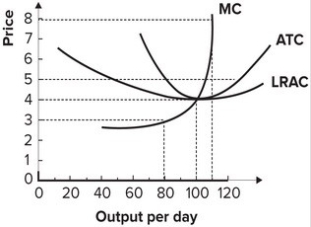
(Multiple Choice)
4.8/5 (79)
(79) Assume the smart watch industry is a perfectly competitive industry that uses a specialized input. If this industry experiences an increase in demand, we might expect that in the long run:
(Multiple Choice)
4.9/5 (83)
(83) Refer to the graphs shown, which depict a perfectly competitive market and firm. If market demand is D0, the: 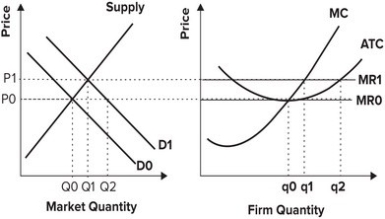
(Multiple Choice)
4.9/5 (83)
(83) Refer to the graph shown. If the firm increases output from 40 to 50, total revenue will increase: 
(Multiple Choice)
4.8/5 (97)
(97) 
Filters
- Essay(0)
- Multiple Choice(0)
- Short Answer(0)
- True False(0)
- Matching(0)